She Did It! Rachel Kavanaugh’s production and newcomer Keziah Ibe’s Eliza hit the right notes
Chichester festival Theatre
⭑⭑⭑⭑
Keziah Ibe & Hadley Fraser in My Fair Lady. Photo: Johan Persson
Let’s start at the beginning. Except, where is the beginning? The overture is missing! I love an overture. It sets the mood and fills you with anticipation.
But it seems churlish to complain when Rachel Kavanaugh‘s production plunges you straight into the uplifting story of an impoverished cockney flower seller called Eliza Doolittle. She soon encounters and confronts Professor Henry Higgins, an expert in phonetics. The musical establishes their characters from the get-go, so we the audience glimpse from the start the quality of the two stars on which the musical stands or falls.
Higgins is entitled, lacking social skills, self centred, insensitive and misogynistic but in Hadley Fraser’s hands, this is leavened by his child-like enthusiasm. He’s often shown in production as stiff and distant but here his sheer bullheaded enthusiasm- and Groucho Marx-like postures- make him more loveable than expected.
Eliza is feisty and ultra aware of her inferior position in society. Keziah Ibe, making her theatrical debut, gets the mix right. And she nails the first big song of the night Wouldn’t It Be Loverly? That’s a relief because a lot of big songs are coming her way, which she goes on to sing beautifully and with expression.
So it’s game on as Higgins and his friend Colonel Pickering set about transforming this ‘squashed cabbage leaf’ as he calls Eliza into a Lady. It’s worth noting that Eliza initiates the process by offering to pay for lessons- an entrepreneurial move that flies in the face of Higgins’ sexist views, as expressed in Why Can’t A Woman Be More Like A Man?
This is the first time 60 year old Chichester Festival Theatre has presented My Fair Lady. So how do the open spaces of the huge thrust stage with no capacity to fly in scenery convey the spectacle? Not with big sets. The lavish Embassy Ball at which the transformed Eliza triumphs is represented by, in effect, a few standard lamps, the ‘street where she lives’ is two lengths of iron fencing, Ascot Races an empty stage. The Chichester ‘wow’ factor, picking up from the musical’s use of the ensemble to provide a kind of Greek chorus, is to fill the stage with people.
So we have Gary Milner as Eliza’s dustman father Alfred P Doolittle leading an exuberant chorus of around twenty through Stephen Mear’s complex choreography in With A Little Bit Of Luck and I’m Getting Married In The Morning, as well as a more restrained but still impressive circle of racegoers. It’s not completely sparse of scenery. There is one magnificent set, namely Henry Higgins’ study. Designer Peter McIntosh has created a massive truck that sweeps on and off stage, full of cluttered corners and different levels for the actors to weave and jump through.
It’s easy to understand why some consider My Fair Lady the perfect musical. Lerner and Loewe‘s songs consistently reveal character or advance the narrative, possibly even more so than those of the great Rodgers And Hammerstein who invented the modern musical. And they’re nicely played by a small orchestra under Cat Beveridge.
Keziah Ibe performs the songs with great eloquence. Her high point is also the apex of the musical itself, the moment when she is so excited at getting the pronunciation right in The Rain In Spain. It’s a moment of euphoria for Higgins, Pickering and Eliza that leads her into the incomparable I Could Have Dance All Night.
There is also a lot of dialogue, perhaps this was because Lerner, who wrote the book as well as the lyrics, wanted to give due respect to George Bernard Shaw‘s socialist message in Pygmalion, on which the musical is based. There’s a lot of conversation about class divisions and the importance of language as a marker of class: Shaw’s point being we’re all people with the same qualities and faults under our disguises. So you need good actors, which this production has assembled in spades.
A loverly production
Gary Milner & company in My Fair Lady. Photo: Johan Persson
In the end, Eliza undergoes more than a superficial transformation. She realises there is more to happiness than a romantic husband and a ‘loverly’ room. And she has learned from those around her that there is more to class than how you speak. From Colonel Pickering, well played by Tony Jayawardena, she learns politeness and respect, although he is shown to be a bit of a dunderhead. From her father, she acquires cynicism. From Higgins, she not only acquires received English but the value of being honest to oneself and others. She also learns what she doesn’t want when she is courted by the full hearted but empty headed Freddie, nicely played by Ben Culleton. He performs On The Street Where You Live. It’s my favourite song from the musical even if it is, as the programme points out, evidence that ‘his head is too much in the clouds’. I guess I’m an old romantic.
Eliza also observes the women in Higgins’ life as a model for dealing with him. His housekeeper Mrs Pearce and his mother, given strong, humorous portrayals by Finty Williams and Belinda Lang respectively, maintain a balance between loving him and being honest with him.
Eliza initially leaves because she feels unrecognised for her achievement. (Higgins and Pickering take all the credit in the song You Did It, behaving as so often like two little boys). Ultimately Eliza recognises he can’t help being what he is, but, more than that, he has a depth of character that the featherweight Freddie or the pliant Pickering haven’t. Most importantly, in this production, it is clear she realises she wants to be with him as an equal.
For his part, Higgins seems more stuck in his ways and shows less development, but he learns to feel love for another person, or as he puts it, I’ve Grown Accustomed To Her Face. Hadley Fraser delivers the song with great poignancy from the front of the stage, despite the difficulty of bringing emotion to songs that are virtually spoken, this in deference to the non-singing Rex Harrison who first played Higgins. Rex? Forget him. Hadley takes the crown.
As a love story, it’s highly unlikely and potentially offensive to feminists. The problem is exacerbated because the coming together of Higgins and Eliza was not the climax intended by Shaw. Quite the opposite: the professor was to be left a sad and sorry man by the newly independent woman. However, Rachel Kavanaugh, supported by her fabulous cast, makes it work by avoiding extreme portrayals and emphasising friendship and respect as the basis for their relationship. Well done, Ms Kavanaugh, You Did It!
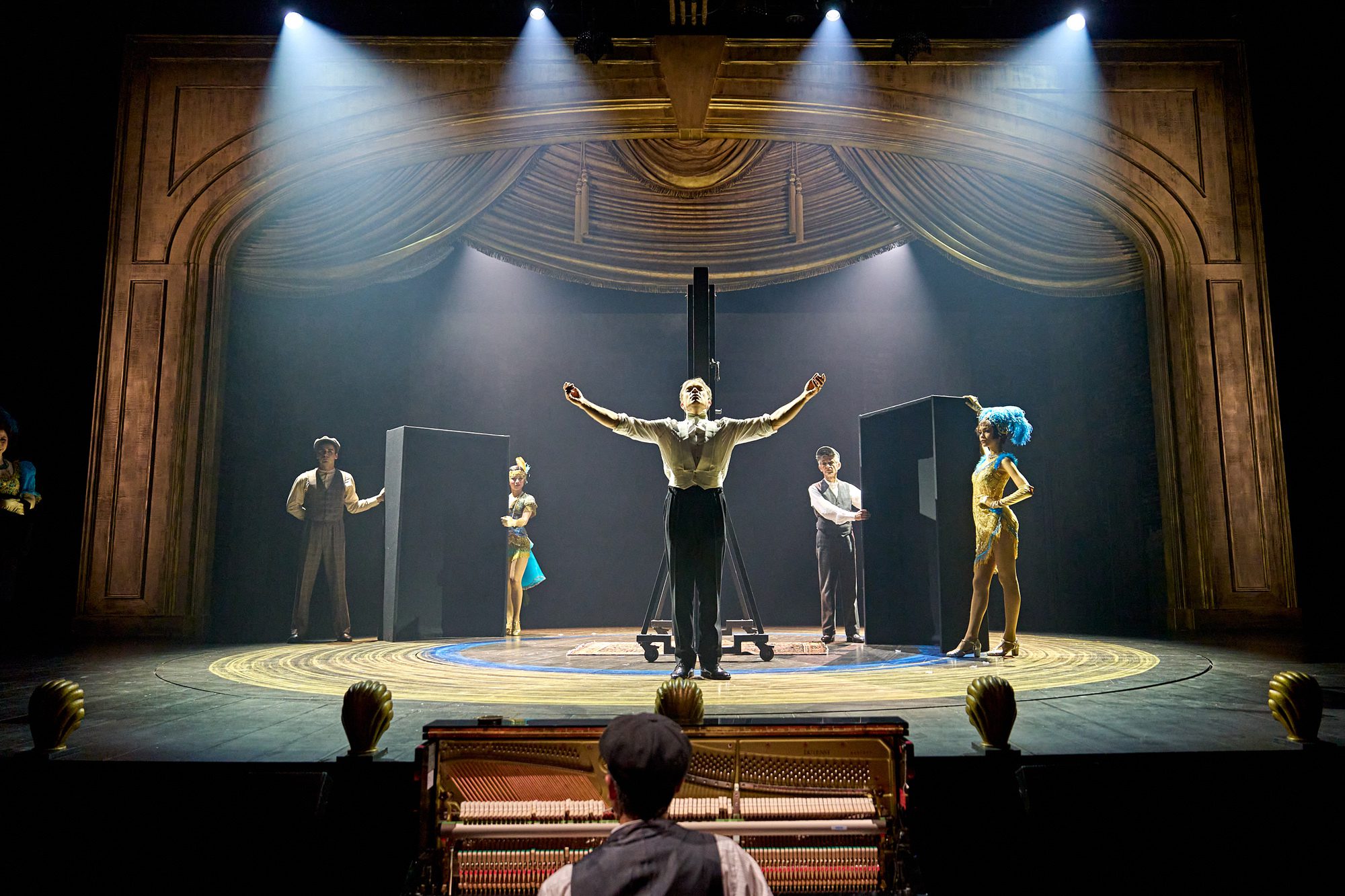
Hadley Fraser, Jenna Augen & David Haig in Magic. Photo: Manuel Harlan
Magic- the art of creating something believable that seems inexplicable. The magic of an illusionist like Houdini. The magic of spiritualism. The magic of actors creating real people. There are many kinds of magic explored and linked in David Haig‘s play Magic at Chichester Festival Theatre, about the time Sir Arthur Conan Doyle met Harry Houdini. The concept is genuinely interesting, and well acted. But is it magical theatre? I’m afraid not quite.
The play is about a search for truth (something even more urgent today than then, I suspect). Doyle, the creator of Sherlock Holmes, and Houdini, the world’s greatest illusionist, form a friendship because both are genuinely interested in whether those they love live on after death. They both would like spiritualism to be the answer. Doyle, the creator Sherlock Holmes, turns out to be far more gullible than Houdini, who is cynical because he is well versed in the tricks of his own trade.
First a word about spiritualism. It was a religious movement, popular in the US and the UK, that gained a lot of traction after the First World War when people were grieving for dead sons, not to mention the many who died in the great Influenza outbreak of 1919. More than a simple belief in ghosts, spiritualists at the time thought that the spirits of people who die live on in the afterlife and can be contacted to guide or comfort us, through mediums. Already a spiritualist, Sir Arthur became an even more fervent believer after the loss of members of his family, in particular his beloved son Kingsley who was killed in the Great War. Houdini was devoted to his dead mother and dearly wished to be able to communicate with her.
It’s a drama loosely based on a true story. The true bit being that Doyle and Houdini formed a friendship back in the 1920s, based on mutual admiration and a common interest in the afterlife. In the play, it becomes strained because Doyle’s obession with spiritualism led him to refuse to believe evidence that magic did not exist (he was even convinced that some of Houdini’s tricks involved genuine dematerialisation). The illusionist showed an equally obsessive determination to expose fake mediums’ ruses. Unfortunately for their friendship, this included the medium who apparently united Doyle with his dead son, and the writer’s own wife who pretended to receive messages from beyond the grave. In real life, they became distant enemies but in the play their residual mutual admiration means they maintain a fractious friendship that adds a real tension to the drama. That’s a trick of the writer’s trade- conflict being the driver of great stories.
David Haig, who wrote the script, plays Doyle. Hadley Fraser is Houdini. The pair exude both warmth and grief. Haig plays Doyle as a good chap, who, as an ex-public schoolboy, has been taught to contain his complex emotions, but can’t hold back his enthusiasm and his desperation. One of the many tricks of his trade as an actor is a twinkly-eyed smile that he deploys to magical effect. Hadley Fraser is appropriately stocky, pugilistic, thin-skinned and burning with passion, much like a bulldog puppy.
Tricks of the trade
Jenna Augen and Claire Price provide sharp depictions of their highly supportive wives, Bess Houdini and Jean Conan Doyle. Although the humorous down-to-earth New Yorker and buttoned-up middle class Brit are in sharp contrast, they too form a friendship, and provide us with a useful break from the intensity of the main characters. Jade Williams is a suitably melodramatic medium.
There is poignancy to the play. It shows us the depths of grief and what it can do to us, be it heartbreak or obsession. So there is theatrical magic in the story of these two characters’ friendship, and that’s where David Haig’s script and Lucy Bailey‘s production scores. Where it goes wrong is when it tries to show us the magic of seances and illusions.
We can only imagine the spectacle and showmanship of Houdini’s shows. Trying to show us this on the limitations of a theatre budget is a mistake. We begin with Houdini performing one of his great escapes- he is suspended upside down while releasing himself from handcuffs. Far from causing my jaw to drop, all I could manage was a shrug. If he’d been in chains and underwater, then maybe… Similarly, near the end, he appears to walk through a brick wall, but of course it’s a piece of scenery, presumably made of wood not brick, and there isn’t time for the kind of buildup that Houdini would have given such a main event. Having said that, there are many lovely little touches, for example when Harry is sitting chatting and casually makes a playing card appear and disappear in his hand. Credit to illusion designer John Bullein.
A couple of seances are recreated, and are more comical than spine-tingling, Carrying them out partly in the dark simply left me in the dark as to how Doyle could fall for them.
Add to this, Chichester’s large thrust stage is set out with a proscenium arch at the back to remind us, that Houdini’s act and the seances, and indeed the play itself, are all theatre. Joanna Parker‘s design is lovely but again a low budget of four or five vaudeville showgirls moving lightweight scenery around doesn’t make for theatrical magic. I’m sad to say, it just looks half baked.
A difficult decision no doubt, but I think this intimate drama would have worked better in Chichester’s smaller Minerva Theatre.
Magic can be seen at Chichester Festival Theatre until 16 May 2026. Buy tickets directly from the theatre Paul was given a review ticket by the theatre.
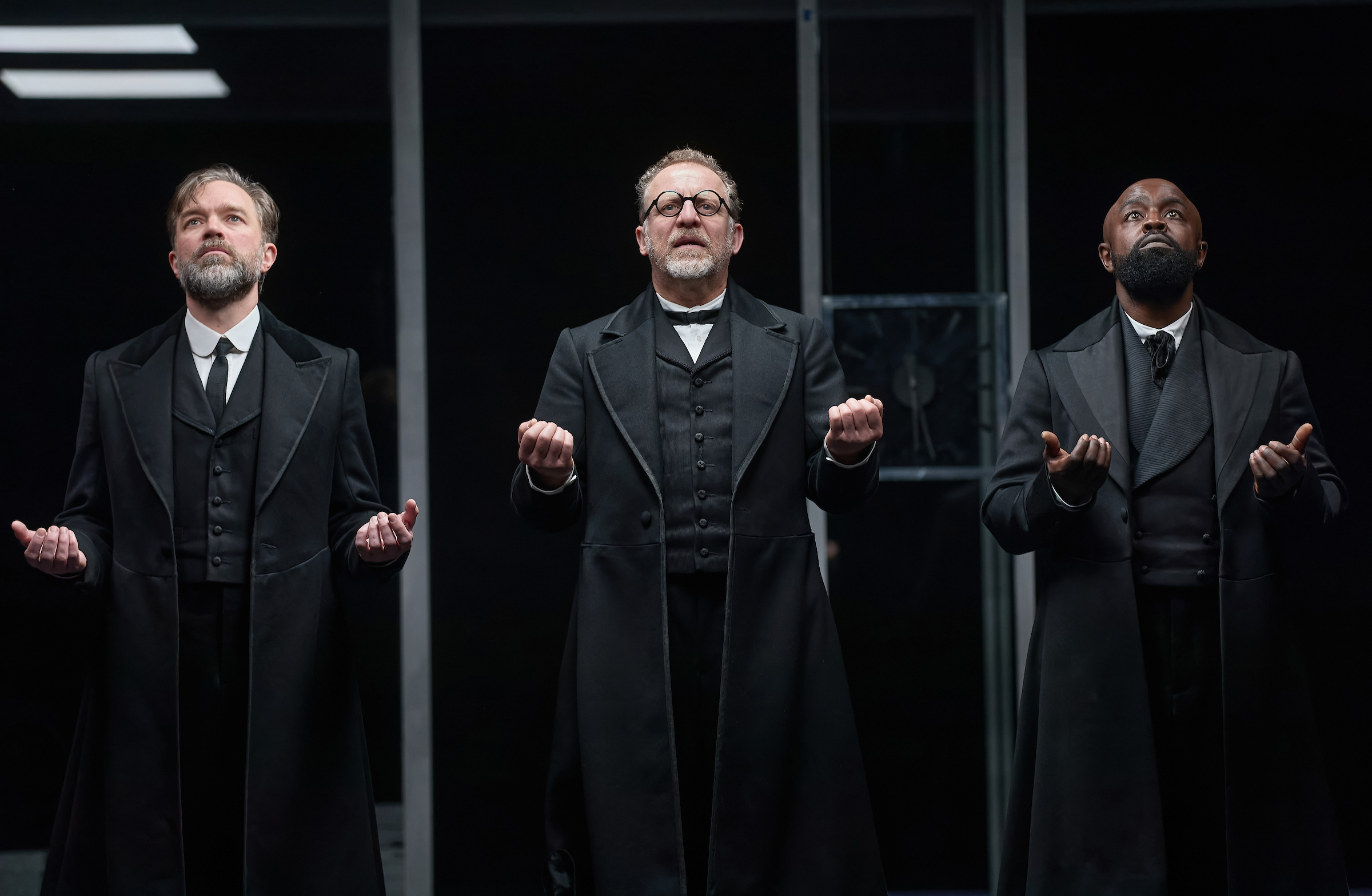
Michael Balogun, Hadley Fraser & Nigel Lindsay in The Lehman Trilogy. Photo: Mark Douet
Lehman Brothers Inc was the highest profile bankruptcy of the 2008 financial crash. Of course there were bigger investment banks in America that played an even bigger part in the collapse of the financial markets and many banks, in the UK as well as the US, ended up being bailed out with our money. But it was important that someone got punished and Lehman was not in the category of ‘too big to fail’.
We are all still suffering from that collapse and subsequent bailout, of course, but at least one good thing came out of it- The Lehman Trilogy. It began, as so many great shows have, at the subsidised National Theatre, went on to the West End then to Broadway and now it’s back in the West End, laden with Oliviers and Tonys, at the Gillian Lynne theatre. With a new cast. So do they measure up to the originals, and what is it that has made a play about a subject as dry as finance such a huge success?
The Lehman Trilogy asks the question, how did a company as important and powerful as Lehmans end up being so reckless and destructive. To find out we travel back to when Henry Lehman and his two younger brothers first came to America back in 1844.
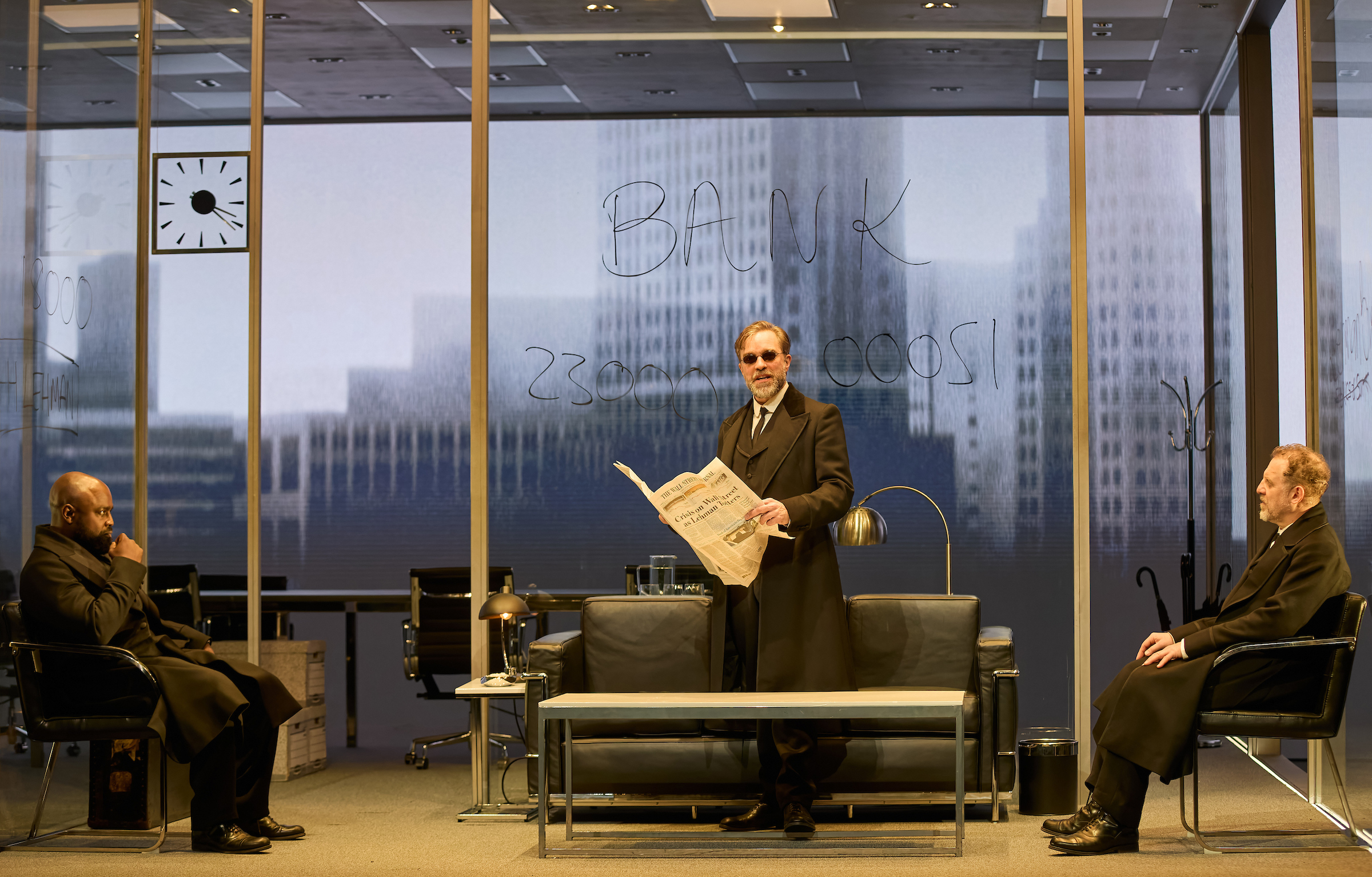
It’s an epic story told on a large stage. At the centre is a large box in which the action takes place. Parts of it are glazed, and the inside is divided into spaces by glass. It is the kind of modern characterless glass office occupied by financial institutions everywhere. It is decorated with a desk, a boardroom table, and lots of boxes used for transporting files- memorably seen as sacked employees carried them out of the building.
We start with the moment Lehmans went bust. Everything that happens in the 164 years leading up to that moment takes place in that space, so we never forget where we’re heading. At the back and sides of the stage, designer Es Devlin has placed a semi-circular wall onto which projects appropriate landscapes that give us a visual context- the cotton fields of Alabama that provided the Lehmans with their first trading opportunity to the skyscrapers of New York.
The Lehman Trilogy. Photo: Mark Douet
As I said, the scale of the story is epic, the set feels epic, yet amazingly, just three actors play not only those three brothers but the succeeding generations and everyone they come in contact with. They tell us the story, and act it out, sometimes without even carrying out the actions they are describing. At one point, a character says about himself ‘he adjusts his tie’ but he doesn’t actually do it. Our own imagination creates the epic.
Myriad characters come and go, often briefly but vividly sketched. The actors, without changing costumes, become children, brides-to-be, cotton farmers, and many more. This leads to a lot of comedy but it also means they never quite stop being, nor can we forget, those immigrant brothers who started it all.
It is the purest kind of acting that relies not on props or costumes but entirely on voice and body. They speak a rhythmic language that verges on poetry or perhaps more accurately rap. In fact, much of this play’s power comes from Ben Powers’ adaptation of Stefano Massini’s Italian original script.
It’s a Brechtian way of telling a story, interesting, funny and gripping but not emotionally involving, which is reinforced by it taking place within a glass box. So, we always see that this is a story not of a family but of American capitalism.
It is an acting tour de force from Michael Balogun, Hadley Fraser and Nigel Lindsay. There is one wonderful moment I remember when Hadley Fraser plays eight different potential brides in rapid succession. Or the same actor, who I would have to say was the first among equals, briefly plays a man described as someone whose body is built around his smile. And it is.
So, in three acts, we see the brothers committed to their Alabama community trading in actual goods- cotton- buying , selling and transporting it. Helping rebuild the cotton trade after a disastrous fire. At first, you admire their ability also to see disasters as opportunities.
The new generation born in America begin to forget their Jewish roots: shiva when the first brother dies lasts seven days, the next three days, then, so anxious are they not close the business, three minutes silence for the last of the brothers.
Money becomes all important. They no longer trade in something physical- they never see the coffee or iron or other commodities. They trade shares not products. As the new generations succeed the old, the Lehmans become shareholders not partners so they have much less to lose, and the risks become greater. After a period of regulation following the Wall Street Crash, the American idea of liberty, so inspiring but also so potentially damaging, re-emerges and the scene is set for the final disaster.
It’s a salutary tale that makes you admire these entrepreneurs, then despise the heartless money grabbers they become, while laughing at the sheer lunacy of ithe world of finance.
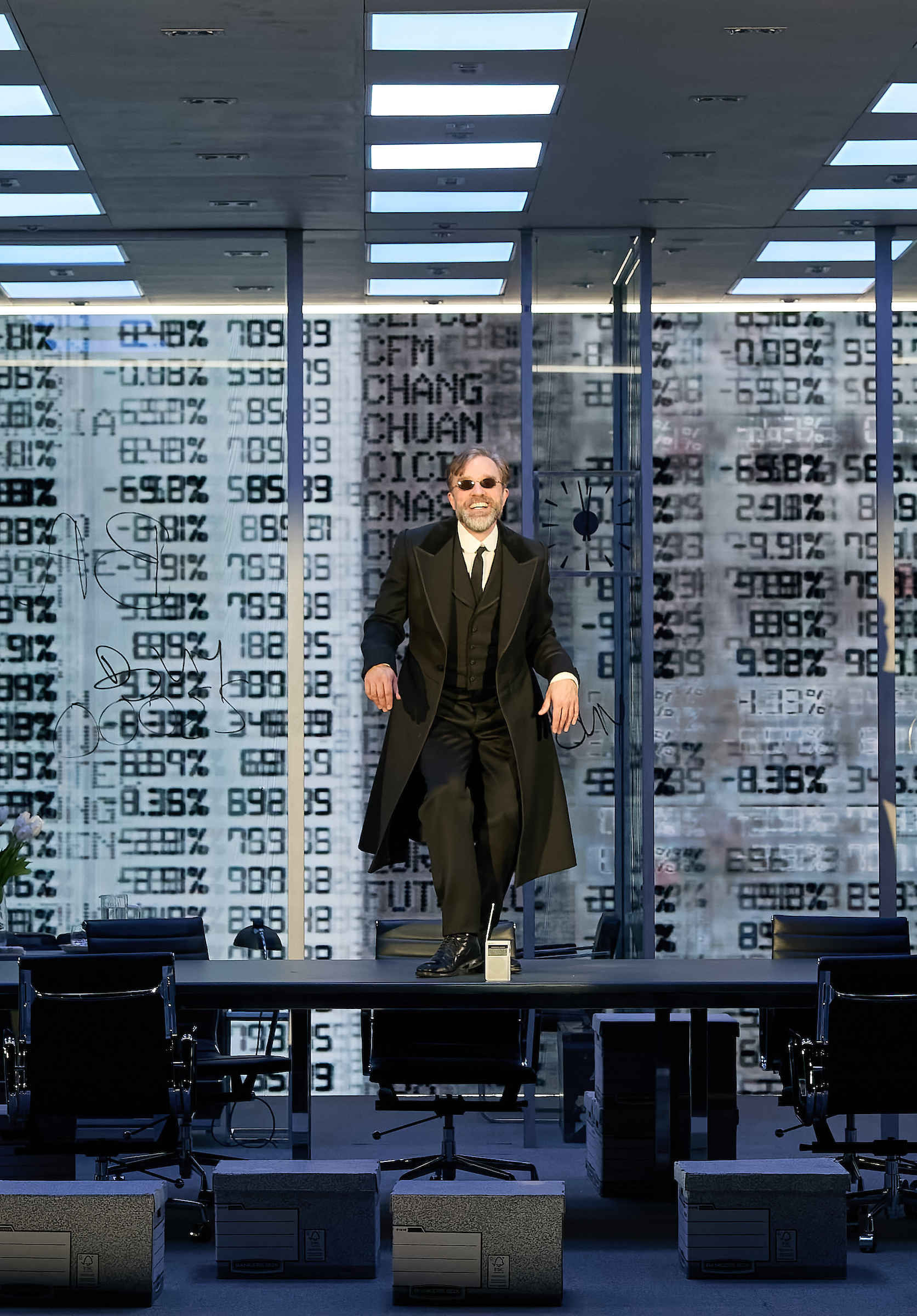
Hadley Fraser in The Lehman Trilogy. Photo: Mark Douet
The third act tails off a little as the final Lehman dies, without any of them suffering the consequences of their actions. It is others that take the company and the financial world over the edge. But not without a , as they found out when the music stopped moment when a metaphor of dancing sees the last of the Lehmans, again it’s Hadley Fraser, no longer making decisions but simply standing on a table doing the twist, as the computer coding spins across the back projection, showing the algorithms that have taken over from human beings, making him and his colleagues more and more money but taking them further and further from the real world. It is literally dizzying, as dizzying as the bankers found it trying to understand their own complicated and ultimately worthless financial packages, which became apparent when the music stopped. A special word of praise to the video designer Luke Halls.
This may not be a story that you can get emotionally involved in, but this is Theatre at its finest, thanks to director Sam Mendes and his writers.
If you haven’t already seen it, don’t miss this opportunity.
February 2018: Reviews of Network with Bryan Cranston, Mel Brooks’ Young Frankenstein, Amadeus, Strictly Ballroom and This House plus a preview of the best theatre shows opening in February.
Subscribeto the One Minute Theatre Reviews podcasts by clicking the RSS icon in the sidebar or subscribe viaiTunes
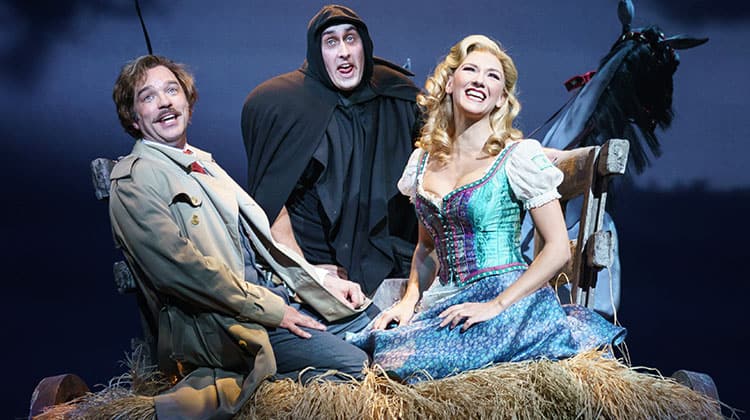
Hadley Fraser, Ross Noble and Summer Strallen in Mel Brooks’ Young Frankenstein
I guess you’ll either love or hate the crude humour of Mel Brooks’ Young Frankenstein, currently at The Garrick Theatre London. Think Carry On or Benny Hill. Think corny jokes about women bewitched by men who are large down below and men hypnotised by women who are large up top.
Personally I loved it. It takes a comic genius like Brooks to turn what could seem base and old fashioned into good-hearted fun. And, despite being primarily a movie maker, he knows how to write a stage musical. The Producers was a huge hit and Young Frankenstein, again based on one of his movies, deserves to be.
Mel Brooks has a way of creating hilarious characters and putting very funny words in their mouths. Those words come thick and fast so, if some jokes miss the target, there’s a hit close behind. Brooks’ view of male-female relationships may seem like a relic from the past but the conflict between ego and id is eternal. So the theme of men and women having their ideals undermined by their animal desires is the stuff of great comedy.
Take the number Please Don’t Touch Me, led by Dianne Pilkington, as an example. It contrasts hilariously Frankenstein’s fiancee’s prim behaviour with her filthy mind.
Lots of laughs from Ross Noble and Lesley Joseph
All the song-and-dance numbers are superbly choreographed in classic style by the director Susan Stroman including a wonderful version of Puttin’ On The Ritz.
The cast may change but there is enough meat for any good performer to get their teeth into. Having said that, I’ve nothing but praise for the current team. Hadley Fraser has the biggest part (you see how Brooks’ humour is catching). He is spot on as the high-minded Frederick Frankenstein.Summer Strallen, who was outstanding in Top Hat, shows why she is one the best musicals performers around. They’re a lovely pair- Fraser and Strallen, I mean (damn you, Mel Brooks!).Lesley Joseph and Ross Noble get lots of laughs as the servants. (Sorry, I’ve run out of sexual innuendos.)
The stereotypes of men and women are dated but if you can accept that, Young Frankenstein is a lot of fun.
Here’s the review of Young Frankenstein on the YouTube channel One Minute Theatre Reviews-
Manage Consent
To provide the best experiences, we use technologies like cookies to store and/or access device information. Consenting to these technologies will allow us to process data such as browsing behaviour or unique IDs on this site. Not consenting or withdrawing consent, may adversely affect certain features and functions.
Functional
Always active
The technical storage or access is strictly necessary for the legitimate purpose of enabling the use of a specific service explicitly requested by the subscriber or user, or for the sole purpose of carrying out the transmission of a communication over an electronic communications network.
Preferences
The technical storage or access is necessary for the legitimate purpose of storing preferences that are not requested by the subscriber or user.
Statistics
The technical storage or access that is used exclusively for statistical purposes.The technical storage or access that is used exclusively for anonymous statistical purposes. Without a subpoena, voluntary compliance on the part of your Internet Service Provider, or additional records from a third party, information stored or retrieved for this purpose alone cannot usually be used to identify you.
Marketing
The technical storage or access is required to create user profiles to send advertising, or to track the user on a website or across several websites for similar marketing purposes.