Theatre review: David Harewood as Othello with Toby Jones & Caitlin FitzGerald

One of the finest Othellos of our time

Theatre Royal Haymarket

⭑⭑⭑

Toby Jones, Caitlin FitzGerald & David Harewood in Othello. Photo: Brinkhoff/Moegenburg

The new production of Othello at the Theatre Royal Haymarket is the finest I have seen—and I have seen a few. Director Tom Morris has achieved this triumph by keeping the production straightforward and by casting David Harewood at precisely the right point in his distinguished career to inhabit the title role completely. Added to that are two further superb performances from Toby Jones and Caitlin FitzGerald, plus an additional standout who doesn’t receive above-the-line billing.

If you’re not familiar with the plot, then please stop reading now, because I’m going to assume you know that it’s about a man who is tricked by a cynical liar into believing his wife has cuckolded him and prompting him to murder her.

You can tell from that crude summary, Othello is a at heart a domestic tragedy. Of all the lead characters in Shakespeare’s tragedies, Othello is the least grand. He’s not a King or even a noble, By comparison with Macbeth, Lear or Mark Anthony, he is strikingly ordinary. What makes him stand out is that he’s successful in his career, and an outsider. For audiences, he is very easy to identify with, as he falls victim to someone determined to wreck his life. The play is also Shakespeare’s most plot- as opposed to character- driven tragedy, and presented with such clarity (there’s no subplot) that it is inevitable an audience will be gripped and carried along.

Director Tom Morris understands this and, to his credit, has not imposed any show off interpretation. He trusts Shakespeare’s language to carry the drama, and in the hands of his exceptional cast, it does.

The background is military. Othello is a soldier who has won great victories for Venice. He knows his worth yet still wrestles with a form of impostor syndrome, aware that his race renders him inferior in the eyes of many and that his high standing derives only from his battlefield prowess. His secret marriage to a white woman from patrician Venetian society underscores his fear that the union will be condemned. His insecurity makes him wonder whether it was merely his storytelling that enchanted Desdemona into marrying an ageing black man. It’s a part bursting with contradictions.

Into these polished shoes steps David Harewood, perfect for the part. Wearing a beautiful silky green suit (Shakespeare later refers to jealousy as a ‘green-eyed monster’), he is elegant, poised, and physically imposing. He radiates authority and speaks lyrical lines beautifully and lucidly. But we can also see straightaway why the rigidity of a military man and the lack of confidence of an outsider set him up for his downfall at the hands of Iago.
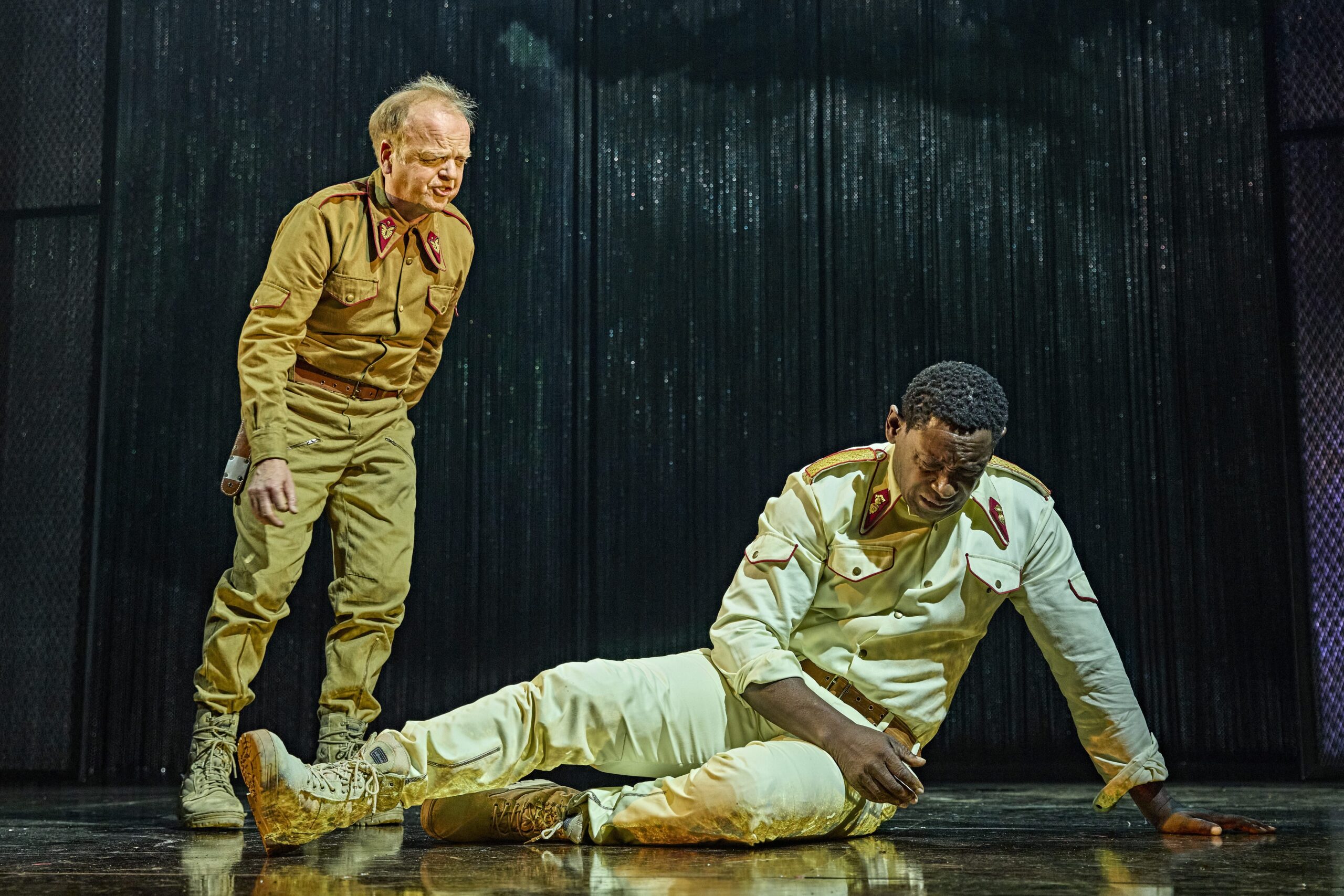
Toby Jones and David Harewood in Othello. Photo: Brinkhoff/Moegenburg

Toby Jones has the task of creating a rounded picture of someone whose history we learn remarkably little about, despite him having more lines than Othello, and indeed more lines than any character in Shakespeare except Hamlet and Richard The Third.  He does it brilliantly.

Iago is perceived to be an ‘honest’ soldier. The word occurs over 50 times in the play, as Shakespeare piles on the irony, thus giving the audience something to laugh about in an otherwise serious drama. The important thing is, he is trusted by Othello as a good ‘honest’ soldier.

Toby Jones deploys his familiar genial countenance when addressing others, then swivels toward the audience with a face hardened and eyes glacial.

All the cast are superb

He is aggrieved that he has been passed over for promotion. Othello has appointed Michael Cassio as second-in-command, He seeks vengeance for the slight. Spotting Othello’s vulnerability—Desdemona—he devises a plan to humiliate him. That Othello is so easily convinced his wife is having an affair is, in context, quite plausible: they married in haste and in secret. So, how well does he truly know her? Her enraged father, played with distinction by Peter Guinness, warns him early on, ‘She has deceived her father, and may thee.’ Iago then improvises his way through a thrilling campaign of insinuation, his plot evolving with each new contingency, something Toby Jones conveys with wonderful darting eyes.

Even if you did still have any doubt that Othello would fall for this villain’s machinations, you have only to recall Celebrity Traitors to see how difficult people find it to detect deception, and how trusting they are of appearances. Not that I’m comparing Alan Carr with Iago. More generally, we all know how hard it is to differentiate between truth and falsehood in the mouths of con artists.

Jealousy pervades the play, as does a corrosive sense of inferiority. Both Othello and Iago are driven by these impulses, Jones’s Iago, despite the chip on his shoulder, remains implacably steely, while Harewood’s Othello disintegrates visibly. His once-perfect outfit becomes dishevelled; his tongue which initially roamed nervously around the inside of his mouth, now flicks out of the corner; he spits out words that previously he would have modulated. A tragic flaw has enabled a villain to bring him down, but, once he accepts the supposed evidence of Desdemona’s betrayal, the military tactician resurfaces, coldly orchestrating her destruction.

As for Desdemona: I was initially sceptical about casting an older actor. The text seems to suggest she is  young and disingenuous—initially she is seen as having been ‘stolen’ by Othello, and later she is naively oblivious to Othello’s changing temperament. But Caitlin FitzGerald, a mature performer, illuminates the role in unexpected ways. She conveys the giddy rapture of early love while also interacting with Othello on equal footing, asserting herself in their arguments with a modern feminist inflection.
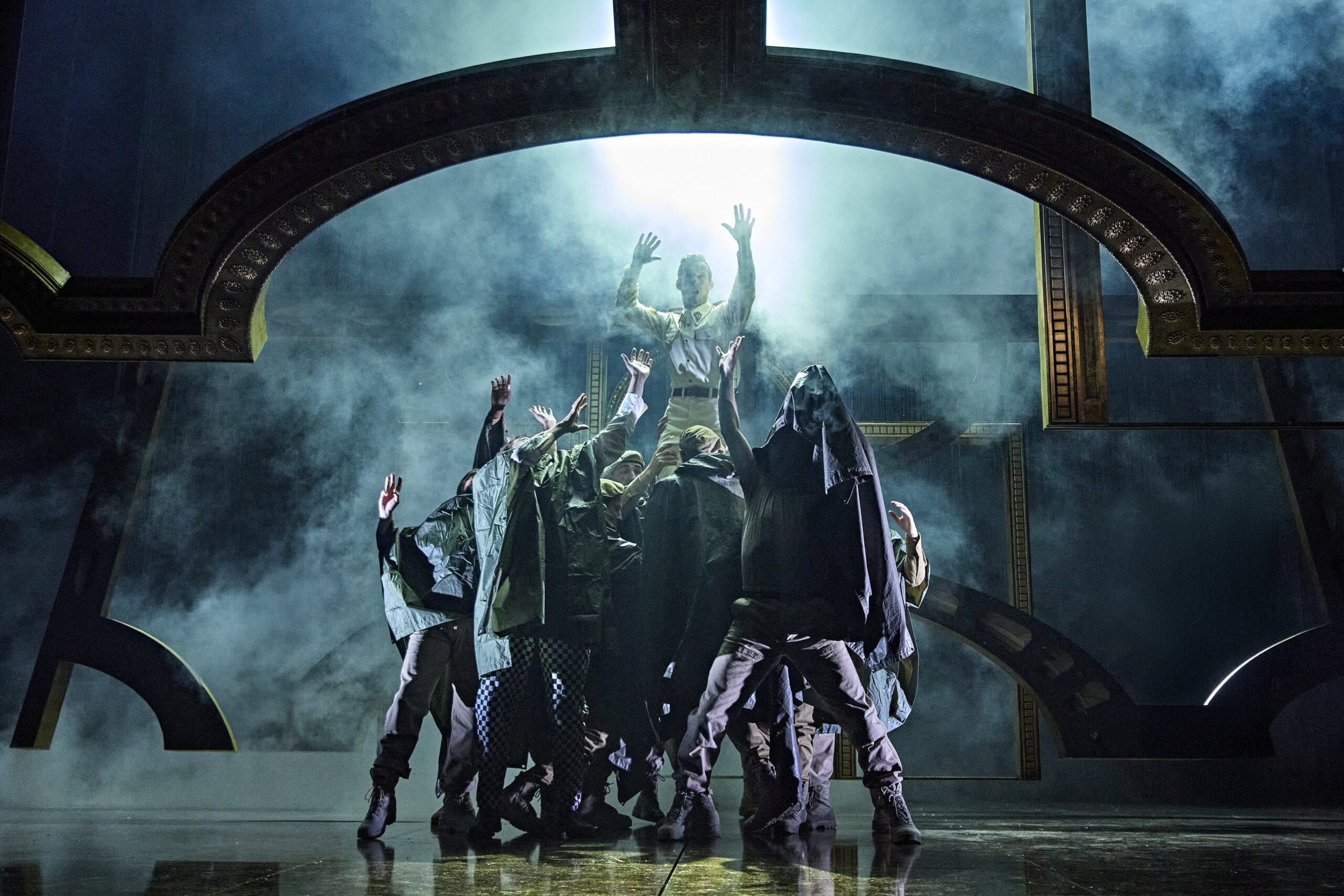
Othello at Theatre Royal Haymarket. Photo: Brinkhoff/Moegenburg

Similarly, Emilia — wife to Iago and maid to Desdemona — receives a powerful push from Vinette Robinson. Though nearly as cynical as her husband, Emilia possesses a moral core he lacks. In this production, she seems to speak for all women as she voices her views on men and on the catastrophe unfolding around her with bruising, heart-breaking passion.

Other parts are deftly realised: Luke Treadaway is a sensitive Cassio, not at all arrogant as he is often portrayed; Tom Byrne as Roderigo is the perfect fool as Iago’s dupe.

Although the dress is modern, Ti Green‘s set is neutral. Gilded geometric structures evoke the opulence of a Venetian palace before reconfiguring into corridors, chambers, and shadowed streets. Nothing distracts from the momentum of the drama. Even PJ Harvey’s atmospheric music—almost continuous—never competes with the action.

In this production, Toby Jones’ portrayal of evil personified remains the driving force, but it is David Harewood’s subtle, flawed Othello who takes centre stage.

Othello can be seen at the Theatre Royal Haymarket until 17 January 2026. Click here to buy tickets direct from the theatre

Paul paid for his ticket

Watch this review on the YouTube channel Theatre Reviews With Paul Seven
Read Paul’s roundup of the critics’ reviews here

Best Of Enemies at Young Vic – review

The best new play I’ve seen this year

★★★★★

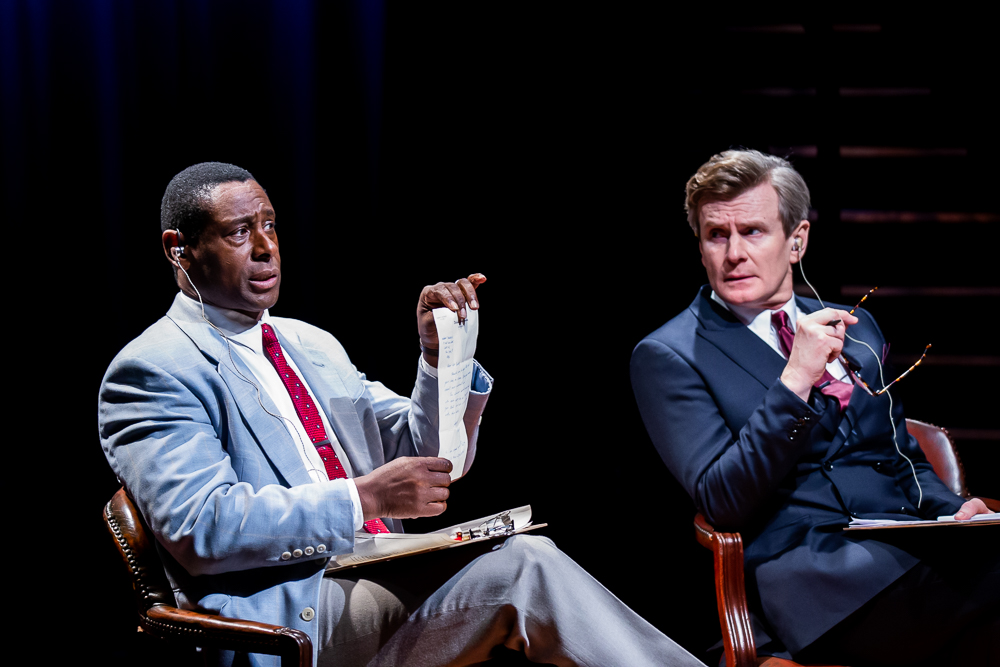
David Harewood and Charles Edwards in Best Of Enemies by James Graham at the Young Vic in London.
David Harewood and Charles Edwards in Best Of Enemies at the Young Vic. Photo (c): Wasi Daniju

Best Of Enemies at the Young Vic is the best new play I’ve seen this year. James Graham’s writing is vivid, funny, and shocking. There are towring performances by the two leads David Harewood and Charles Edwards. And the production directed by Jeremy Herrin with a set by Bunny Christie is perfect.

Given the subject matter – the 1968 presidential election and in particular some televised debates between the influential conservative thinker William F Buckley and the liberal writer Gore Vidal – you might think Best Of Enemies is not for you, but you’d almost certainly be wrong. I know it sounds boring but believe me, in the hands of writer James Graham and director Jeremy Herrin, it becomes electrifying theatre.

Best Of Enemies may tell us a lot about the polarised society we live in today, but it does so in the form of a gripping entertainment that takes us inside the heads of two protagonists, narcissistic to the point of recklessness.

The play begins with the immediate aftermath of one of the later debates. There is anger and shock at language that has been used, although at that point we don’t know what’s been said or how it’s come to this. We then go back and see that the story began with ABC TV News, in a race for ratings, deciding to have well known intellectuals talking about the Presidential conventions, at which the Republican and Democratic candidates are elected.

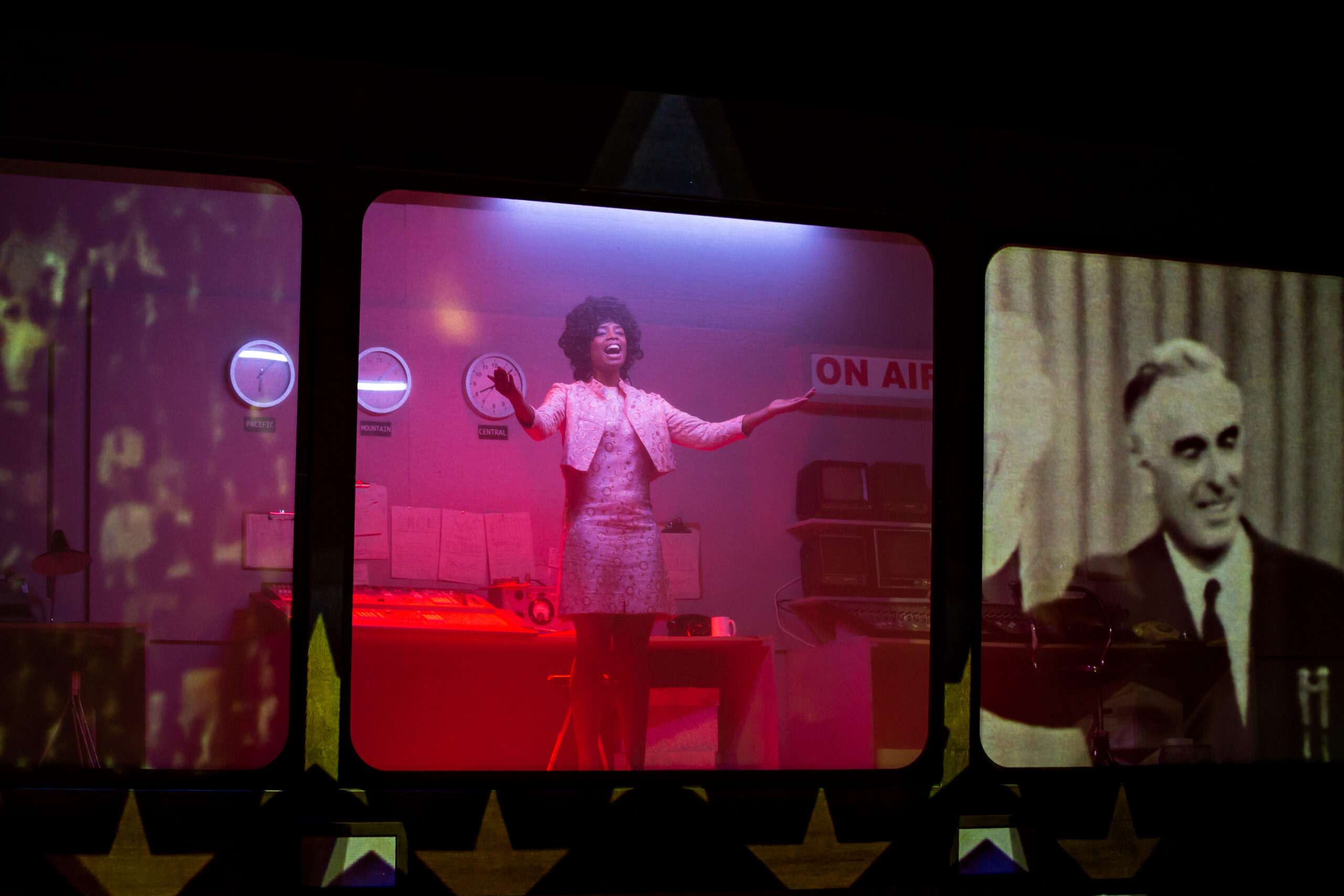
This is about the corrupting influence of TV and there are three big screens high up at the back of the stage to remind what viewers are seeing, as well as showing us the studio control area. We see how the participants both take part because they see it as a way of promoting themselves. We then see over a series of debates how the confrontational format generates more heat than light.

We and they realise that how they come across is more important than what they say. Buckley’s wife Pat says: “That’s all this is. Who do I like the most?’ At the end, Vidal prophesies that this means that one day a candidate could get elected because he was more likeable rather than having the best policies. Don’t we know it?

Okay, that’s the bones of it but what James Graham has done is flesh that skeleton with bits of verbatim speech from the debates and lots of fictional dialogue that brings to life the two protagonists.

Electrifying performances by David Harewood and Charles Edwards

The two leads charge the production with electricity. David Harewood plays William F Buckley. You might be surprised that a Black actor is playing a right-winger whose whiteness was part of who he was, but a good actor inhabits the role. In this case, the role is of a man not comfortable in his own skin. Mr Harewood relishes the part, not only the external mannerisms, tics and lip licking and other nervous affectations, but also the inner person- the loneliness of the outsider, the devoted husband, the foundation of his beliefs, and the desperation to win. He does a remarkable job of making us feel sympathy for someone who could so easily be the villain, because of his racism and homophobia. When the first debates go badly for him under an onslaught from Vidal, I actually felt sorry for him. Then we see him planning to raise his game.

Charles Edwards conveys the smooth charm, razor wit, the insufferable superiority, obsession with power, and the vulnerability of Vidal. He was a patrician and his sense of superiority, while insufferable, helps him dominate those early debates. Then Buckley prepares better and starts to score points, and as Vidal squirms, so do we.

They are both intellectuals and they’re both narcissists. They want to win the debate so they can be more influential in the world of politics. Each of them is delighted when they’re recognised by leading politicians. They’re not portrayed as bad people, their extreme views seem to be more like an academic exercise than something from the heart, but they do have hearts and it’s their pride, and above all their desire to win that drives them from civilised conversation to conflict to playground name calling. Both seek out each other’s weaknesses, initially of their arguments but eventually personal ones, and you find yourself not wanting to look, as their feelings are exposed.

They live in ivory towers, not what most of the electorate would recognise as the real world. Obsessed by their personal dislike of each other, they don’t even anticipate the effect of their clashes on the world of politics, which is moving from compromise to polarisation. In the real world things fall apart.

Justina Kehinde in Best Of Enemies

We are shown something of what’s going on in that real world of 1968: Robert Kennedy and Martin Luther King are assassinated; an extreme feminist shoots Andy Warhol; there are protests about the Vietnam War. Looking back, we see that this was the beginning of the end of consensus politics and the start of polarisation: Left v right, young v old, plus conflicts of gender, race and sexuality. And on the other hand, there’s the so-called silent majority which Presidential candidate Richard Nixon appealed to. So tempers are rising, creating a sense of a pressure cooker.

The set itself is a small open stage surrounded on three sides by audience, turning the protagonists into gladiators in an arena.

All the other actors are first class. Among them, there’s Clare Foster as Buckley’s cheerful wife Patricia, Syrus Lowe as the angry but expressive James Baldwin and John Hodgkinson who plays the chair of the debates, revelling in the viewing figures but out of control of the wild horse he is riding. It’s only a cast of ten but they take on many characters, all well delineated, so you might think there were twice as many actors. It seems like every one of the characters has a contribution to make and every line has something to say.

Under the direction of Jeremy Herrin, this production zings along. As with the Wolf Hall trilogy or James Graham’s This House, which he also directed, he uses movement to add a physical excitement to the dialogue. I like the way he and James Graham make politics exciting. Because politicians shape our country and it’s a crying shame we find them boring or see them reduced to personalities.

Why were they the ‘best’ of enemies? They needed one another and they’re really quite similar.

Best Of Enemies is performing at the Young Vic until 22 January 2022.  Performances will be streamed live on 20, 21, 22 January, 7.30pm, and 22 January 2.30pm GMT. Tickets from youngvic.org

Paul received a complimentary review ticket from the producers.

Click here to watch this review on YouTube

×