Theatre review: Kiss of the Spiderwoman

A musical to rival Cabaret and Chicago

MAST Southampton


⭑⭑⭑⭑⭑

Fabian Soto Pacheco, Anna-Jane Casey and George Blagden in Kiss of the Spiderwoman. Photo: Marc Brenner

John Kander and Fred Ebb are best known for writing Cabaret and Chicago. Their musical Kiss of the Spiderwoman is far less familiar.  Adapted from the novel by Manuel Puig, it premiered in  the West End in  1992 before transferring to Broadway in 1993 where it won seven Tony Awards including Best Musical.  I can’t believe it’s not performed more often.The score, infused with evocative Latin rhythms, stirs deep emotions, while story is profoundly moving, not to mention harrowing. This co-production by Bristol Old Vic, Leicester Curve and Southampton MAST is tremendous.

This revival is far more intimate than the apparently spectacular premiere over thirty years ago. But no way is it a cut price version. The set entirely befits what is ultimately a love story. The setting is a prison cell in 1970s Argentina, shared by Valentin, a political prisoner, and Molina, a gay man.

These were dark times in that country. The growth of fascism shown in Cabaret is fully developed here, the celebrity prisoners of Chicago are now wretched victims of the governments of Juan Peron’s widow and the subsequent military junta of General Galtieri. Trades unionists, left wingers and gay people face imprisonment, torture or, notoriously, become The Disappeared.

Seeking refuge from the brutality of prison life, Molina, played by Fabian Soto Pacheco and wearing soft feminine garments, transports himself to his childhood memories of movies featuring a screen goddess called Aurora. As he recounts the plots of these films, the star materialises before us singing and dancing.

David Woodhead’s set brilliantly contrasts the austere greyness of the cell and its two narrow beds and floor to ceiling iron bars, with the colourful glamour of Aurora and her fabulous costumes, designed by Gabriella Slade. She appears as a mature woman, presumably reflecting a child’s perception of the movie star as much older than himself.

Anna-Jane Casey is charismatic in the role, commanding the stage with her swaggering dance and her seductive smile. Projected at the back of the stage are scenes from her black-and-white movies, cleverly created by Andrzej Goulding.

George Blagden delivers a compelling performance as Valentin. As an idealistic revolutionary, and a heterosexual, he is initially indifferent or even hostile to Molina but comes to value the escape into ‘beauty and love’, as the latter describes it. The movies and their songs become more meaningful to him than the ideological book by Karl Marx he keeps by him.

Both sing and act well.   Molina is vulnerable and pragmatic,  Valentin tough and principled. Although both remain attached to loved ones outside the prison walls, their love for each other grows, as both recognise and appreciate the strengths of the other. Inevitably we think of fluidity of gender and sexuality.

The prison authorities attempt to exploit this developing relationship to pressure Molina into extracting information about Valentin’s associates.

What follows is a gripping struggle within Molina between love and self preservation. Throughout, the movies (a metaphor for all art), not only provide escape from life but a blueprint for how to live

All the acting is top class but I’ll mention Jay Rincon as the cunning, sadistic Prison Warder.  His chilling performance sends a shudder down the spine and makes the scenes of violence that much more believable.

This production, directed by Paul Foster, serves as a timely reminder to people like me who spend most of our time in London theatres that regional productions can be as artistically accomplished, emotionally powerful and theatrically thrilling as anything the capital has to offer.

Kiss of the Spiderwoman completes its short tour at The MAST Southampton on 6 June 2026. 

Paul paid for his ticket.

Watch this review on the YouTube channel Theatre Reviews With Paul Seven
The Taxidermist’s Daughter – Chichester – review

Kate Mosse’s first play provides a dramatic opening to new Chichester season

★★★

A production photo from The Taxidermist's Daughter by Kate Mosse taken on 8th April 2022 at Chichetser Festival Theatre
The Taxidermist’s Daughter at Chichester Festival Theatre. Photo: Ellie Kurttz

The opening of this year’s Chichester Festival Theatre season could not be more dramatic. I’ve rarely felt such goosebumps as when the lights went up on The Taxidermist’s Daughter began: an initial jump at the loud discordant sound and disturbing lighting, churchgoers frightened by hanging dead crows, a chilling recitation of Who Killed Cock Robin.

This play has Chichester running in its veins. It is written by Chichester resident and Festival Theatre stalwart Kate Mosse, and set in nearby Fishbourne. I don’t know how much of the credit goes to Kate Mosse and how much to director Roisin McBrinn, but this is a play designed for the Festival Theatre space and the production works perfectly there.

Unfortunately, the gothic horror story doesn’t quite live up to the production. The evocation of a bygone time and place, and the sense of the past contained in the present are excellent. However, Kate Mosse has made the decision to turn her original mystery story into a revenge play while retaining a question mark over the whys and wherefores of what’s going on. The belated explanation means that I for one found it hard to understand or sympathise with the revenge that a mystery woman is carrying out.

The play lacks the tension of the best thrillers: the killing spree doesn’t even begin until the end of act one. And the mystery doesn’t grip enough to justify the delay, despite raising many questions:  who are the women who have escaped from the local asylum, who has hung dead crows in the church, what happened all those years ago, why are people being killed, are these connected? Spoiler alert- yes they are!

Connie Gifford can’t remember the details of a traumatic event in her childhood.  She is trying to continue her drunken father’s tottering taxidermy business and is troubled by both the past and present. Daisy Prosper conveys well her sweet disposition and vulnerability.

We eventually learn that a group of leading men from the community committed crimes and, because of their position in society and because the crimes were against women, they have got away with it. ‘The men charged to protect us are the ones we must fear the most.’

The message is perennial. Inevitably we will think that not enough has changed a hundred years on, when powerful men like Jimmy Savile and Jeffrey Epstein get away with crimes against women and girls for years. But, for audiences of revenge fiction, taking the law into one’s own hands is a cathartic response to the failures of the system.

The stars of the show are the creative team

The Taxidermist’s Daughter is not as spooky as The Woman In Black nor as bloody and grand guignol as the recent production of The Lieutenant Of Inishmore which starred Aidan Turner. Nevertheless, it does a decent job in both those genres.

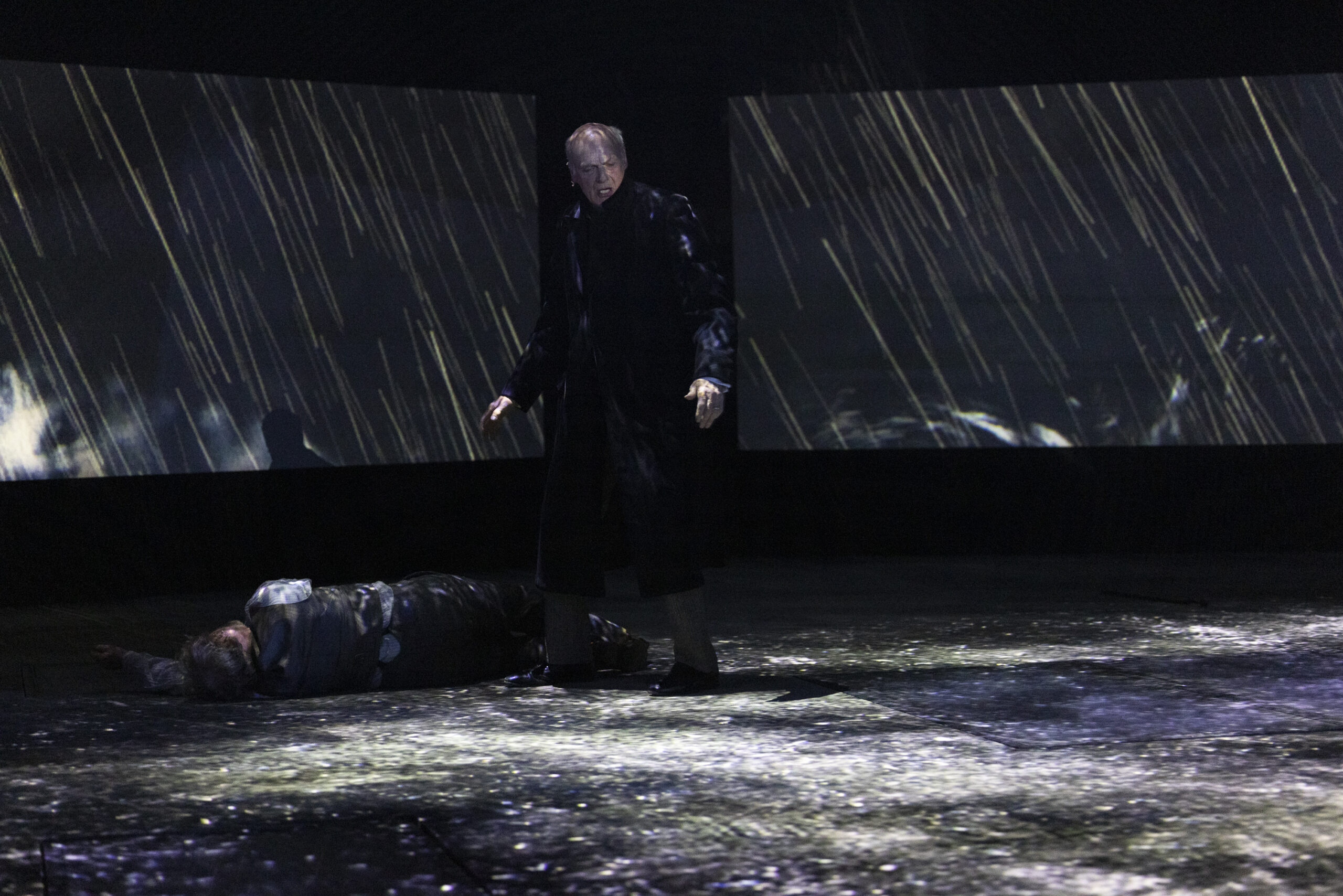
In this, the play is helped enormously by the creative team, who are the real stars of the show. Sinead Diskin’s frightening music and sound and the stark, flashing lighting designed by Prema Mehta. Paul Wills’ set design keeps the stage bare. Sinister black-and-white projections proliferate- on the back wall, the floor and on hanging screens. These often take the form of extraordinary videos by Andrzej Goulding, which show us fragments of faces, dark foliage, water- oh yes, the water. I’ve seen a lot of water on this stage over the years but this projection of splashing water onto the floor was more convincing than any real water I’ve seen.

And water is significant because Fishbourne is marshland and it’s 1912, the year of the great flood, and the action takes place as the deluge begins. So the mystery woman may be seen as washing out evil from the community.

The production uses every square inch of the stage. There are entrances from all directions, and pieces of set- often stuffed birds in display cabinets- rise from a multitude of holes in the floor. It does what theatre does best: it inspires the imagination. In fact, the scariest moment is probably when we finally see the crime, and that’s because we don’t actually see it, but are given all the information we need to imagine it.

Production photo of Pearl Chandra in The Taxisermist's Daughter by Kate Miosse at Chichester festival Theatre in 2022
Pearl Chandra in The Taxidermist’s Daughter. Photo: Ellie Kurttz

Many of the characters are sketched rather than detailed portraits. Pearl Chandra as the mystery murderer is passionate and energetic without going over the top.  Forbes Masson does well as Connie’s father Crowley Gifford, a man plagued with guilt about what happened in his past, who is now barely holding himself together.

We also meet a nice man: Harry, a gentle young artist, played by Taheen Modak. Although the play focuses on the position of women in early 20th ventury society, men too had to know their place, so it’s good to see at least one young man whois nice and gentle and breaks free from the chains of a professional career to become an artist. It’s not overtly stated in the play but it’s hard not to remember that this young man is only a couple of years away from being sent to the slaughter of the first world war, a victim of powerful old men, in a war that will change the village more than the flood.

But maybe that’s putting too much weight on what is in the end an enjoyable gothic horror story in a glorious production.

The Taxidermist’s Daughter can be seen at Chichester Festival Theatre until 30 April 2022. Click here for tickets and information.

The reviewer was given a press ticket by the producers.

Click here to watch this review on the One Minute Theatre Reviews YouTube channnel


×