Theatre review: John Proctor is the Villain

A joyous celebration of young women

Jerwood Downstairs at Royal Court Theatre

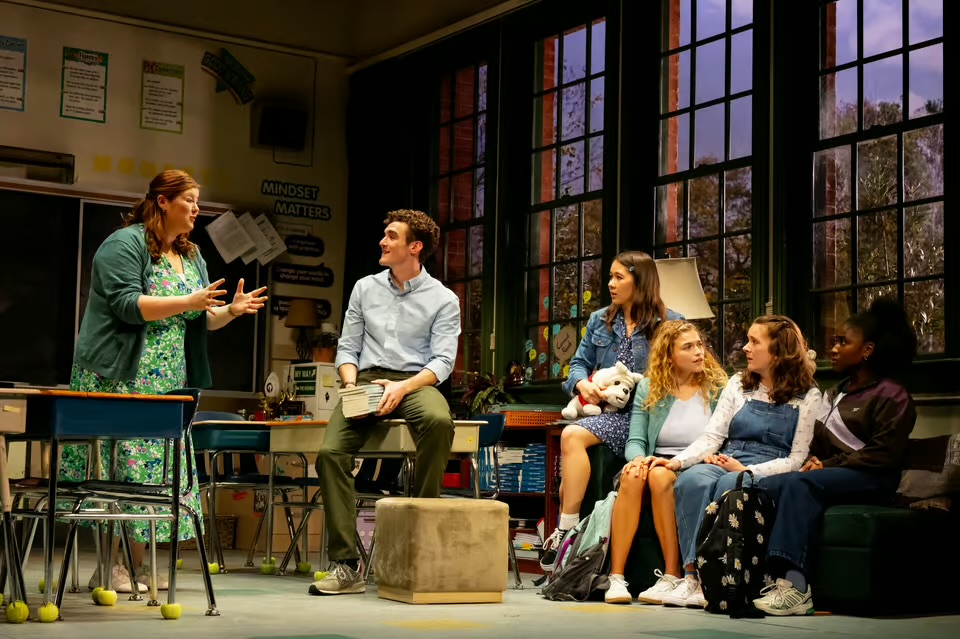
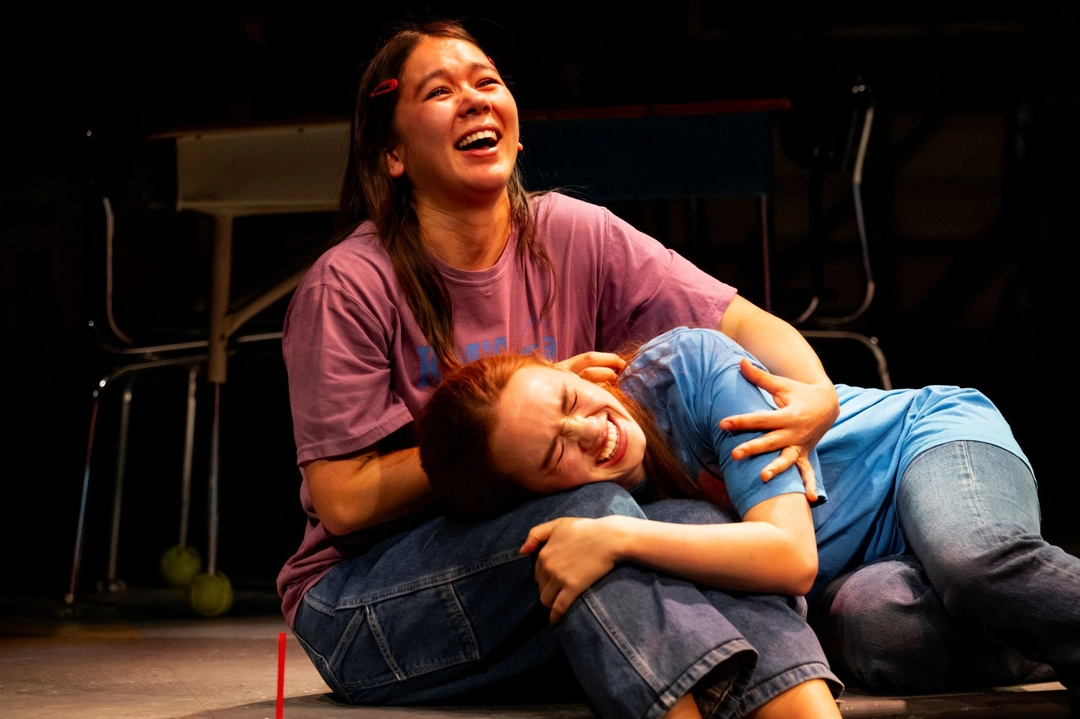
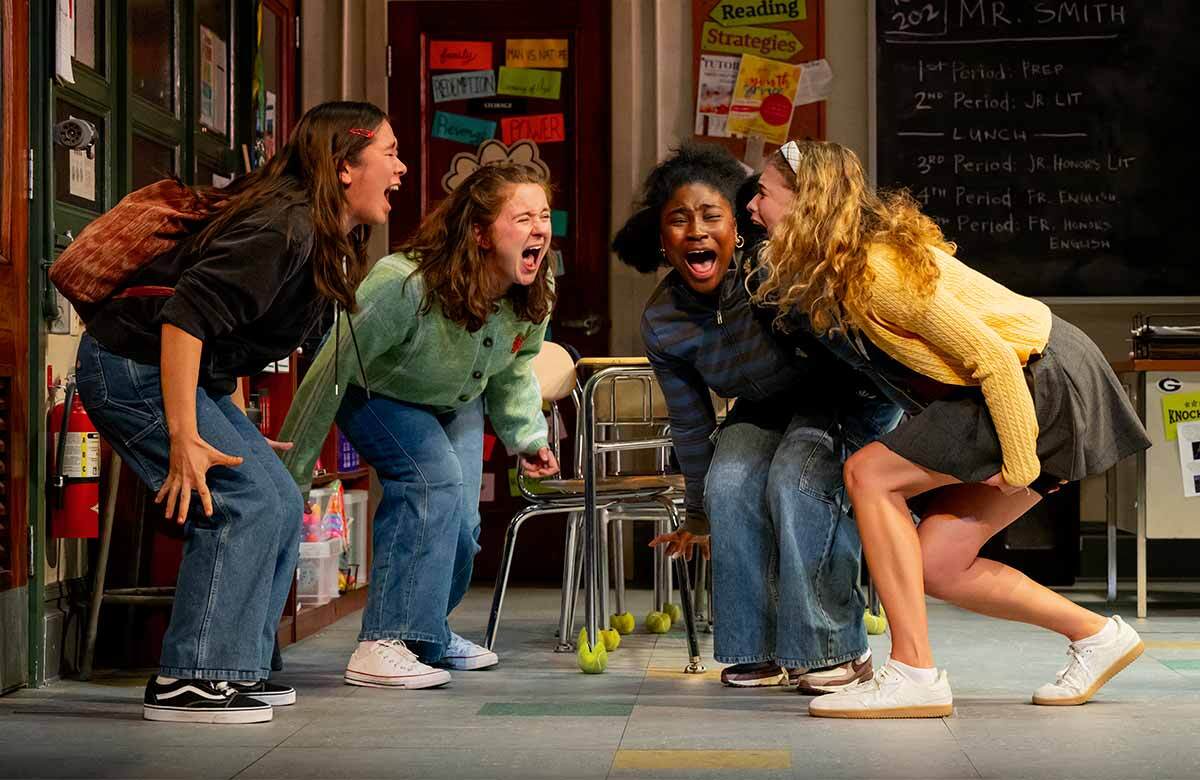
John Proctor Is The Villain at the Royal Court Theatre Photo: Camilla Greenwood

⭑⭑⭑⭑⭑

It’s set in rural America. It’s about teenage girls in a high school. It has a point to make and it makes it. There are many reasons why I shouldn’t like  Kimberly Belflower‘s play John Proctor is the Villain. And yet I loved it.

Why? Well, let’s begin at the end: an uplifting, liberating finale for the young women whose world we have inhabited for the last couple of hours. The previously mundane classroom lighting becomes a euphoric light show as the girls dance to Green Light by Lorde, defiantly in unison ,and unified behind the abused women of The Crucible. I had a tear of joy in my eye.

If you’re anything like me (old white male), it may be a world you’ve scarcely encountered before. For women, the girls’ friendships, their passion and their early encounters with sex will likely resonate more. It doesn’t matter. One of play’s defining strengths is the authenticity with which it draws these young women, compelling you to care about them, regardless of your age, gender or background. The dialogue is believable, and often very funny, inviting us to laugh both with and at the girls. It captures the angst and rapture, the confidence and vulnerability, of standing on the brink of adulthood.

So where does the play begin? The year is 2018. We’re in a high school classroom in a ‘one-stoplight town’ in Georgia. A class of four 16 to 17 year old girls, and a couple of boys, are studying Arthur Miller’s The Crucible under the guidance of a charismatic teacher called Carter Smith. He’s approachable, affable and speaks their language. Unsurprisingly, they adore him.

Momentous events unfold, but don’t expect subtext and intricate layers. The girls are who they are and don’t really change. They are affected not by internal transformation of the kind John Proctor undergoes in The Crucible, but from the external circumstances that confront them.

What evolves in the play is their perception of society- both their immediate environment and the wider world.  This is the time when the #MeToo movement is at its most visible and influential. The girls form a feminist group. All is going well until Shelby returns after several months of unexplained absence. Tensions rise. Raelynn is far from pleased: the two had been best friends until Raelynn’s boyfriend Lee cheated on her with Shelby. Lee remains in the class. Oh, and Ivy is in a predicament because her father, whom she reveres, has had an affair with his secretary.

Through the prism of #MeToo and their own lived experiences, they begin to recognise both the ways in which a male-dominated society seeks to diminish them and the power inherent in their identity and friendship. To Mr Smith, The Crucible‘s John Proctor is one of the great heroes of literature, admired for defying the Witch Trials, until Shelby prompts a re-evaluation. Does this married man’s affair with a young servant, who he later calls a ‘whore’, make him less a hero, more a villain? The subsequent discussion ends in a bombshell.

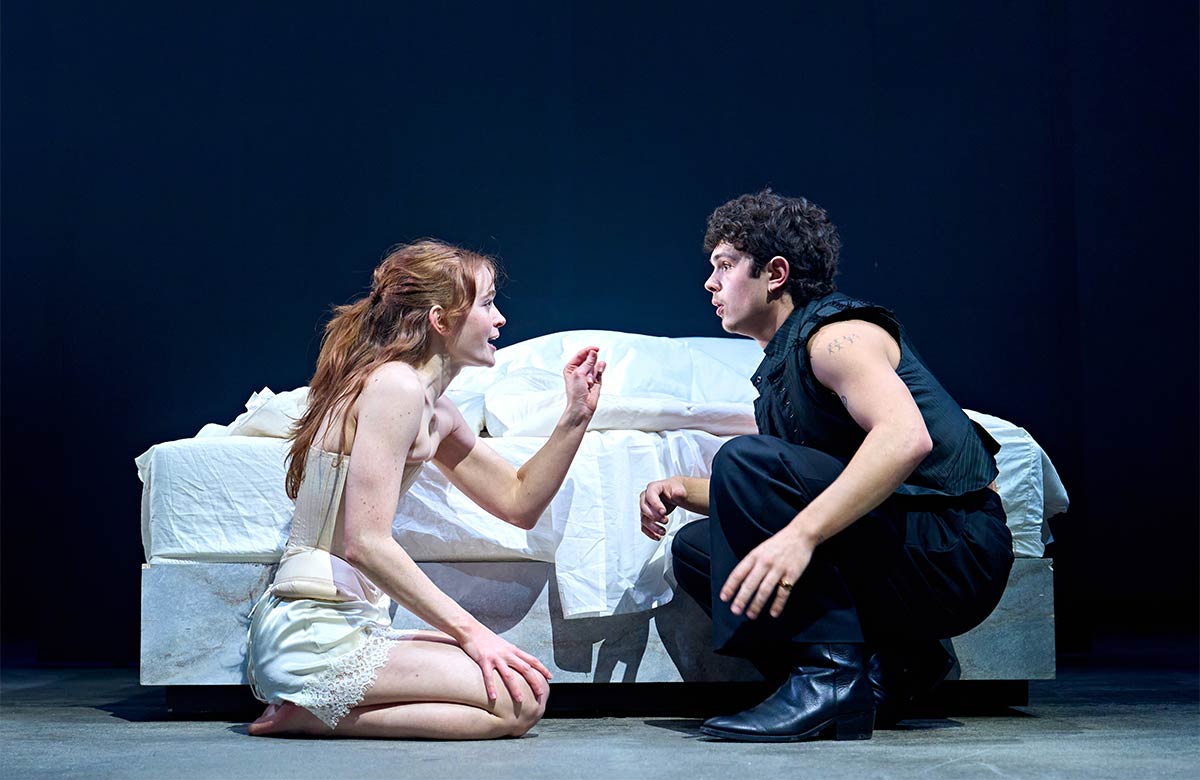
Miya James and Sadie Soverall in John Proctor is the Villain. Photo: Camilla Greenwood

The young women deliver remarkable performances. The future of British acting is safe, if they are anything to go by. A standout is Sadie Soverall as the troubled but clever Shelby. Miya James brings a rare stillness and intensity to Raelynn. Lauren Ajufo is Nell, the girl who comes from a big city, Holly Howden Gilchrist is the swot and ‘teacher’s pet’ Beth, and Clare Hughes is the straightlaced Ivy. Much credit is surely due to director Damya Taymor (who also directed the Broadway production) for eliciting such nuanced work.

The other actors complete a formidable ensemble. Dónal Finn is entirely convincing as the smiling, superficially charming teacher. He’s a magnetic actor, who seems ubiquitous at the moment, having appeared on stage in Hadestown, is also currently to be seen on screen in The Other Bennet Sister and Young Sherlock. Charlie Borg makes the most of the smaller role of Lee, a representative sexist male. Reece Braddock as the dopey but sympathetic Mason and Molly McFadden as the inexperienced young counsellor are both making their professional stage debuts, but you really wouldn’t know it from the quality and confidence of their acting.

The design, by AMP featuring Teresa L. Williams, initially presents a naturalistic classroom complete with blackboard, fluorescent lights and daylight filtering through the windows. Yet appearances are deceptive. Natasha Katz‘s lighting isolates characters in moments of revelation, while the ecstatic final sequence, when the girls challenge the male hierarchy, plunges the room into chaos through jarring projections and a striking mauve wash.

It’s sadly true that #MeToo doesn’t seem to have made more than a small dent in the ways of the world. We remain surrounded by stark examples of male toxicity: figures such as Harvey Weinstein, Jeffrey Epstein and Mohamed Al Fahed are high profile examples, but far too often, in everyday life, those in positions of authority- teachers, fathers and other men take advantage of women and girls. In a city near me, a number of male teachers at a girls’ school have recently been prosecuted for sexually abusing their students.

There may be an element of wish fulfilment in the rapid ideological awakening of these girls (and one of the boys) to feminism. Ordinarily, I would resist a drama whose message hammers me so hard on the head, but this joyous play is irresistible.

This year marks the 70th anniversary of the Royal Court Theatre, which in 1956 became the first British theatre to stage The Crucible. While John Proctor is a Villain may not possess the same depth and complexity as Miller’s masterpiece, it offers something equally valuable: a thought-provoking and thoroughly enjoyable night out at the theatre.

Paul was given a review ticket by the theatre. The review was slightly revised for clarity on 7 April 2026.

John Proctor is the Villain can be seen at Jerwood Theatre Downstairs at The Royal Court Theatre in London until 25 April 2026. Buy tickets direct from the theatre

Click here to read the roundup of other critics’ reviews of John Proctor is the Villain

Watch this review on the youtube channel Theatre reviews With Paul Seven

Theatre reviews roundup: John Proctor is the Villain

Vivid play about reaching adulthood

Royal Court theatre
John Proctor Is The Villain. Photo: Camilla Greenwood

Kimberly Belflower’s 2022 play John  Proctor is the Villain was a sensation on Broadway and looks like being one over here. The same production directed by Danya Taymor, but with a British cast, has arrived at the Royal Court theatre to an exceptional three 5 star reviews and four 4 stars. This gives it the second highest average rating for Limited Run Shows, at the time of writing. The critics liked the portrait of teenage schoolgirls in a strict religious community discovering adulthood at the same time as the #MeToo movement broke. Some loved it (‘joyous, blazingly intelligent’ FT) while others liked it but found it too obvious. They all praised the young women in the cast.

[Links to full reviews are included but a number are behind paywalls and therefore may not be accessible]

5 stars ⭑⭑⭑⭑⭑

Sarah Hemming wrote a detailed, insightful review in The Financial Times (such a shame her reviews are hidden behind a very expensive paywall). She declared: ‘what a joyous, blazingly intelligent play this is: at once a restless interrogation of the role of art in defining and expressing who we are; a compassionate, funny portrayal of what it means to be a teenage girl; and a furious appraisal of the way power games repeat across generations. It’s staged with irrepressible energy by Danya Taymor and her terrific young cast.’
‘What really makes the play is its vivid and touching depiction of young women trying to navigate their way to adulthood against this roiling backdrop. They’re played with great affection and aching authenticity here.’

Marianka Swain at LondonTheatre declared: ‘if there is any justice, it will soon bring its whip-smart, potent, gloriously funny and remarkably affecting drama to the West End.’ She remarked: ‘Belflower beautifully captures the way that adolescent girls (and especially those in a small, insular, religious community) are simultaneously knowing and innocent, playing out fantasies of adulthood but still, heartbreakingly, just children.’ She ended: ‘It all culminates in the most extraordinary, heart-pounding, viscerally cathartic climax I’ve ever experienced, brilliantly utilising Lorde’s song “Green Light” along with an interpretive dance that moves from kooky to joyful to a full-on rebellion. This play likewise makes me want to scream, laugh, cry, and dance. It’s not just a drama: it’s a revolution.’

Cindy Marcolina at BroadwayWorld couldn’t fault it: ‘Belflower’s work is perfectly plugged into the rippling effects that cause societal disruption. The script is as emotionally intelligent as it is fun and casual, but it also reveals a proclivity for fostering debate. She questions the nature of authority, debating the need for it and addressing the abuse of power. Her characters are smart, provocative, proactive, and unapologetically proud of who they are. Most of anything, they feel real.’ She concluded with a call to action: ‘The production is relatable, accessible, poignant, and bursting with ideas. Beg, borrow, steal, but get yourself into this utterly galvanising room!’

4 stars ⭑⭑⭑⭑

An underlying anger pulses through Alice Saville’s review in The Independent: ‘if you want to really understand the millions of small, hidden dramas that erupted in the wake of #MeToo, plays like this one are the way to do it. And its frenzied, Lorde-fuelled dancefloor climax is the perfect outlet for anyone who feels a bit crazy thinking about everything we’ve forgotten, as the world’s brief mass feminist awakening is replaced by deadening silence.’

Claire Allfree at the Telegraph praised ‘a gifted young British cast’, noting ‘Miya James is both unshowy and mesmeric as Raelynn; Saltburn’s Sadie Soverall is horribly compelling as the wild and glowering Shelby.’ She admitted: ‘There are quibbles. Modern readings of The Crucible already cast doubt on Proctor’s behaviour; he’s no longer quite the fully paid-up canonical hero Belflower needs him to be. The play feels a little thin, too. It relies on an emotional charge rather than a thorny argument… But it nails absolutely the timeless fury of female adolescence.’

The Standard’s Nick Curtis described it as ‘a terrific piece of provocative entertainment.’ He wrote: ‘Though the play is mechanical in the way it works through #MeToo issues, with some scenes straining credibility, Belflower is acute on the way women and girls are manipulated and gaslit. And on victim-blaming and the excuses people make for predators.’

Time Out‘s Andrzej Lukowski explained: ‘what Belflower does do brilliantly is nail the intersection between the relatively brief apex of the #MeToo movement and a generation of smart, naive school girls who would have been the right age to absorb its rhetoric at the precise moment they’re discovering what it was a reaction to’. He reported: ‘Danya Taymor’s production…is an absolute blast, the many serious issues raised all of a piece with its breathless ebullience and Belflower’s endlessly witty text. As much as anything else, it’s a wholehearted celebration of teen girl dorkiness and a rebuttal to the idea their lives should be viewed through a sexual lens, even in sympathy.’

3 stars ⭑⭑⭑

The Stage‘s Sam Marlowe said the play was ‘at pains to spell out its themes and subtext, sometimes to a declamatory, over-explicit fault. But, in a tenderly handled production by Danya Taymor, it has a huge, pulsing heart and captures something of the thrilling, almost unbearable intensity of adolescent girlhood, building to a wildly emotional conclusion of mingled defiance, joy, rage and hope.’ She concluded: ‘Belflower’s play is, in many ways, one familiar story wrapped in another; but it’s done with wit and leaves us, with its final, glorious act of rebellion, on a high of irrepressible optimism.’

The Times’ Clive Davis questioned whether the play is the ‘modern classic’ some claim; ‘There’s certainly plenty to savour in Danya Taymor’s high-energy production, recast for London audiences, which burrows deep inside the overheated psyches of teenagers. At its sharpest, the dialogue generates waves of laughter too.’  Unlike some other reviewers, he found the ending a letdown: ‘Belflower can’t quite resist forcing home her message in the closing scenes. Ambiguity goes out of the window’.

The Guardian’s Arifa Akbar called it ‘a moving play… (that) catches the mood of 2018 for a bewildered generation of girls growing into womanhood in the shadow of Weinstein.’ She liked the way: ‘Belflower’s dialogue captures the way girls talk to each other with humour and pathos, as well as how they internalise the world’s micro-aggressions towards women.’ But she had reservations, one of which was: ‘the relationships here are flattened by their cuteness, rather than sharp-edged and gritty, as this cusp of girlhood and adulthood so often tends to be.’

Critics’ average rating 4.0⭑

John Proctor Is The Villain can be seen at the Royal Court Theatre until 25 April 2026. Buy tickets directly from the theatre. Transferring to Wyndham’s Theatre from 2 February until 24 April 2027.

Read Paul’s review of John Proctor is the Villain here

If you’ve seen John Proctor Is The Villain at the Royal Court Theatre, please leave a review and/or rating below

Theatre reviews roundup: Teeth ‘n’ Smiles

Self Esteem boosts vintage rock drama

Duke of York’s Theatre
Rebecca Lucy Taylor in Teeth ‘n’ Smiles. Photo: Helen Murray

Rebecca Lucy Taylor, better known as pop star Self Esteem, grabbed the critics’ attention in this revival of David Hare’s 1973 play about a fading and disillusioned 1960s band. She plays Maggie, the drunken, troubled lead singer on the night of a chaotic gig. The critics loved her performance (‘sensational’ WhatsOnStage) but had differing opinions as to whether the play was ‘dated’ (Standard) or ‘feels current’ (Independent). Daniel Raggett‘s production was generally appreciated as capturing the mood of a live gig.

[Links to full reviews are included but a number are behind paywalls and therefore may not be accessible]

Four stars ⭑⭑⭑⭑

The Times’ Clive Davis gave us a précis: ‘David Hare’s play about music, ambition and burn-out takes place in that most English of settings, a May Ball at a Cambridge college. Cult singer Maggie Frisby is having another dark night of the soul, and her disgruntled musicians are going through the motions.’ Rebecca Lucy Taylor, he said: ‘gives a formidable portrayal of a talent in free fall, fighting off her demons while making life just about impossible for everyone around her.’ As for the production: ‘Daniel Raggett…captures the frenetic mood of a night where the performers are struggling to hold everything together.’

WhatsOnStage‘s Sarah Crompton loved Self Esteem: ‘Taylor is sensational as Maggie, full of self-loathing and fight in almost equal measure, staggering around the stage but never going down. When she sings…she is mesmeric, holding the audience in the grip of her hand while never losing sight of her character’s pain and her inability to quell it.’ She admitted: ‘It’s not a perfect play, sending sparks in all directions, but it is both witty and wise. Because Hare tackles serious themes, it’s easy to forget how funny he is’.

Holly O’Mahony writing for LondonTheatre noted: ‘if this period piece is not exactly hard-hitting in 2026, it’s still a well-paced play running on a whip-smart script that’s very entertaining in all its salty sarcasm.’ She was impressed by the stars: ‘Taylor’s Maggie grows more self-assured each time she gets behind the microphone. Her vocals are familiarly powerful and raw – and those booking for the sheer chance of seeing Self Esteem up close on stage won’t be disappointed on this front. Chloe Lamford’s set design sends the band’s own stage sliding right to the front each time they perform, which increases the intimacy.’

The Independent‘s Alice Saville didn’t think the play was as dated and irrelevant as some of the 3 and 2 stars below did. Instead: ‘Half a century on, Hare’s play feels current in a different way, capturing the vampiric nastiness of an industry that still picks up talented musicians, tours them til they break, then declines to pick up the pieces.’ She was also keen on the production: ‘Daniel Raggett’s staging makes the most of Hare’s witty one-liners without sacrificing the essential bleakness of this story.’

Three stars ⭑⭑⭑

Time Out‘s Andrzej Lukowski was unmoved: ‘…Hare’s words feel glaringly lacking in serious engagement with a half-century of musical, cultural and feminist discourse. Daniel Raggett’s gently absurdist, lightly Beckettian production eschews fussy period details and indeed Chloe Lamford’s set is effectively styled like a gig. But it feels like it has more in common with John Osborne’s cracked vaudeville The Entertainer than with the rock business.’ He concluded: ‘you’re left with Rebecca Lucy Taylor pouring her heart into the semi-broken body of a play that would never get commissioned today.’

The Guardian‘s Arifa Akbar found: ‘the dialogue does not have enough meat on its bones. This seems like a play with no centre, though it has plenty of anarchic spirit and humour. Both the emotional intensity and intellectual focus are missing…It is as if the script itself is waiting for the songs to arrive.’ She summed up: ‘come for the play and stay for the astounding music.’

The Stage‘s Sam Marlowe liked the star: ‘her casting in Daniel Raggett’s production gives the entire undertaking credibility and thrill.’ But: ‘the problems with Hare’s play persist. Part proto-punk gig theatre, part elegy for the hippie dream of the 1960s, it’s a vague, meandering piece, stuffed with self-conscious philosophising and semi-formed stereotypes. The wafty writing is at odds with the bludgeoning, full-frontal energy of the songs and the situation’.

The Sunday Times’ Dominic Maxwell confessed: ‘I ended up admiring Taylor’s performance but not surrendering to it.’ He expanded: ‘Taylor is good. Slowed down, she may be terrific. Yet I suspect you need a great performance to emit the palpable sense of damage required here. And the frisson of having a real rock band on stage is not what it might have been 50 years ago.’

There haven’t been any theatre reviews in The i for over a month, so it was a pleasure to see their once regular reviewer Fiona Mountford popping up at The Telegraph. She began by asking: ‘Does it have anything of burning import to say to us in 2026? The awkward answer is a resounding “No”’ She then declared: ‘I have long held the view that David Hare writes mouthpieces rather than three-dimensional characters and this play only serves to confirm my hypothesis.’ Good to have you back, Fiona.

Two stars ⭑⭑

The Standard‘s Nick Curtis had a few sharp questions too: ‘Why revive this dated piece about a minor-league rock band combusting at Jesus College Cambridge’s 1969 May Ball? Why do it with a pop star who’s only had one previous major stage acting role, in Cabaret at the Kit Kat Club? And why is everybody shouting?’ He found the play: ‘coarse and lumpen in Daniel Raggett’s unmodulated production’.

Adam Bloodworth at CityAM found many faults: ‘too many of the narrative arcs, fights and breakdowns feel contrived and surface-level…The band members feel fairly tropey…You end up wondering what the central narrative drive or jeopardy is supposed to be.’ He did concede: ‘Self Esteem’s live performances with the band…are compelling’.

Critics’ average rating 3.2 ⭑

Value Rating 26 (Value rating combines critics’ rating with typical ticket price)

Teeth ‘n’ Smiles can be seen at the Duke of York’s Theatre until 6 June 2026. Buy tickets directly from the theatre

If you’ve seen Teeth ‘n’ Smiles at the Duke of York’s Theatre, please leave a review and/or rating below


Theatre reviews roundup: R.O.I. (Return On Investment)

Fast moving comedy about capitalism

Hampstead Theatre
R.O.I. at Hampstead Theatre. Photo: Marc Brenner

In Aaron Loeb‘s new play, directed by Chelsea Walker, two venture capitalists (Lloyd Owen and Millicent Wong) meet a scientist (Letty Thomas) with abhorrent views but who has the means to eradicate cancer and more. They see the opportunity to do good or make a lot of money. Disappointingly, not many of the professional critics turned out for it. Those that did enjoyed the exploration of moral dilemmas but some found a few too many issues being covered.

[Links to full reviews are included but a number are behind paywalls and therefore may not be accessible]

4 stars ★★★★

Gary Naylor at The Arts Desk summed up: ‘Loeb’s play sparkles when these moral dilemmas are front and centre, the nexus between capitalism and science continually poked and probed, the profit motive necessary but, er, cancerous. They’re stirred into a heady mix of raw racism and doomsday geopolitics with the carapace of ethical boundaries proving to be of little effect against the tsunami of money rolling in and the sweet tang of White Supremacism spicing up the action.’

‘I was thoroughly entertained and provoked throughout every fast-talking, big-thinking moment’ said The Standard‘s Nick Curtis. He continued: ‘There’s something thrilling about the way global subjects and vast moral dilemmas can be addressed by four actors in a small room.’

Dave Fargnoli of The Stage was hooked: ‘Challenging, thought-provoking and sometimes gasp-inducingly close to the bone, this relentlessly twisty slice of speculative fiction…digs into some profoundly prescient ethical dilemmas.’

3 stars ★★★

The Guardian’s Arifa Akbar found: ‘Aaron Loeb is a businessman as well as playwright and it shows: his play zings with quickfire patter between May and Paul, a certain Mamet-esque sparring reminiscent of Glengarry Glen Ross. Its aim to show us what might happen when a big scientific breakthrough is funnelled through the machinery of venture capitalism is ambitious but a little too hectic.’ She expanded: ‘It’s all rather hard to digest in around 100 minutes. There are more than a headful of ideas, while the personal stories are too brief to pull at your emotions.’

For Cindy Marcolina at BroadwayWorld: ‘Working around an ethical discourse is fun if it’s matched with a solid story, but the narrative lacks the appropriate pull to properly propel the philosophical side forward.’

The Times’ Clive Davis found it ‘rattles along at such a manic pace. Events unfold over several years, yet the effect is like watching an entire TV mini-series on fast-forward.’ He noted: ‘In cold print it all sounds slightly dotty…another character (here played by Sarah Lam) makes a last-minute entrance, yanking the script in another direction. Walker’s breezy direction just about keeps us hanging on, and Hayley Egan’s video design adds depth. A sombre Duke Ellington piano miniature, Melancholia, bookends the action, but the piece often has the aura of a screwball comedy.’

Critics’ average rating 3.5★

R.O.I. (Return On Investment) can be seen at Hampstead Theatre until 11 April 2026. Buy tickets directly from hampsteadtheatre.com

If you’ve seen R.O.I. (Return On Investment), please leave a review and/or rating

Theatre reviews roundup: Summerfolk

Middle classes’ overlong search for meaning 

Olivier Theatre, National Theatre
Summerfolk at the National Theatre. Photo: Johan Persson

Gorky‘s rarely performed play from 1904 takes up where Chekhov left off and shows members of the new middle class enjoying a summer break. Many of the critics enjoyed the parallels with today’s professional class among the 23 well-acted characters. Quite a few thought it was a bit long, although that was mitigated by Moses and Nina Raine‘s lively adaptation and Robert Hastie‘s direction.

[Links to full reviews are included but a number are behind paywalls and therefore may not be accessible]

5 stars ★★★★★

‘The new regime at the National has delivered its first bona fide hit’ declared The Times’ Clive Davis. ‘Robert Hastie’s glorious revival is rich in period detail yet the modern turns of phrase in Nina and Moses Raine’s version conjure up visions of 21st-century families bickering over what to watch on Netflix in a Tuscan Airbnb.’ He was clearly swept away: ‘the moments when they talk about the sense of rootlessness that haunts them even after they have risen in the world are almost unbearably poignant. This is a play that blends laughter with tears.’ 

4 stars ⭑⭑⭑⭑

The Standard‘s Nick Curtis summed up: ‘This sumptuous, bittersweet slice of turn-of-the-20th-century Russian life is just the sort of thing the Olivier stage was built for. Director Robert Hastie has assembled a stunning acting ensemble, bringing shade and texture to Maxim Gorky’s 1904 skewering of a feckless educated class, caught between Tsarism and the coming upheavals. Their travails are agony to them, hilarious to us, and it all unfolds on a gorgeous set by Peter McKintosh where the sun-bleached ribs of a summer dacha give way to a dappled, forested stream.’

WhatsOnStage‘s Sarah Crompton declared: ‘the Raine siblings have provided a contemporary translation full of humour and vigour, bringing some 23 characters to clear life and the production has an excellent cast, including Doon Mackichan as a hapless poet, Justine Mitchell as a crusading doctor and Paul Ready as a high-living lawyer, who are expert in the fine calibration of comedy, landing their words with precise force.’

Hearther Neill on The Arts Desk liked the way the Raine’s had trimmed the play’s length: ‘Speed serves the comedy well under Robert Hastie’s beautifully modulated direction, with characters constantly on the move, forming and dissolving small conversational groups, rarely at rest on the Olivier stage. This is a sprawling ensemble piece, featuring 23 well-distinguished characters, all of them dissatisfied with life, either longing for love or desperate to escape unsatisfactory marriages.’ She continued: ‘These people are almost all ridiculous and heading for a tragedy that they seem to intuit but not understand,which makes them at least recognisable, even forgivable. Peter McKintosh’s sets suggest simple interiors and a forest of tall plank-like trees. He has introduced very real water, however, for paddling and taking a dip, perhaps to emphasise the isolation of this group from what is happening in the world beyond their disappointing idyll.’

Gary Naylor for BroadwayWorld found: ‘It’s hard to like any of this menagerie of misanthropes, but it’s easy to be amused by them, Nina and Moses Raine’s adaptation sparkling with the language clever people use to talk to other clever people’. He saw the parallels with today’s audience: ‘There we were, like Vavara’s soi disant friends, ex-working class made good (well, goodish) by education and luck, grateful for the health and wealth it has brought but slightly perplexed as to why it doesn’t feel better’.

The Telegraph’s Dominic Cavendish was pleased to see it back on stage: ‘Robert Hastie presents this valuable curiosity, laced with a timely sense of collective dread, in terrific, painterly, ensemble style.’ But…’The slight drawback? The script, by brother and sister Nina and Moses Raine, is loaded with distracting modern vernacular and some swearing (including the C-word).’

Dominic Maxwell of The Sunday Times praised the acting: ‘Is the cast…the most exciting ensemble of actors you’ll see all year? Well, after watching them spend three hours quipping, spatting, seducing, repulsing, making points and missing the point, I can only say good luck finding any better.’

3 stars ⭑⭑⭑

LondonTheatre‘s Anya Ryan still found it a bit long: ‘At its centre lies a pressing question: does anything really matter when the world is falling apart? Yet, despite the hazy glow of this new version by siblings Nina Raine and Moses Raine, it’s a message that lands with a heavy hand. Over its lengthy three-hour running time … a cast of 23 characters cycles through the spotlight, each reaching for some sense of meaning.’

Dave Fargnoli of The Stage announced: ‘Seething with secret tensions and simmering resentments, this faithful yet ponderous adaptation captures the anxiety, humour and heartbreak of Maxim Gorky’s piercingly prescient 1904 study of the indolence of the bourgeois.’ He expanded: ‘It is a sprawling, deliberately slow-moving piece, with director Robert Hastie taking time to gradually build an atmosphere of suffocating, inescapable ennui. And although the production never achieves the necessary sense of impending doom, the play’s world remains intriguing: believable, feverish, stifling as the muggy heat of a summer day.’

Time Out‘s Andrzej Lukowski found it ‘overwhelming at first: it feels like you’ve been plunged into a sprawling existential soap opera, teeming with characters and plot lines that have been running for years that you’re having to familiarise yourself with on the fly.’ He went on: ‘The pleasures are pretty soapy throughout: essentially three hours of compulsive people watching.’ He commented: ‘Hastie’s production at best has a bucolic but beautifully deadpan rhythm. As with his recent Hamlet, though, I couldn’t help but feel that he’s not that good at seizing control of large ensemble casts: Rundle electrifies the stage anytime she steps on it, but apart from that it can feel like a freewheeling blur of similarly dressed people bickering for three hours. The Raines’ adaptation is modern, witty and at best bracingly pungent but it feels a bit inbetween-y in tone, neither really quite set in 1904 Russia, nor our present’.

The Guardian‘s Arifa Akbar reacted with faint praise: ‘At almost three hours, it is ambling but with sparks of intensity – rather like a summer’s day. One character gives a hostile review of The Cherry Orchard: “Went on too long. Didn’t like it.” This goes on a little too long as well, although it is likable enough.’

The Independent and its reviewer Alice Saville returned to the theatre after a few weeks’ absence but she may wish she’d delayed her return: ‘Gorky’s play wears its themes on the surface. And its lack of subtlety doesn’t feel especially well-served by Robert Hastie’s production, which relies on broad performances and an open, cluttered-feeling set that doesn’t allow for more intimate moments between its warring characters. The structure is strange, too, with a tighter first half followed by a ballooning second part that never reaches the catharsis we seem to be building to…Still, the best moments of Summerfolk shine out, strikingly modern.’

Critics’ average rating 3.7⭑

Value rating 53 (Value rating combines the critics’ rating and the typical ticket price)

Summerfolk can be seen at the Olivier, National Theatre, until 29 April 2026. Buy tickets directly from nationaltheatre.org.uk

If you’ve seen Summerfolk, please leave a review and/or rating below

Theatre review: The BFG

A magical show for all ages

Chichester Festival Theatre

⭑⭑⭑⭑

The BFG at Chichester Festival Theatre. Photo: Marc Brenner

This joint production by Chichester Festival Theatre and the Royal Shakespeare Company is hugely impressive — no pun intended. If The BFG lacks quite the same tug at the heartstrings as that other celebrated Roald Dahl adaptation, Matilda, it more than compensates with its magical staging, inventive effects, and the delightful interplay between human performers and puppetry.

The set for The BFG is perfectly suited to the thrust stage at Chichester. We, the audience, are placed right in the heart of the giant’s world, as enormous figures loom out towards the front row and Chris Fisher’s illusions dazzle and surprise.

You probably know the story — the book has sold more than 40 million copies — but just in case: Sophie is a little girl living in an orphanage. One night she encounters a mysterious giant who is out collecting dreams. To preserve his secrecy he carries her off to Giant country, but the two soon become friends, and Sophie christens him the Big Friendly Giant.

The BFG explains that his nightly mission is to capture pleasant dreams and deliver them to unhappy children, while destroying nightmares. He also reveals that other giants roam the land — far larger and far less friendly — and that they have a taste for what he calls “human beans”. Together, Sophie and the BFG devise a plan to enlist the Queen’s help in capturing the fearsome giants.

John Leader in The BFG. Photo: Marc Brenner

Central to the success of this production is its ingenious use of puppets, designed by Toby Olié. At times the BFG appears as a puppet alongside a human actor playing Sophie; at others the roles are reversed, with Sophie represented as a puppet while the BFG is portrayed by an actor. The transitions between these forms are executed so seamlessly that you barely notice them happening.

The puppeteers are magnificent. The BFG puppet is operated by four performers, who imbue him with life through wonderfully subtle movements and gestures. When he appears at human scale, John Leader gives us a warm, endearing BFG, and much of the comedy arises from his exuberant ‘squiff-squiddling’ of the English language: wondercrump, winksquiffler, gobblefunking, and so on.

On the night I attended, Sophie was confidently played by Martha Bailey Vine, who navigated the character’s emotional journey — from fear and frustration to sadness and delight — with assurance. The adaptation by Tom Wells also introduces a friend for Sophie called Kimberley, excellently portrayed on that occasion by Uma Patel.

The Queen, played with relish by Helena Lymbery, is enormous fun, evolving from ceremonial figurehead to decisive leader. Indeed, this is very much a story in which females ultimately save the day.

Support comes from two hapless RAF men, played with great humour by Philip Labey and Luke Sumner. Sargon Yelda is Tibbs the butler, who begins stiffly formal but grows increasingly animated as events unfold. And there’s the villainous giant Bloodbottler, played at human scale by Richard Riddell, which creates another fascinating puppetry dynamic: the BFG becomes a small puppet, and Sophie an even tinier mannequin.

And this is perhaps where the production reveals both its greatest strength and its one slight weakness. As wonderful as the puppetry is, it can sometimes be harder to emotionally connect with the smaller puppets. The sense of danger is therefore somewhat diminished, along with the emotional stakes. That said, I suspect this may simply be the perspective of an adult — younger audience members are likely to be completely enthralled.

The BFG is a magical show from former CFT Director Daniel Evans, who is now at the RSC. Glasses of frobscottle all round!

The BFG can be seen at Chichester Festival Theatre until 11 April 2026 (buy tickets directly from cft.org.uk) and then in Singapore.

Paul was given a review ticket by the theatre.

Click here to watch this review on the YouTube channel Theatre Reviews With Paul Seven.

Theatre reviews roundup: Yentl

Tense and transgressive but too long

Marylebone Theatre
Yentl at Marylebone Theatre. Photo: Manuel Harlan

Forget the Barbra Steisand version, this adaptation goes back to the original short story by Isaac Bashevis Singer. The reviews ranged from 4 to 2 stars for this story of a young woman called Yentl, played by  Amy Hack, (‘driven and wholly believable’ The Stage) living in a restrictive turn-of-the-20th-century Jewish community where girls are not able to be formally educated, who disguises herself as a man in order to become a scholar. The production by the Australian Kadimah Yiddish Theatre and directed by Gary Abrahams was considered tense but also too long because of an excess of exposition (‘more subtext, less exposition’ WhatsOnStage). Nevertheless the play’s discussion of such modern issues as gender and inequality were appreciated. Much praise was bestowed on the narrator played by Evelyn Krape.

[Links to full reviews are included but a number are behind paywalls and therefore may not be accessible]

4 stars ★★★★

Gary Naylor of BroadwayWorld discussed Evelyn Krape’s narrator as being ‘the agent of transgression, the counterweight to a society that values conformity (Tevye’s “Tradition”) above both honesty and joy. And that’s where the play punches 2026 in the solar plexus (…) the play demands that its audience confront what are today called culture wars. What is the damage wrought by insisting… that individuals deny their specific manifestation of humanity in order to conform to another’s version of what they should be?’

3 stars ★★★

Paul Vale at The Stage found it ‘both richly theatrical and refreshingly uncompromising’ and ‘a potent story, told with imagination and flair’. He described the way ‘Yentl’s journey becomes a pressure cooker of desire and frustration. Through Hack’s marvellously driven and wholly believable Yentl, we get a real sense of that tension building and the dangers they face on the road they have taken.’

Miriam Sallon for WhatsOnStage summed up: ‘It’s a fun yarn, and the cast and crew are clearly trying to tell Yentl’s story in earnest. But perhaps because of the original short format, or perhaps because half the play is in Yiddish with English surtitles, there are so few moments in which someone isn’t explicitly explaining what’s happening. This is understandable given the audience has to contend both with the Yiddish and the many Jewish customs that are key to the plot. But if you’re going to make a short story a two-and-a-half-hour play, it’s going to need .’

2 stars ★★

The Times’ Clive Davis was the harshest critic: ‘Cut 30 minutes or so from the script, and it might take flight. As it stands, this otherworldly tale becomes the equivalent of a long day in the seminary.’

Critics’ average rating 3.0⭑

Yentl can be seen at Marylebone Theatre until 12 April 2026. Buy tickets directly from marylebonetheatre.com\

If you’ve seen Yentl at Marlebone Theatre, please leave a review and/or rating below

Theatre reviews roundup: The Holy Rosenbergs

Jewish family drama waylaid by big issues

Menier Chocolate Factory
Tracy-Ann Oberman & Dorothea Bennett-Manuel in The Holy Rosenbergs. Photo: Manuel Harlan

The revival of Ryan Craig‘s 2011 play The Holy Rosenbergs was well received by the critics. Most felt the ‘issues’ were laid on a bit thick at times but all agreed it covered important matters (‘brave and intelligent’ – WhatsOnStage), was funny at times (‘sitcom-funny’ – Standard), and well acted (‘finely wrought performances’ – The Times). Many brought attention to its similarities to the plays of Arthur Miller, particularly All My Sons. The cast is led by Nicholas Woodeson and Tracy-Ann Oberman  as the couple preparing for the funeral of their son, lost in Middle East war. Woodeson’s character is also struggling with the failure of his business. Dorothea Myer-Bennett was praised for her role as a lawyer controversially investigating human rights abuses in the war on Gaza. Lindsay Posner‘s direction ‘sets a cracking pace’ (The Stage) but most critics felt the ending was a let down.

[Links to full reviews are included but a number are behind paywalls and therefore may not be accessible]

4 stars ⭑⭑⭑⭑

WhatsOnStage‘s Sarah Crompton said: ‘the play’s strength is that it grounds its arguments so firmly in a family, bound by tradition and love but separated by politics.’ She also declared: ‘The cast are simply superb’. She ended: ‘the final confrontation between Ruth and her father doesn’t quite ring true. But Posner and his cast make sure the tension never lessens.  The Holy Rosenbergs is an imperfect play, but a brave and intelligent one too.’

David Jays for The Guardian began: ‘A death in the family is always a reckoning. In this absorbing revival of Ryan Craig’s play from 2011, it is also an unravelling, one in which morality and geopolitics play out on a highly patterned carpet in a Jewish suburban dining room.’ He pointed out: ‘Craig describes his plays as “comic tragedies”, and there’s certainly humour in Lindsay Posner’s finely acted production as the Rosenberg parents, never knowingly under-catered, frantically paper over the cracks. Goujons are lauded, macaroons and marble cake foisted on the unwilling.’

Matt Wolf for LondonTheatre looked back at the original National Theatre production of 2011: ‘The difference is a production from Lindsay Posner that cuts far more deeply than the text did first time round, coupled with a realisation that the central issues of the play occupy today’s headlines with a gathering ferocity reflected in the commitment of Posner’s first-rate cast.’ He noted: ‘Words, of course, can wound as well, and it’s been some time since I’ve been to a play where one remark or another made a rapt audience so audibly draw breath.’ He recorded: ‘You watch enthralled at Craig’s skill in layering the debate, all the while lamenting the seeming eternal nature of the arguments here laid forth.’

The Times’ Clive Davis was amused as well as moved: ‘This is an evening where a debate about Israel, the morality of war and the meaning of community can suddenly land a sharp blow to the funny bone(…)Time and again, you find yourself laughing through the pain while admiring the finely wrought performances from a cast led by Tracy-Ann Oberman.’

Aleks Sierz at The Arts Desk called it a ‘brilliantly provocative play’. He noted: ‘Lindsay Posner’s well-focused production, which balances pain with humour, is set in a recognizably real suburban interior, designed in detail by Tim Shortall, and fields some emotionally truthful acting.’

3 stars ⭑⭑⭑

Franco Milazzo for BroadwayWorld concluded that it was ‘a sturdy, occasionally engaging examination of family, faith and political conscience. Yet in trying to say everything at once, this revival ends up diluting its strongest ideas. In a play so preoccupied with the question of who we are, the most surprising thing is how hard it is to pin down exactly what this one wants to be.’

The Standard‘s Nick Curtis summed up: ‘This is a serious, and at times seriously funny, bid to show how events in Gaza impact Jews elsewhere, but also a clumsy one.’ He explained: ‘On one level David and Lesley Rosenberg (Nicholas Woodeson and Tracy-Ann Oberman) are a sitcom-funny, kvetching suburban couple but they are also preparing for the funeral of their son Danny, a pilot with the Israel Defense Forces, killed in the first Gaza War’ and ‘the way argument is loaded into the play feels forced, particularly in a blatantly engineered second-act showdown’.

Dave Fargnoli of The Stage thought: ‘Though Craig’s writing is contrived – with various authority figures dropping in at the Rosenbergs’ Edgware home to deliver eloquent speeches advocating specific viewpoints – the piece remains thought-provoking. Director Lindsay Posner sets a cracking pace that never flags, smoothly segueing between each set-piece debate while drawing out the text’s sly, dark humour.’

Time Out‘s Andrzej Lukowski noted: ‘Posner’s production is conservative in its naturalism – the songs are the most flamboyant thing about it – but he gets fine performances out of his cast, particularly Dorothea Myer-Bennett as Ruth, whose fiery dedication to justice masks her vulnerability as a human being.’ Like other critics, he pointed out the similarities to Arthur Miller’s writing: ‘There’s a Miller-esque tone to the domestic side of it, with Woodeson’s struggling caterer David having a whiff of Willy Loman to him as he blithely fails to grasp that he’s yesterday’s man.’ He complained: ‘The trouble is that for all its bracing relevance, the Israel/Gaza stuff is so bombastic as to overwhelm the more nuanced family tragedy.’

Critics’ average rating 3.7⭑

The Holy Rosenbergs can be seen at The Menier Chocolate Factory until 2 May. Buy tickets directly from the theatre

If you’ve seen this production of The Holy Rosenbergs, please leave a review and/or rating below

Theatre reviews roundup: Marie & Rosetta with Beverley Knight

Soaring singing but pedestrian script

@sohoplace
Beverley Knight & Ntombizodwa Ndlovu in Marie & Rosetta. Photo: Johan Persson

The script of Marie & Rosetta by George Brant does not do justice to the thrilling story rock’n’roll godmother Sister Rosetta Tharpe and her protege Marie Knight, according to the few critics who have reviewed its transfer to @sohoplace. However the performances by Beverley Knight and Ntombizodwa Ndlovu were highly praised. I’ve added some reviews from its opening at Rose Theatre. They reached the same conclusion.

[Links to full reviews are included but a number are behind paywalls and therefore may not be accessible]

4 stars ⭑⭑⭑⭑

Theo Bosanquet at LondonTheatre applauded the stars: ‘it features, in Beverley Knight and Ntombizodwa Ndlovu, two powerhouse vocal performances that amply convey the talents of the two women they portray.’ Less so the script: ‘Brant’s script has an unfortunate tendency to feel like filler, the production only really sparking to life during the musical numbers and deftly choreographed moments of physical intimacy…But it’s a poignant story nevertheless, the tension between the free-spirited master and her god-fearing apprentice richly drawn, and their romantic chemistry never too far from the surface, culminating in a deeply moving finale.’

While praising the singers, Clementine Scott at BroadwayWorld pinpointed the problem with the production, ‘Being as constricted as it is to one setting, and one point in time, inevitably sometimes Marie & Rosetta runs out of steam. Much of the dialogue that veers outside the dressing room feels awkward, unfortunately including Rosetta’s account of racism and segregation in the American South, a clumsy historical reference rather than an emotional personal anecdote. Marie’s account of her failing marriage is emotively performed, but lacks some of the specificity of the women’s intellectual and musical conflicts.’

3 stars ⭑⭑⭑

Maygan Forbes for WhatsOnStage raved about the Ms Knight: ‘The evening’s undeniable centre of gravity is Knight. Her portrayal of Rosetta is charismatic, funny and commanding, but it is her singing that truly stops the show. Knight performs with such ferocious power and clarity that the music feels almost otherworldly. At several points, her voice genuinely raises the hairs on your arms…The sound alone is worth the ticket.’ Otherwise: ‘Ultimately, Marie and Rosetta is a production elevated by extraordinary musical talent but held back by a script that never quite matches its subject’s legacy.’

Here are some reviews of the production from its opening at the Rose Theatre:

4 stars ⭑⭑⭑⭑

Ammar Kalia for the Guardian felt: ‘The music is immediate and brilliant, with Knight and Ndlovu reaching a soaring harmony on the swaggering Rock Me, rumbling into a sultry groove on Tharpe’s nightclub favourite I Want a Tall Skinny Papa and highlighting Knight’s mighty solo vocal on Didn’t It Rain.’ But like others, he thought: ‘The script, however, is a disappointment.’

Holly O’Mahony for The Stage said: ‘In George Brant’s intimate two-handed play, studded with rock and gospel hits and directed by Monique Touko, Knight digs deep to embody the Arkansas-born singer, who inspired the likes of Elvis and Johnny Cash but whose potential was stifled by a racially segregated America.’

The Times’ Clive Davis declared it ‘creaks in places, but Monique Touko’s production … is lifted by incandescent vocals from the R’n’B singer Beverley Knight.’

3 stars ⭑⭑⭑

The Standard‘s Nick Curtis summed up: ‘The singing from both leads is magnificent, the acting passionate but the script by American writer George Brant is pedestrian and heavy on exposition.’

Critics’ Average Rating 3.7⭑

Marie & Rosetta can be seen at @sohoplace until 11 April 2026

If you’ve seen Marie & Rosetta at @sohoplace or the Rose Theatre, please leave a review and/or rating below

Theatre reviews roundup: Broken Glass

Strong performances in modern production of late Miller play

Young Vic
Eli Gelb, Pearl Chandra & Alex Waldmann in Broken Glass. Photo: Tristram Kenton

Following last week’s Bird Grove and Evening All Afternoon, another play where the acting seemed to outweigh the play and production. Arthur Miller‘s late play is set in Brooklyn 1938 and concerns a Jewish couple affected by events in Germany. The critics didn’t think it was one of his best but opinions as to its quality varied.  As did the reviews of director Jordan Fein’s ‘modern’ production. However, the actors were universally praised. Eli Gelb plays Philip Gellburg, repressed, self hating and desperate to fit in at his non-Jewish workplace. Pearl Chandra is his wife Sylvia who has been struck by a mysterious paralysis. Her physician is played by Alex Waldmann. The set designed by Rosanna Vize was generally liked even if some effects didn’t hit the mark.

[Links to full reviews are included but a number are behind paywalls and therefore may not be accessible]

4 stars ⭑⭑⭑⭑

The Guardian‘s Arifa Akbar was blown away: ‘The interweaving of the personal, political, social and sexual seems inchoate, but there is so much emotive power in Jordan Fein’s production, such extraordinary performances by Gelb and Chanda, and so many chilling parallels to current political indifference to the horrors around the world, that the play’s lack of internal coherence becomes irrelevant.’

The Standard‘s Nick Curtis was on board for the ride: ‘Self-loathing and Freudian sexual unease haunt the story along with the thinly veiled antisemitism of gentile American society. It’s a peculiar, intense, talky brew with the yadda-yadda energy (and the gender attitudes) of a 1930s movie. Jordan Fein’s production leans stylistically into the play’s strangeness but features terrifically naturalistic performances, especially from Pearl Chanda as the off-centre Sylvia.’

The Telegraph‘s Dominic Cavendish reported: ‘In a taut, timely and finely acted revival by American director Jordan Fein, a drama that might sound contrived and far-fetched becomes brilliantly gripping.’ He was concerned that: ‘under harsh office lighting, the mise-en-scène risks distracting us from the real source of the evening’s power: its nuanced performances.’ He described the latter: ‘Chanda is magnificently understated as the stricken Sylvia (…) Gelb … is superb, too, as her dowdy, defensive hubby – decent but with a bullying edge that explains Sylvia’s primal recoil from him as the fascist enemy within.’ He concluded: ‘Modish trappings aside, Miller’s tale carries a lasting sting of truth. It’s a play for today.’

WhatsOnStage‘s Sarah Crompton described Eli Gelb as: ‘extraordinary here, lending Phillip a buttoned-up physicality that finds release in twitching shoulders and nervous little hand gestures, and chin tucks. He begins as a great lumbering bully…and ends as a frightened child.’ She concluded: ‘Fein’s thoughtful direction holds and tightens the corkscrewing emotions and thoughts of the play in a production that is always gripping and often devastating. It’s a messy play, but an important one, compelling in the richness of its concerns.’

3 stars ⭑⭑⭑

Time Out’s Andrzej Lukowski called the play ‘a seething Freudian stew, spiced with Jewish guilt, a heady, occasionally surreal blend of desire and regret.’

Dave Fargnoli for The Stage commented: ‘Full of powerful themes and brutally unvarnished emotion, this is a knotty, confronting piece, but it lacks the focus and tragic force of Miller’s better-known plays.’ ‘Director Jordan Fein works hard to create a deliberately awkward, uncomfortable atmosphere here, with actors stranded on stage for long stretches ignoring the action or variously crawling over, flopping on to or jumping up on the furniture in eruptive fits of emotion.’ ‘Pearl Chanda gives an intense performance as Sylvia, trying to maintain an air of calm composure, but liable at any moment to snap.’

Alexander Cohen at BroadwayWorld described the set: ‘the boundary between the Gellburgs’ Brooklyn interior and the streets of Berlin has dissolved. Scenes melt into one another; characters linger onstage long after their scenes have ended. Bright office lights are kept on for much of the show, washing the stage in a clinical glare and drawing half the audience into their torrid world.’

The Times’ Clive Davis joked: ‘Watching a fine cast go about their business over the course of two hours with no interval is like watching medics doing their best to keep a patient from slipping away.’ He warned: ‘anyone who has ever been irked by (Miller’s) moralising tendencies will find more to annoy them here. Everything is just a little too schematic.’

Tim Bano for the Financial Times noted: ‘Fein peppers the production with touches of oddness: actors stand zombie-like at the edge of the stage, lights suddenly extinguish with heavy thuds. These flourishes enliven what is otherwise sluggish. There is little emotional charge to the quieter, more tender scenes, but then Fein aces the later moments that take place at screaming pitch as Miller lets pure anguish take hold of his characters.’

The Independent’s Alice Saville found fault with the production: ‘Miller’s play is claustrophobic and intense, set mostly in the couple’s messy bedroom. In contrast, Fein’s production is deliberately bright and spacious, making their marriage explode across a big arena-style stage, every ugly detail highlighted by office-style fluorescent lights. Still, his attempts to refurbish this story get stuck at surface level.’ She conceded: ‘This revival feels worthwhile, without quite achieving the shattering contemporary relevance it strives for.’

Julia Rank for LondonTheatre found it ‘too meandering and repetitive’ but noted: ‘it has got several striking qualities with present-day resonance’.

Critics’ Average Rating 3.4⭑

Broken Glass can be seen at the Young Vic until 18 April 2026 Buy tickets directly from the theatre

If you’ve seen Broken Glass at the Young Vic, please leave your review and/or rating below
×