Theatre reviews roundup: Mother Courage And Her Children

Michelle Terry triumphs as Brecht’s wartime entrepreneur

Shakespeare’s Globe
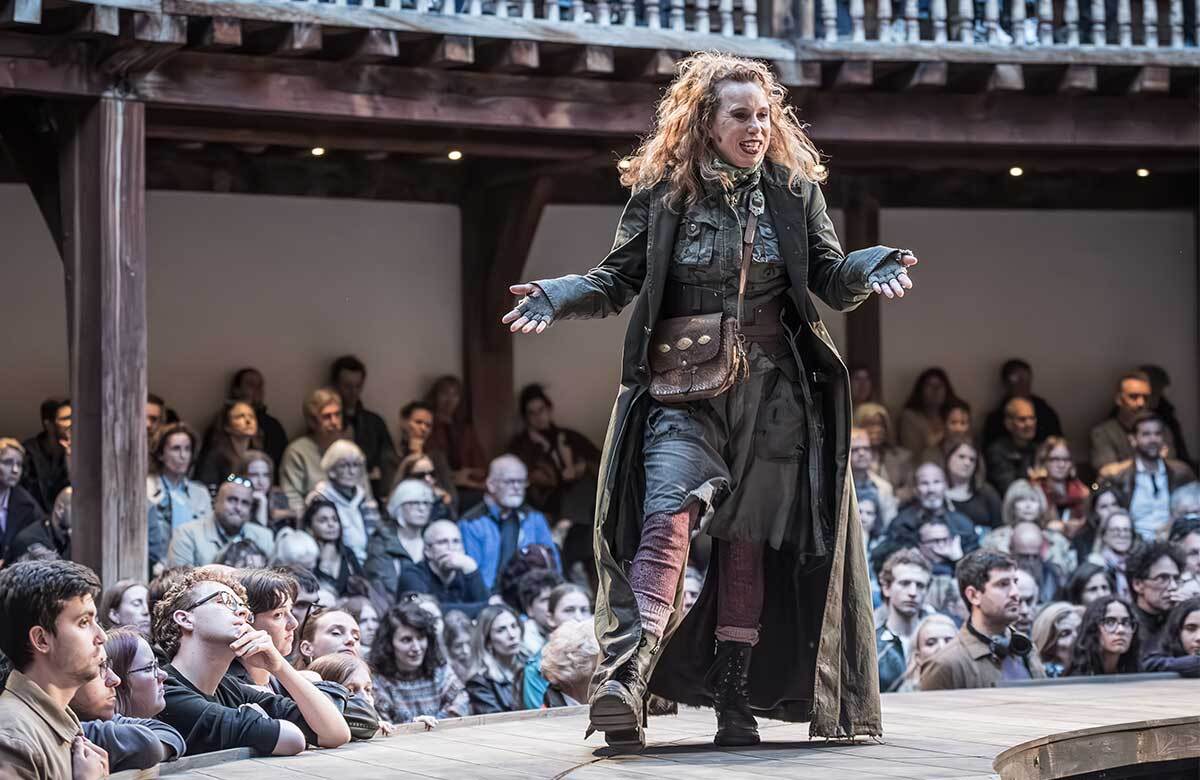
Michelle Terry as Mother Courage at The Globe Theatre. Photo: Marc Brenner

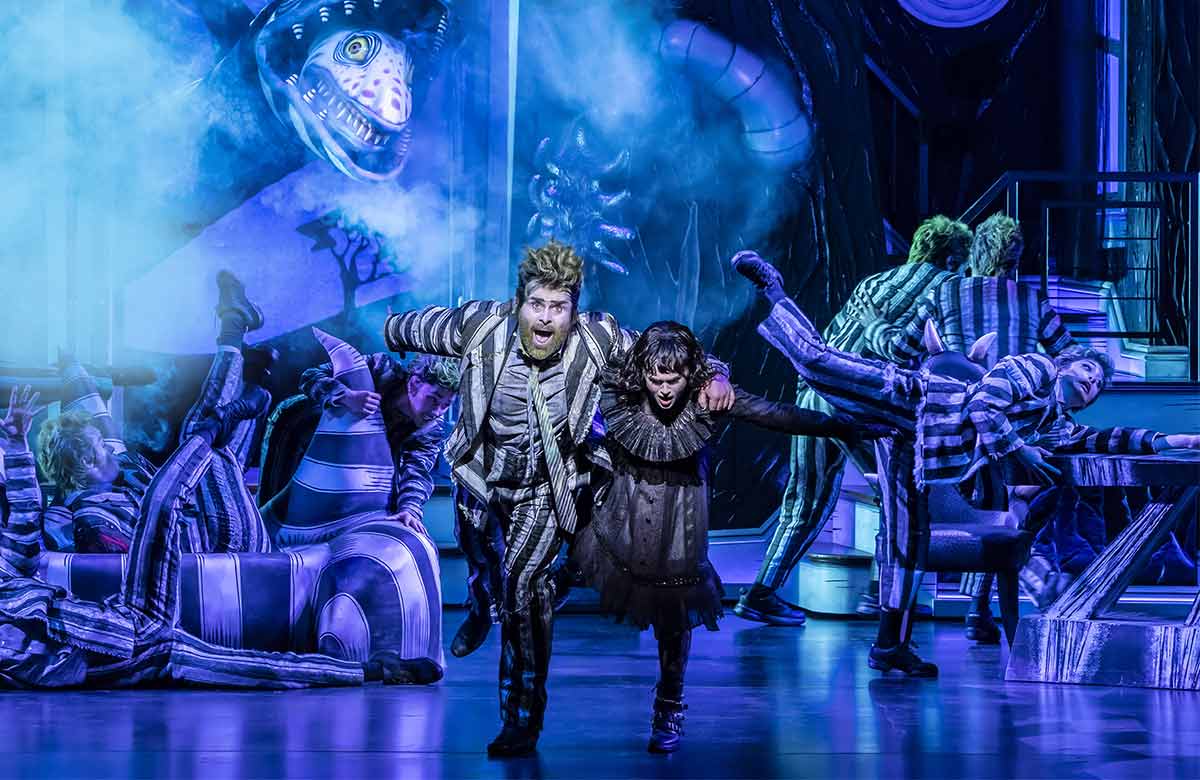
Running alongside A Midsummer Night’s Dream this summer, Shakespeare’s Globe is programming their first play by Bertolt Brecht. Many critics loved the emotional impact of Artistic Director Michelle Terry’s performance as Mother Courage and Anna Jordan’s gritty adaptation of the story of a woman trader who adapts to the horrors of war, but a minority felt Elle While‘s production wasn’t true to the author’s ‘epic theatre’ genre, intended to keep the audience at a distance. There were mixed opinions about the set and the singing, but the reviewers praised Vinnie Heaven, and Rawaed Asde and Rachelle Diedericks as the Children.

[Links to full reviews are included but a number are behind paywalls and therefore may not be accessible]

4 stars ⭑⭑⭑⭑

The Guardian’s Arifa Akbar contemplated the decision to veer away from Brecht’s intention: ‘This production … seems to break the first rule of Brecht’s epic theatre, which requires emotional distance. It conjures Brecht’s upside down world, in which war denotes order and profit, while underlining all the losses that Mother Courage faces in spite of her relentless entrepreneurialism and attempts at profiteering – selling anything from burgers to ammunition and sex. But it is human, moving and funny. The distance closes and the production becomes devastating in its most savage moments, when Mother Courage loses her children, one by one. Translator Anna Jordan justifies these moments by interpreting Brecht’s rule of verfremdungseffekt as making the drama “strange” rather than distanced. And in director Elle While’s powerful production, the emotional drama is tightly controlled, flaring up momentarily.’

Fiona Mountford for the Telegraph noted: ‘the Globe’s first ever foray into the German playwright’s work has two glorious weapons in its (pacifist) arsenal. The first is Anna Jordan’s astute and nimble adaptation and the second is artistic director Michelle Terry triumphing in the towering central role.’

‘At the heart of it all is Terry,’ agreed WhatsOnStage’s Sarah Crompton, ‘coarse, funny, shocking. She commands the space as she wheels and deals, sharp-eyed in search of a quick buck, a profit. She claims she is doing it all to survive, but Terry is good at communicating how alive it makes her feel’.

Holly O’Mahony at The Stage described Michelle Terry: ‘(her) superpower is her rare ability to slip into any part and seem born to play it – and this really is a winning turn. Utterly charming and manically chipper’.

Tom Wicker for Time Out said: ‘Terry is astonishingly good as Mother Courage. She’s bawdy, broken and ferocious, with a physicality always halfway between entreaty and attack.’

The Standard’s Nick Curtis praised other members of the cast: ‘There’s nice work too from Vinnie Heaven and Rawaed Asde as Courage’s sons, and a deeply moving performance from Rachelle Diedericks as her mute daughter Kattrin. But the show belongs to Terry. Her Courage is a flame-ringleted force, attractive in her crude energy, repellent in her lack of morals, fascinating in the unforgiving brusqueness of her motherly love. It’s a hardcore performance in a hardcore show that won’t be to everyone’s taste.’

Theo Bosanquet for LondonTheatre described the set: ‘Designer takis [sic] has taken the theme of dystopia and run with it, covering one pillar with oil drums and scaffolding, while the costumes are all filthy denims, torn vests and blood-caked overcoats.’

3 stars ⭑⭑⭑

The Arts Desk’s Rachel Halliburton noted ‘Elle While’s uncompromising production is like a Mad Max cabaret at the end of time, a post-apocalyptic vision of a world corrupted by violence and greed. The impact is heightened by a punchy, expletive-stacked translation from Anna Jordan that vividly demonstrates the corrosive impact of conflict on language.’ Her middling rating seemed surprising given the amount of praise she lavished but: ‘Trivial though it may sound to observe, if only the singing had been uniformly strong, this production would have been astonishing.’

2 stars ⭑⭑

The Times’ Clive Davis agreed about the music: ‘The Globe’s house style, all jaunty, ragged street melodies, one part jazz, one part folk, is beginning to sound threadbare.’ He made clear he doesn’t like the play, calling it: ‘drama that presses home the same grim message at length.’ He thought:broadway  ‘the lumbering version of Mother Courage and Her Children … is not going to do much to dispel Brecht’s reputation for being didactic.’ As if that wasn’t enough: ‘It doesn’t help that this production, designed by takis, lacks visual flair.’

Unlike The Guardian’s critic, Gary Naylor at BroadwayWorld was not so forgiving of the liberties taken with Brecht’s work. He didn’t think this genre of theatre worked in the Globe space: ‘The distance, strangeness and alienation that lies at the heart of Epic Theatre just can’t be established. It is impossible to avoid theatre’s history, theatre’s wonder and, most of all, theatre’s connection to its public at The Globe, built explicitly to place such thoughts at the heart of its work.’ In any case, he wasn’t keen on the production : ‘For all its ambition and Terry’s remarkable energy in portraying a remarkably energetic woman, the vision of this production never resolves into a clear picture, too sharp at some times, too fuzzy at others’.

Critics’ average rating 3.5 ⭑

Mother Courage and Her Children runs at Shakespeare’s Globe until 27 June 2026. Buy tickets directly from the theatre www.shakespearesglobe.com

If you’ve seen Mother Courage And Her Children at Shakespeare’s Globe theatre, please leave your review and/or rating below

Theatre review: Stage Kiss

Play within a play tickles both brain and funny bone

Hampstead theatre


⭑⭑⭑⭑

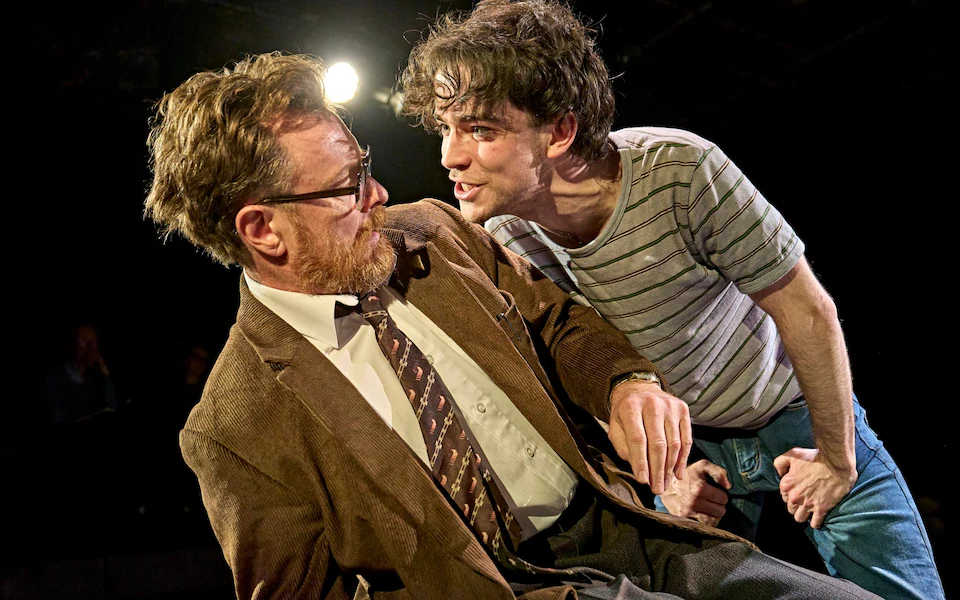
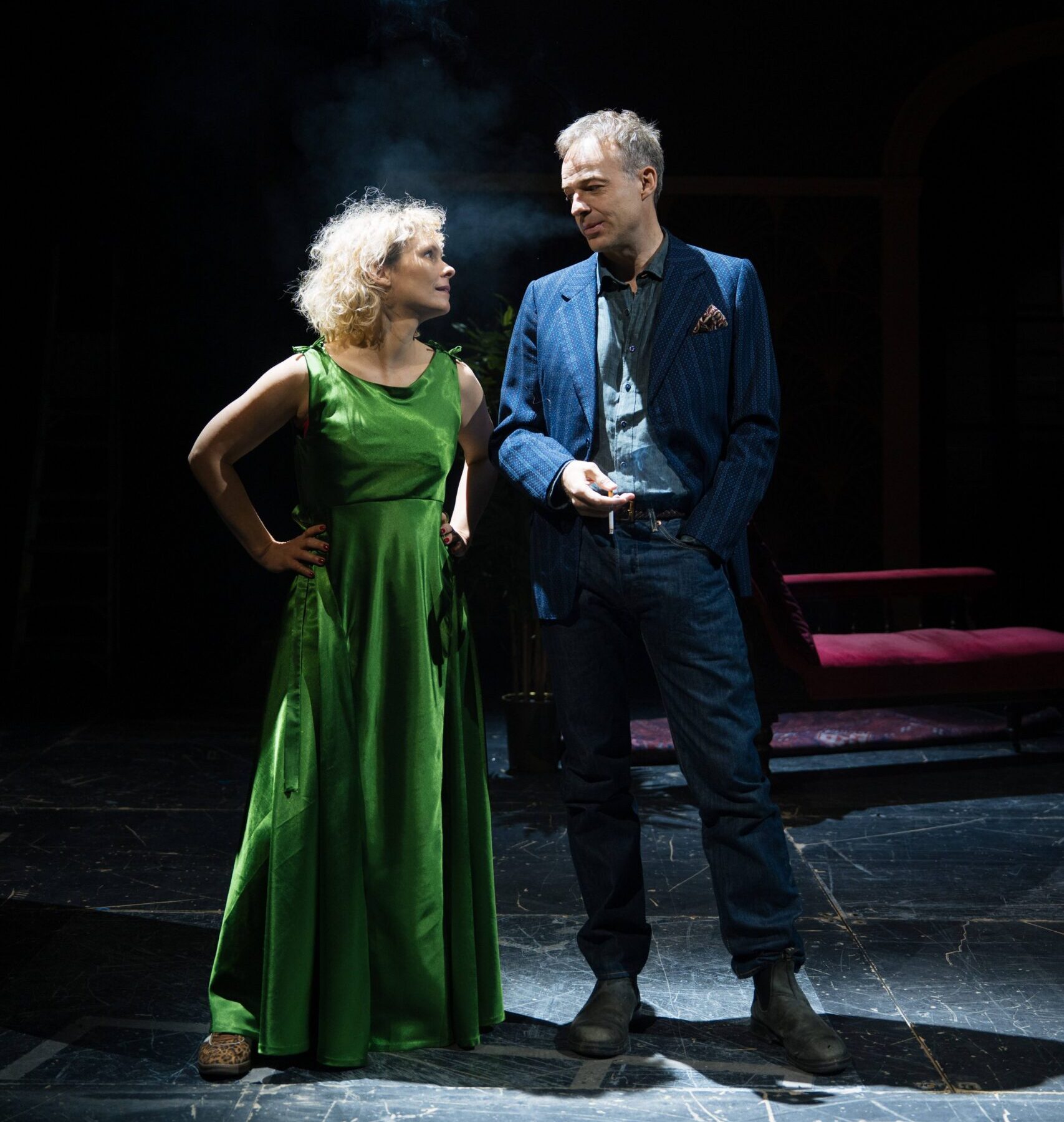
Myanna Buring & Patrick Kennedy in Stage Kiss. Photo: Helen Murray

We start with an audition. It takes place under full house lights, so, before we think about hiding in the darkness and immersing ourselves in the play, we’re reminded we’re in a theatre, and the people on stage are all actors. Don’t worry, the lights soon go down. We find out the play is going to involve kissing. What we don’t realise at this point is the blurring of boundaries between actors pretending to kiss and actors pretending to be pretending to kiss. In the first act we watch rehearsals and part of the performance of a revival of an dreadful 1930s musical comedy. Since the stilted dialogue can only be performed in a pompous way, you could say it’s a meal of corn and ham.

The spoof of a Cary Grant/Katharine Hepburn style screwball comedy is amusing and the mishaps of the rehearsals are genuinely funny.  There’s a director played by Rolf Saxon who refuses to direct (‘Follow your instincts’ he says), props waiting to be tripped over, songs that burst out from nowhere. Having said that, it’s not in the class of the great behind-the-scenes farce Noises Off.  In fact, I was getting a little bored with the theatrical in-jokes. Then it got a lot more interesting.

Stage Kiss is a clever comedy that delves into the nature of art. It turns out the two leads met years earlier and had a torrid affair, which is now reigniting, even as their characters in the play revive their earlier love. It is fascinating that what happens on stage becomes reality off stage, while conversely the actors’ real life affects their performance. The two leads are referred to as She and He, and the director as, well, The Director. Does this make them anonymous lumps of clay that authors and audiences can mould into whatever sculpture we like? Maybe.  Certainly, both change as the evening progresses, as does the setting. At first Myanna Buring as She is a ditzy blonde, then she’s a dominating actor. then she’s a broken woman. Patrick Kennedy as He is passionate, then arrogant, then childish.

The author Sarah Ruhl is definitely toying with the confusion between art and life. We are after all watching actors in a play pretending to be pretending to be kissing. At one point I was thinking He went off with She’s daughter in real life until I remembered that happened in the first play within the play.

In the second act, the two actors are living together and get involved in another not terribly good play this time set in the gritty 1970s but with dialogue to match that seems implausible to today’s ears. Once again the cast are convincing at being unconvincing.  A more aggressive relationship in the play reflects the lovers’ new real life issues. It’s all very meta theatre.

The kiss is key, because, while the two plays-within-a-play are awful, the kisses between He and She within them appear to be what we might call in the context real. This is made clear when the under-talented understudy, a delightfully goofy performance by James Phoon, tries to kiss She and looks like a python about to devour its victim. She then demonstrates how to kiss, using another cast member played by Jill Winternitz who subtly indicates how genuinely moved she is by the experience. But we can’t forget what is presented as authentic is still well rehearsed acting. To get all the levels to work so well is a considerable achievement by the actors and director Blanche McIntyre.

Just to throw us off balance further, the husband in the first play and the real husband in act two are played by the same actor, a calm, tolerant character on both sides of the curtain, performed to perfection by Oliver Dimsdale. The role The Husband plays in the twist is a reminder from the author that art is manipulation. It can fulfil our fantasies or reflect our more prosaic life.

The set begins as a bare rehearsal room but gradually fills up until designer  Robert Innes Hopkins presents us with a believable stage set for a 1930s play, and then a naturalistic apartment with a messy bed, that subsequently becomes another stage set.

This reinforces what Sarah Ruhl seems to be saying: that art and life merge in our own brains. “All the world’s a stage.” We create a story of our lives inside our heads and we bring real emotions to our experience of art. The problem I had with this funny and thoughtful piece of art is that the fate of the three principals didn’t arouse enough emotions in me. Even so, it is a pleasure to have one’s brain tickled as well as one’s funny bone.

Stage Kiss can be seen at Hampstead Theatre until 13 June 2026. Buy tickets directly from the theatre

Paul was given a review ticket by the theatre

Watch this review on the YouTube channel Theatre Reviews With Paul Seven

Read the roundup of other critics’ reviews

Theatre reviews roundup: Stage Kiss

Life imitating art- entertaining or boring

Hampstead Theatre
Myanna Buring & Patrick Kennedy in Stage Kiss.
Photo: Helen Murray

Sarah Ruhl‘s play Stage Kiss went down well in the US, so the UK premiere was much anticipated. In the event, the critics’ reaction was lukewarm. The play includes two plays-within-the-play which involve amusing parodies of rehearsals and the acting world. It also delved into the way emotion from art and real life can get confused, by us as well as the people on stage. Some critics thought this worked (‘profound..entertaining’ Time Out), others didn’t (‘borders on the bland, bloviating, and boring’ BroadwayWorld). The cast were praised: Myanna Buring as She, Patrick Kennedy as He, Rolf Saxon as The Director, Oliver Dimsdale as The Husband. The production is directed by Blanche McIntyre.

[Links to full reviews are included but a number are behind paywalls and therefore may not be accessible]

4 stars ⭑⭑⭑⭑

Nina Culley for Time Out found: ‘The dialogue is zigzagging, joyfully absurd with the right amount of twists. The tension between the hamminess of Act One and the grit of Act Two is a juxtaposition rarely staged this openly – and if it never quite commits to either, Ruhl’s comedy holds it together. In the end, what Stage Kiss leaves you with is something approximately profound, but above all, very entertaining.’

The Times’ Clive Davis called it a ‘light but droll comedy (that) delights in playing games with the audience.’ ‘Ruhl has enormous fun sending up the conventions of a period piece where a maid makes hurried entrances and the leads utter clipped, pseudo-worldly dialogue before breaking into the occasional song.‘ ‘MyAnna Buring and Patrick Kennedy are perfectly poised as the lovers. Rolf Saxon quietly steals scenes as the director, while the multitasking James Phoon wins well-deserved laughter as an inept understudy. Blanche McIntyre’s direction is attentive to every comic detail’. He ended: ‘Just when you think Ruhl is losing focus, you realise that she is still toying with us.’

Helen Hawkins at The Arts Desk spoke of Ruhl ‘niftily juggling meta themes with standard comedy of manners tropes as she probes the line where real life blurs with stage life. She brings a sly but warm, grounded humour to the material that allows the audience to sit back and enjoy the ride.’

’It’s playful but sincerely meditative’ summed up Miriam Sallon for WhatsOnStage.

3 stars ⭑⭑⭑

The Standard’s Nick Curtis noted: ‘There’s an interesting idea here, I think, about how we use actors as proxies to explore how life should be lived. But it gets stomped on by the galumphing comic business, which includes toppling pot-plants, onstage injuries and misfiring props, and the knowing staginess of it all.’

Dave Fargnoli of The Stage found: ‘While Buring and Kennedy nail the humour of their roles, the chemistry between them never quite convinces, always feeling strained. More believable and tender is She’s attachment to her husband, the surprisingly humble finance bro Harrison – given an aura of quiet acceptance by Oliver Dimsdale.’

2 stars ⭑⭑

Lucinda Everett for The Guardian liked the earlier part of the evening but: ‘Stage Kiss also has its sights set on the interplay between art and life – specifically whether onstage romance can conjure real feelings – and here it comes unstuck, thanks to some pointed but unsteady metatheatricality.’

Cindy Marcolina at BroadwayWorld didn’t pull her punches: ‘this is an uncomplicated, easy, unchallenging comedy for the easily pleased that borders on the bland, bloviating, and boring. Not only it’s too melodramatic for what it is, but it also contains so much surplus material that its two-hours-ten-including-an-interval could be streamlined into a 90-minute-straight-through by a dramaturg.’

Critics’ average rating 3.3⭑

Stage Kiss can be seen at Hampstead Theatre until 13 June 2026.  Buy tickets directly from the theatre

If you’ve seen Stage Kiss, please post your review and rating here

Theatre reviews roundup: Krapp’s Last Tape

An evening in the presence of greatness

Royal Court Theatre
Gary Oldman in Krapp’s Last Tape. Photo: Jack English

An hour an ten minutes might not constitute a full evening’s entertainment for some but for the critics it was a case of quality not quantity in this Beckett themed double bill. The main attraction was Gary Oldman who directed, designed and starred in Samuel Beckett’s Krapp’s Last Tape, which premiered at Theatre Royal York. All the critics, with one exception, lavished praise on his portrayal of an old man listening to himself on tape 30 years earlier and displaying surprise and disappointment at how life hasn’t turned out as he expected. The critics’ awe at being in the presence of Mr Oldman extended to universal references to his role as Jackson Lamb in Slow Horses, and the fact that the tape recorder was also used by Michael Gambon and John Hurt when they played Krapp.
The curtain raiser was a new play by 19 year old  Leo Simpe-Asante called Godot’s To-Do List, which was generally well received. In it, a young Godot (Shakeel Haakim) is detained by a voice giving him tasks to perform.

[Links to full reviews are included but a number are behind paywalls and therefore may not be accessible]

4 stars ⭑⭑⭑⭑

BroadwayWorld’s Aliya Al-Hassan was entranced by Oldman: ‘His performance in Krapp’s Last Tape is mesmerising: the role requires the actor to bring so much to the act of a cough, a sigh or eating a banana (or three) and Oldman imbues all actions with huge purpose’…(He) displays huge vocal skill; the recordings of his younger voice have a brighter, more lyrical tone, contrasting with the creaky gruffness of older age.’ She gave three stars to Godot’s To-Do List: ‘a fun and quirky opener’.

The Standard’s Nick Curtis analysed Gary Oldman’s performance: ‘Oldman’s Krapp (the scatology is deliberate) is a layered, nuanced investigation of Beckett’s low-key miniature. He mines pathos and comedy from a softening of the eyes or a tightening of the mouth as much as from the scanty text (…) watching Oldman eat a banana is mesmerising. The first thing Krapp does is devour two of them, deliberately and with relish. Emotions chase each other across his face: greed, melancholy, guilt (…) The ending, when Oldman stares ahead as the light dwindles on the quietly turning tape spools before him, is magnificent.’

The Independent’s Alice Saville pointed out: ‘This play is Beckett at his brilliant, merciless best, and Oldman’s staging brings out all its cruelty by showing how utterly destroyed Krapp has been by his own self-deluded ambitions (…) It takes a lot of genius and a lot of experience to convey oceans of complexity in a few short words – and Oldman’s return to Beckett does just that. It’s a profoundly weighty half an hour, saturated in regret and loathing for the youthful hubris that’s gone before.‘ She was critical of the choice of opener: ‘there’s also a juvenile crassness to its jokes about pig orgasms, and a flimsiness to its structure that can’t stand up to Beckett’s masterfully constructed monologue.’

The Telegraph’s Dominic Cavendish noted: ‘as he cradles the old reel-to-reel kit, and listens intently, and inscrutably, it’s as if Oldman’s derelict, largely desk-bound figure is trying – impossibly – to spirit himself into the words, and the warmer past, itself.’ He called Godot’s To Do List ‘simple but inspired’.

The Stage’s Sam Marlowe welcomed: ‘all the skill and presence you’d expect from Oldman is very much in evidence; bleakly absorbing.’ She commented on Godot’s To-Do List: ‘ Simpe-Asante has a confident command of theatrical gesture and language, and Haakim is engaging as the confounded everyman Godot.‘

Chris Wiegand of The Guardian thought the new play a worthy opener:  ‘Simpe-Asante laughingly considers, yet crucially does so with compassion, the sense that any of us could ever wield any kind of control in this world. It shows, at one point quite literally, a futile search to be in sync with your surroundings.’ About Krapp he said: ‘Oldman’s direction delicately captures a sense of nightfall, with the dying moments of Malcolm Rippeth’s lighting design creating a terrible pathos (…) A stillness concealing tumult is exactly what Oldman’s expression captures as the machine whirs almost like lapping water, and he picks over what is left behind in life when the tide goes out.’ Perhaps in an attempt to having to provide an average rating, Mr Wiegand gave no rating. I’ve assumed 4 stars because that was his rating when he saw it in York.

Tim Bano for The Financial Times commented on the curtain raiser: ‘You could read it as a piece about the tyranny of tech, how our watches now tell us when to stand up; you can see it as a warning about our inability to enjoy the present moment. Wry and smart, it finally explodes into a Beckettian flash of words about the meaning of existence.’  As part of his analysis of Oldman’s performance in Krapp’s Last Tape, he noted: ‘you can almost see those small scenes from his life drift across his eyes, his face responding with expressions of fondness, then dismissal, before a final staring sadness as he fades slowly to black.’

‘Simpe-Asante has created something fresh and modern’ noted Olivia Rook at LondonTheatre before moving on to the main event: ‘It is an understated performance that requires patience from its audience — much of the time Oldman is chuckling or grunting at something his former self has said; in other moments, he sits in silence.’

3 stars ⭑⭑⭑

Was the lavish praise of Gary Oldman in the 4-star reviews a case of the Emperor’s new clothes (or in this case a Jackson Lamb style ‘grubby shirt’)? The Times’ Clive Davis declared himself ‘slightly underwhelmed’.  He noted: ‘Much of the time Oldman strikes impassive gestures as he spools back and forth on his old school reel-to-reel machine’. He liked the opener: ‘a little like hearing the lugubrious Beckett given a generous dose of laughing gas.’

Critics’ average rating 3.9⭑

Krapp’s Last Tape can be seen at the Royal Court theatre until 30 May 2026. It’s sold out but returns and Monday rush tickets may be available from royalcourttheatre.com

If you’ve seen this double bill at the Royal Court, please leave a review and/or rating below

Theatre review: 1536

Delightful and devastating, controlled and convincing drama

Ambassadors Theatre


⭑⭑⭑⭑⭑

Tanya Reynolds, Siena Kelly, Liv Hill in 1536. Photo: Helen Murray

Don’t be fooled by the posters showing women in smart Tudor dresses. SIX it ain’t. 1536 is the year Henry the 8th accused his wife Anne Boleyn of treason and killed her. Ava Pickett’s play imagines the effect this might have had on women at the lowest levels of society, and, by implication, how the behaviour of powerful men today might influence other men in their attitude to women. And what a well written, superbly acted drama, it is.

It looks at three, I suppose we’d call them, peasant women- their camaraderie, their mutual support, and their ultimate downfall at the hands of men, who are emboldened by the King’s actions. It starts out with some very funny scenes as Ava Pickett’s fast-moving, scintillating dialogue establishes the characters of the women, but it ends in overwhelming tragedy.

Anna played by Siena Kelly enjoys sex. She knows she looks attractive and makes sure she exploits what she sees as an asset. It’s her power over men. She has a sharp tongue and a ribbing sense of humour. The butt of her jokes is usually Jane, played by Liv Hill, Anna’s polar opposite: slow-witted, shy and a virgin. Tanya Reynolds plays the conciliatory Mariella, a worldly midwife saddened by thwarted ambitions.

It’s a joyous portrait of female friendship. The conversation between them is so easy and natural- they speak like modern Essex women (Ms Pickett is from Colchester), which adds to the sense that you could bump into them on a night out.

Then they are shaken by the news (two days old) that the King has imprisoned the Queen. They find it impossible to believe. Inevitably rumours abound but the word is she has had many lovers, including her brother. She may even have plotted to assassinate the monarch. Can it be true? It doesn’t matter. If the King says it is, it must be.

We meet two of the men in their lives. Richard, played by Oliver Johnstone, is one of Anna’s lovers, even while he is courting Jane (for her dowry). George Kemp is William, a married property owner who has a relationship with Mariella. Both appear to be mild mannered.

When things start to go wrong, the male hierarchy follows the King’s example. Anna is labelled a whore while Richard is seen as having been seduced. The other two are also treated badly and (what’s new?) not believed. It’s clear men call the shots and the play proceeds to become very dark indeed, as the bonds with men on which the women relied start to break. As in any oppressive society, the oppressed women not only take the blame for men’s wrongs but start to turn on each other.

It would be so good to be able to say how much society has changed. Shamefully, far too many of today’s powerful men set an example of verbal and physical abuse of women.

Tender and tragic

Liv Hill, Siena Kelly & Tanya Reynolds in 1536. Photo: Helen Murray

All this is acted out on a single set cleverly designed by Max Jones. Clumps of dry trodden down grass, a dead tree and scrubby bushes symbolise the oppressive country. It is meant to be excessively hot, and we feel the heat that is beating the women down at the same time as it stirs the men to cheer the execution of the King’s wife without ever questioning her guilt. Then as now people in power control the information, and gossip (for which read social media) whips up the fake news.

The lighting by Jack Knowles contributes to the atmosphere, and between scenes plunges us into impenetrable blackouts that parallel the darkness in which the local population is kept.

It’s a stunning achievement for a debut play. Credit to the Genesis Almeida scheme for commissioning it, and to the Almeida for this pacey production directed by Lyndsey Turner. West End transfers from small theatres sometimes don’t work but the Ambassadors is appropriately intimate. 1536 is tender and tragic, delightful and devastating, controlled and convincing.

1536 can be seen at The Ambassadors Theatre until 1 August 2026.

Paul was given a review ticket by the producer.

Read a roundup of other critics’ reviews of 1536 here

Click here to watch a video of this review on the YouTube cahnnel Theatre Reviews With Paul Seven

Theatre review: Mass

Grief, guilt & hope in gripping play about a school shooting

⭑⭑⭑⭑⭑

Adeel Akhtar, Lyndsey Marshal, Monica Dolan & Paul Hilton in Mass. Photo: Richard Hubert Smith

Two couples meet six years after a mass school shooting in the USA that left both their teenage sons dead. In this gripping play about grief, parental love, anger and forgiveness, there are depths of emotion in Fran Kranz‘s Mass that are hard for those of us watching to take. There were moments when I felt I couldn’t breathe. I don’t think I have never been among an audience so quiet.

The production is an extraordinary coming together of script, direction, design and acting. First, the cast. There are some actors so magnetic that they dominate a play with their star quality. Then there are actors- sometimes called character actors- who are so good at immersing themselves in a role that they become one among equals. That’s not to say that the main actors in Mass can’t lead a play- they can and have- but what is valuable about them in an ensemble play like this is that they don’t bring baggage. And that enables you yourself to become immersed in what seems like a real conversation told verbatim.

A couple who lost their son are meeting the couple whose son was the shooter and who killed himself. Jay and Gail, parents of their murdered boy Evan, bring grief and anger to the round table and confront the parents of the killer. Inevitable questions are asked: did they not realise their son was a potential killer, couldn’t they have done something to prevent it? In response, Richard and Linda express their sorrow, their incomprehension at how their son Hayden became a killer, and their own guilty grief at his loss.

Adeel Akhtar‘s Jay is clearly a civilised, liberal man- he offers water and worries about recycling- but at times cannot control the animosity he feels. Lyndsey Marshal‘s Gail is an empty shell. Paul Hilton‘s Richard is stiff and defensive but has a downcast face, racked with sorrow. Monica Dolan‘s Linda is so upset at what became of her little boy that her tears seem wrenched from deep inside her. Both mothers are especially moving when they remember their sons as young children.

You can’t look away from this impeccable production

Mass at The Donmar. Photo: Richard Hubert Smith

It is essential to maintaining the tension that there is no break in continuity in Carrie Cracknell‘s impeccable production, so the participants remain seated for nearly the whole exchange. That’s rare in itself because so many directors seem to make the actors walk up and down just to keep it interesting. Consequently, to avoid us having to look at the back of someone’s head the whole time, there is a revolve that moves imperceptibly but turns them round regularly so we get to see all their faces, and you can’t look away from all the pain they are expressing.

The play is set in the meeting room of a church, ironically a soulless piece of modern architecture with lots of glass and light but no human touch. This is expertly conjured by designer Anna Yates, who shows us the mundane kitchen and corridors and stairs outside the room. As if to emphasise the way something extraordinary can happen in the middle of something quite everyday, at the start and end of the play, the room is set up and cleared by other characters played by Rochelle Rose, Amari Bacchus and Susie Trayling.

This is not a play of despair. Yes, Fran Kranz, who made the 2021 film on which this is based, examines reactions to tragedy, but he also explores the concept of restorative justice. This is where the play takes on a greater dimension. We may not live in the USA- mass killings are far less common here in the UK. They do happen nevertheless. But we are also part of a world in which war and terrorism breed more of the same. And at an individual level, people cope with the results of knife attacks, dangerous driving and more. Loss leaves people seeking retribution, but the resultant resentment and revenge can destroy us. Reconciliation, where the perpetrators admit their guilt and the victims forgive, offers hope that, instead of being consumed by grief, the parents can live alongside it. There is no sense that this is an easy or a complete answer but the understanding the couples gain about each other in the course of the play offers the prospect of peace.

This is an important play. Fran Kranz, Carrie Cracknell and the extraordinary cast of Mass have given us an insight into the anguish of loss and the possibility of hope. The characters may be made up, but the tears we shed at the end are real.

Mass can be seen at the Donmar Warehouse theatre in London until 6 June 2026. Tickets from https://www.donmarwarehouse.com/
Paul paid for his ticket.

Click here to watch the video of this review on the YouTube channel Theatre Reviews With Paul Seven

Theatre reviews roundup: A Midsummer Night’s Dream

Happy Dream

Shakespeare’s Globe
Michael Grady-Hall in A Midsummer Night’s Dream. Photo: Tristram Kenton

Only a few months after The Globe’s last Dream, not to mention the Bridge’s revival of their Dream and an RSC production at The Barbican, London has yet another version of Shakespeare’s popular comedy. Only this time it’s less dark and a lot more frivolous, as all the critics agreed. Emily Lim has a reputation for involving communities in theatre, and she applies her skills and experience to a production that involves the Globe audience in a lot of fun.

[Links to full reviews are included but a number are behind paywalls and therefore may not be accessible]

4 stars ⭑⭑⭑⭑

Miriam Gillinson for The Guardian loved it: ‘It’s generous, creative and clever, always with an eye to making the audience feel included. With gloriously extravagant costumes (concept by Fly Davis), a set that spontaneously blooms from designer Aldo Vázquez, hearty folk music by Jim Fortune and effervescent comic performances, this is the rarest of things: a Dream the whole family can enjoy.’

Rachel Halliburton at The Arts Desk declared: ‘It’s a Dream that’s very much in the Globe’s tradition of crowd-pleasing entertainment, filled with music, laughter, and appropriately absurd audience participation.’

LondonTheatre’s Aliya Al-Hassan was transported: ‘It’s true that we never feel the nervousness of the lovers alone in the forest, nor any of the potentially unsettling aspects of the text. But shying away from the darker sides of the play feels more than appropriate for these troubled times, and this Dream is perfectly frivolous summer fare.’

Clementine Scott at BroadwayWorld felt: ‘This version of Dream is something close to a folk musical, with original songs by Jim Fortune. The inherent artificiality of musical theatre, breaking into song and such, works well with the general sense of performance, and of witnessing some sort of deftly choreographed ritual.’

Time Out’s Andrzej Lukowski was charmed: ‘it uses the Globe’s large, lairy crowd to maximum impact for a production that cheerily deviates repeatedly from Shakespeare’s exact text in a joyous, almost non-stop welter of audience interaction.’

The Standard’s Nick Curtissurprised himself: ‘It can be played dark or light. In Lim’s hands it’s a sunny show, decked with trippy flowers and colourful costumes, where the undercurrent of horror is only faintly implied. There’s copious audience participation, however, which is usually my very idea of horror but works surprisingly well here.’

Calling it ‘irresistible fun’, The Financial Times’ Sarah Hemming said the production ‘emphasises the theatricality and communality of Shakespeare’s comedy. Lim, who has previously worked on large-scale public-interaction theatrical works, foregrounds the role-play in the story and celebrates the transient community created by live theatre.’ She noted: ‘In the programme, Lim talks about “joy as a radical act” that can bind communities together. That’s what she delivers, and it feels pretty necessary right now. ‘

The Times’ Dominic Maxwell praised: ‘Grady-Hall…proves a clown of twinkling restraint. I say “restraint” — his Puck sports green tights adorned by table-tennis balls. Yet he plies his quirkiness calmly and plays the audience like a musical instrument as he encourages different sections to sing different notes on his cue. And that’s the key to the success of an evening that’s not so much good drama as a good time.’

Theo Bosanquet for WhatsOnStage overcame his reservations: ‘it feels the narrative is sublimated to the showmanship, the darker and more poetic aspects of the play drowned out in a (literal) sea of bubbles. But this is forgivable in a version that feels unapologetically fun, escapist and, I daresay, well-judged for the current times.’

3 stars ⭑⭑⭑

The Telegraph’s Dominic Cavendish was the only notable critic not to immerse himself in the lovefest, describing it as a ‘rainbow-colourful, strenuously frisky al fresco version, glutted with audience participation. Yet, for all the admirable industry and invention of Emily Lim’s production, at times I felt as if I’d been trapped in Butlin’s rather than spirited away to an enchanted forest outside Athens (…) The cast seem to be having a ball – many Globe-goers will, too. I just wish there was a bit more trust in the Bard to work his own magic.’

Critics’ average rating 3.9⭑

A Midsummer Night’s Dream can be seen at Shakespeare’s Globe until 29 August 2026. Buy tickets directly from the theatre.

If you’ve seen this production ofA Midsummer Night’s Dream at Shakespeare’s Globe, please leave your review and/or rating below

Theatre review: Magic

Not enough magic in David Haig’s tense drama

Chichester Festival Theatre

⭑⭑⭑

Hadley Fraser, Jenna Augen & David Haig in Magic. Photo: Manuel Harlan

Magic- the art of creating something believable that seems inexplicable. The magic of an illusionist like Houdini. The magic of spiritualism. The magic of actors creating real people.  There are many kinds of magic explored and linked in David Haig‘s play Magic at Chichester Festival Theatre, about the time Sir Arthur Conan Doyle met Harry Houdini. The concept is genuinely interesting, and well acted. But is it magical theatre? I’m afraid not quite.

The play is about a search for truth (something even more urgent today than then, I suspect). Doyle, the creator of Sherlock Holmes, and Houdini, the world’s greatest illusionist, form a friendship because both are genuinely interested in whether those they love live on after death. They both would like spiritualism to be the answer. Doyle, the creator Sherlock Holmes, turns out to be far more gullible than Houdini, who is cynical because he is well versed in the tricks of his own trade.

First a word about spiritualism. It was a religious movement, popular in the US and the UK, that gained a lot of traction after the First World War when people were grieving for dead sons, not to mention the many who died in the great Influenza outbreak of 1919. More than a simple belief in ghosts, spiritualists at the time thought that the spirits of people who die live on in the afterlife and can be contacted to guide or comfort us, through mediums. Already a spiritualist, Sir Arthur became an even more fervent believer after the loss of members of his family, in particular his beloved son Kingsley who was killed in the Great War. Houdini was devoted to his dead mother and dearly wished to be able to communicate with her.

It’s a drama loosely based on a true story. The true bit being that Doyle and Houdini formed a friendship back in the 1920s, based on mutual admiration and a common interest in the afterlife.  In the play, it becomes strained because Doyle’s obession with spiritualism led him to refuse to believe evidence that magic did not exist (he was even convinced that some of Houdini’s tricks involved genuine dematerialisation). The illusionist showed an equally obsessive determination to expose fake mediums’ ruses. Unfortunately for their friendship, this included the medium who apparently united Doyle with his dead son, and the writer’s own wife who pretended to receive messages from beyond the grave. In real life, they became distant enemies but in the play their residual mutual admiration means they maintain a fractious friendship that adds a real tension to the drama. That’s a trick of the writer’s trade- conflict being the driver of great stories.

David Haig, who wrote the script, plays Doyle. Hadley Fraser is Houdini. The pair exude both warmth and grief.  Haig plays Doyle as a good chap, who, as an ex-public schoolboy, has been taught to contain his complex emotions, but can’t hold back his enthusiasm and his desperation. One of the many tricks of his trade as an actor is a twinkly-eyed smile that he deploys to magical effect. Hadley Fraser is appropriately stocky, pugilistic, thin-skinned and burning with passion, much like a bulldog puppy.

Tricks of the trade

Jenna Augen and Claire Price provide sharp depictions of their highly supportive wives, Bess Houdini and Jean Conan Doyle. Although the humorous down-to-earth New Yorker and buttoned-up middle class Brit are in sharp contrast, they too form a friendship, and provide us with a useful break from the intensity of the main characters. Jade Williams is a suitably melodramatic medium.

There is poignancy to the play. It shows us the depths of grief and what it can do to us, be it heartbreak or obsession. So there is theatrical magic in the story of these two characters’ friendship, and that’s where David Haig’s script and Lucy Bailey‘s production scores. Where it goes wrong is when it tries to show us the magic of seances and illusions.

We can only imagine the spectacle and showmanship of Houdini’s shows. Trying to show us this on the limitations of a theatre budget is a mistake. We begin with Houdini performing one of his great escapes- he is suspended upside down while releasing himself from handcuffs. Far from causing my jaw to drop, all I could manage was a shrug. If he’d been in chains and underwater, then maybe… Similarly, near the end, he appears to walk through a brick wall, but of course it’s a piece of scenery, presumably made of wood not brick, and there isn’t time for the kind of buildup that Houdini would have given such a main event.  Having said that, there are many lovely little touches, for example when Harry is sitting chatting and casually makes a playing card appear and disappear in his hand. Credit to illusion designer John Bullein.

A couple of seances are recreated, and are more comical than spine-tingling, Carrying them out partly in the dark simply left me in the dark as to how Doyle could fall for them.

Add to this, Chichester’s large thrust stage is set out with a proscenium arch at the back to remind us, that Houdini’s act and the seances, and indeed the play itself, are all theatre. Joanna Parker‘s design is lovely but again a low budget of four or five vaudeville showgirls moving lightweight scenery around doesn’t make for theatrical magic. I’m sad to say, it just looks half baked.

A difficult decision no doubt, but I think this intimate drama would have worked better in Chichester’s smaller Minerva Theatre.

Magic can be seen at Chichester Festival Theatre until 16 May 2026. Buy tickets directly from the theatre
Paul was given a review ticket by the theatre.

Click here to watch this review on the YouTube channel Theatre Reviews With Paul Seven


Theatre reviews roundup: Grace Pervades

Ralph Fiennes’ love letter to theatre

Theatre Royal Haymarket
Miranda Raison & Ralph Fiennes in Grace Pervades. Photo: Marc Brenner

A second David Hare play hits the West End. Grace Pervades, transferring from Theatre Royal Bath, is very different to Teeth ‘n’ Smiles, the latter centring on a 60s rock band, the former on the leading 19th century actors Ellen Terry and Henry Irving. It seems superfluous to say that the two leads Miranda Raison and Ralph Fiennes received high praise. The critics’ reaction to David Hare was more mixed (‘great humour and excellent control’ WhatsOnStage); ‘It’s easy to admire the craft here, but you engage at a distance’ (The Stage).

Links to full reviews are included but a number are behind paywalls and therefore may not be accessible]

4 stars ⭑⭑⭑⭑

WhatOnStage’s Sarah Crompton declared: ‘Hare writes a love letter to theatre itself, at a time when it was defining its journey into the next century. He does so with great humour and excellent control, beautifully conducted by director Jeremy Herrin.’

The Times’ Clive Davis was diverted by it : ‘It’s a quirky, anecdotal piece which, at its best, is much more amusing than you might expect.’  It was, he said, ‘An evening that celebrates the art of illusion weaves one shimmering backdrop after another.’

The Telegraph‘s Dominic Cavendish thought: ‘David Hare’s genteel homage to (Terry and Irving), and to the changing face of theatre itself, elicits a delightful double-act from Ralph Fiennes and Miranda Raison; he the model of distinguished propriety, she the radiant antidote.’

3 stars ⭑⭑⭑

Broadway World’s Aliya Al-Hussain wrote about the leads: ‘Ralph Fiennes and Miranda Raison are beautifully paired as the couple, with Raison’s Ellen giving warmth and encouragement to Fiennes’s intense and serious Henry’; ‘Raison radiates life and ambition; her world view is much broader than just the theatre and she reflects that life experience on stage.’

Julia Rank at LondonTheatre pointed out: ‘Jeremy Herrin’s production is on the leisurely side and indulges Hare’s tendency towards exposition, with some unnecessary interludes. We’re informed that Irving and Terry were magic in performance and it’s a mistake to try to recreate snatches of their most famous Shakespearean roles with a style that now comes across as mannered.’

Tom Wicker from The Stage said: ‘Raison is luminescent as Hare’s take on Terry, bringing a quicksilver intelligence and a hard-won smile in the face of challenges.’ But he thought: ‘Hare’s writing is typically elegant and artful. It’s as carefully framed as Herrin’s staging…It’s easy to admire the craft here, but you engage at a distance.’

The Standard’s Nick Curtis called it ‘a warm, entertaining love-letter to a blended family of British theatrical pioneers, in which Ralph Fiennes sends himself up delightfully.’ He concluded: ‘Some may wonder why the once-radical Hare is wallowing in heritage theatre, but in fact this is anything but. Under all the period trappings and self-referential lines it’s a celebration of the protean spirit of the stage and the committed, charismatic, animating figures – like Irving and Fiennes – who keep it alive and push it forward. Sit back, relax, enjoy.’

Tim Bano at Time Out decided: ‘It’s all good fun, a cheeky, self-referential and sometimes self-critical play. Never exceptional, but nor too dull, Hare’s play becomes a sweet panegyric, and a really traditional, really entertaining night both at the theatre and of the theatre.’

2 stars ⭑⭑

The Independent’s Alice Saville counterblasted: ‘Hare clearly loves theatrical history. But he doesn’t let his audience love it too, because he’s too obsessed with overlaying it with his own agenda of old (good) versus new (diabolical). Jeremy Herrin’s production feels as stiff and mannered as the traditions that Edward Gordon Craig tried to sweep away. The new may be shocking, but at least it’s rarely quite this boring.’

Critics’ average rating 3.3⭑

Value rating 27

Grace Pervades can be seen at Theatre Royal Haymarket until 11 July 2026. Buy directly from www.gracepervadestheplay.com

If you’ve seen Grace Pervades, please leave are review and/or rating below

Theatre reviews roundup: Mass

Definitely powerful, possibly predictable

Donmar Warehouse
Adeel Akhtar, Lyndsey Marshal, Monica Dolan & Paul Hilton in Mass. Photo: Richard Hubert Smith

Fran Kranz’s Mass, receiving its world premiere at The Donmar, is based on his film of the same name. WhatsOnStage said ‘the immense courage of people who, in real life, attempt to reach forgiveness and understanding is the propulsion for the play’. The people in question are two couples who have both lost their sons in a mass shooting, and meet in attempt at reconciliation. The critics agreed it was a gut wrenching evening, with credit given to the four lead actors: Adeel Akhtar, Monica Dolan, Paul Hilton and Lyndsey Marshal. Director Carrie Cracknell was also praised for the intensity of the production. They disagreed about the script: masterful’ (LondonTheatre), ‘predictable ‘ (The Stage).

5 stars ⭑⭑⭑⭑⭑

WhatsOnStage‘s Sarah Crompton was impressed: ‘Four people sit around a table and talk. Franz Kranz’s lacerating play Mass is built from the simplest and least theatrical of ingredients. Yet in this production, thanks to the skill of director Carrie Cracknell and the intense naturalism of its cast, it becomes something very special.’ She continued: ‘once the characters begin to speak, the essential communion of theatre works its alchemical power; it is impossible not to listen and feel the terrible moral dilemma that gradually unfolds.’ She described the lead performers in detail: ‘Akhtar makes Jay a man who is being eaten from the inside by his anger and his sense of injustice…Hilton’s Richard is similarly hollow…Dolan creates a portrait of a woman in whom sadness is stretched to breaking point…Her entire body seems taut with pain…As Gail, Marshal is equally powerful. Her face seems made of glass, emotions passing across it as she listens intently to everything that is being said.’

Cheryl Markosky for BroadwayWorld described it as ‘simple, but also searingly powerful’. She explained: ‘What it comes down to is a thoughtful script, excellent direction and brilliant performances from all of the actors. They’re all commendable ­– although Dolan is particularly phenomenal as a trembling wreck about to fall apart at any second.’ She found ‘The intimacy of the 250-seater Donmar Theatre is perfect for Mass. We’re up close with the actors, witnessing pain, horror and guilt etched on their faces. Their pain is our pain’.

4 stars ⭑⭑⭑⭑

The Guardian‘s Arifa Akbar said: ‘It is hard to beat the force and sensitive performances of Kranz’s film but Hilton is masterfully brittle, his entire being sunken with apology, while Dolan is whey-faced and shaky. The always brilliant Akhtar is angrier and edgier than his film counterpart and Marshal brings a moving softness.’

The Independent‘s Alice Saville called it ‘an agonisingly intense, beautifully performed study of a couple’s search for forgiveness.’ She concluded that the play ‘really does shine on the Donmar’s small stage, where an audience can see close-up how a single space shifts from an impersonal meeting place into an almost spiritual site of reconciliation. Words are never enough, but they can still reduce a room to tears.’

3 stars ⭑⭑⭑

Holly O’Mahony for LondonTheatre declared: ‘It’s a masterful piece of writing from Kranz: every utterance counts, and each line is a turn of a cog that keeps this grim yet poignant narrative moving.’ On the other hand: ‘However, Carrie Cracknell’s production can feel hands-off, perhaps through an intention to let the text breathe. Unlike James Graham’s Punch, which also tells a story of restorative justice, but paints a fuller picture beyond the brave meeting at its centre, here we really do just watch two sets of parents hash things out at length, which grows monotonous.’

While calling it ‘powerful stuff, for Time Out‘s Andrzej Lukowski also made the comparison: ‘the elephant in the room is James Graham’s recent Olivier-winning play Punch. The plot isn’t identical to Mass. But his Nottingham-set restorative justice drama about a killer confronting his victim’s parents is undoubtedly in the same ballpark, and it’s simply a stronger, more culturally relevant play.’

The Times’ Clive Davis thought: ‘The Donmar Warehouse is the perfect place to see a play as stark as this. The audience sit uncomfortably close to the actors, and an almost imperceptible slow revolve on Anna Yates’s set ensures that we have ample time to study the characters’ anguished reactions (…)It’s almost like reading a real-life transcript, which is both the strength and the weakness of the piece.’

The Stage‘s Sam Marlowe had a problem: ‘once we’ve got to grips with the premise, the drama can only really move in one fairly predictable direction, via pretty much all the emotional milestones you’d expect.’ Having said that, ‘Carrie Cracknell’s production is immaculate – delicate, raw, finely calibrated and faultlessly acted by a stunning cast. The sheer force of the human pain and helplessness laid before us lends the writing a propulsive power.’

Claire Allfree for the Telegraph felt let down:  ‘It’s wrenching to watch, and beautifully performed’ she said, but ‘Kranz’s play draws superficially on the moral complexity of restorative justice, but in truth merely takes the audience through the emotional gears.’  In summing up, she said it strives ‘for emotional impact at the expense of genuinely provocative ideas.’

Nick Curtis’ review in The Standard began promisingly: ‘This gruelling play…is a sincere exploration of a process of restorative justice following a US school shooting. The stage version is realised with crystalline focus by Carrie Cracknell and acted with deep, pressing conviction by a central quartet of fine actors.’ However: ‘it’s too slick, too facile, a neat emotional workout for actors and an easy win for a smugly liberal audience.’ As for the hopeful ending: ‘it feels lazy and hollow.’

Critics’ average rating 3.6⭑

The Mass can be seen at the Donmar Warehouse until 6 June 2026. Buy tickets directly from the theatre

If you’ve seen The Mass at The Donmar, please leave your review and/or rating below
×