She Did It! Rachel Kavanaugh’s production and newcomer Keziah Ibe’s Eliza hit the right notes
Chichester festival Theatre
⭑⭑⭑⭑
Keziah Ibe & Hadley Fraser in My Fair Lady. Photo: Johan Persson
Let’s start at the beginning. Except, where is the beginning? The overture is missing! I love an overture. It sets the mood and fills you with anticipation.
But it seems churlish to complain when Rachel Kavanaugh‘s production plunges you straight into the uplifting story of an impoverished cockney flower seller called Eliza Doolittle. She soon encounters and confronts Professor Henry Higgins, an expert in phonetics. The musical establishes their characters from the get-go, so we the audience glimpse from the start the quality of the two stars on which the musical stands or falls.
Higgins is entitled, lacking social skills, self centred, insensitive and misogynistic but in Hadley Fraser’s hands, this is leavened by his child-like enthusiasm. He’s often shown in production as stiff and distant but here his sheer bullheaded enthusiasm- and Groucho Marx-like postures- make him more loveable than expected.
Eliza is feisty and ultra aware of her inferior position in society. Keziah Ibe, making her theatrical debut, gets the mix right. And she nails the first big song of the night Wouldn’t It Be Loverly? That’s a relief because a lot of big songs are coming her way, which she goes on to sing beautifully and with expression.
So it’s game on as Higgins and his friend Colonel Pickering set about transforming this ‘squashed cabbage leaf’ as he calls Eliza into a Lady. It’s worth noting that Eliza initiates the process by offering to pay for lessons- an entrepreneurial move that flies in the face of Higgins’ sexist views, as expressed in Why Can’t A Woman Be More Like A Man?
This is the first time 60 year old Chichester Festival Theatre has presented My Fair Lady. So how do the open spaces of the huge thrust stage with no capacity to fly in scenery convey the spectacle? Not with big sets. The lavish Embassy Ball at which the transformed Eliza triumphs is represented by, in effect, a few standard lamps, the ‘street where she lives’ is two lengths of iron fencing, Ascot Races an empty stage. The Chichester ‘wow’ factor, picking up from the musical’s use of the ensemble to provide a kind of Greek chorus, is to fill the stage with people.
So we have Gary Milner as Eliza’s dustman father Alfred P Doolittle leading an exuberant chorus of around twenty through Stephen Mear’s complex choreography in With A Little Bit Of Luck and I’m Getting Married In The Morning, as well as a more restrained but still impressive circle of racegoers. It’s not completely sparse of scenery. There is one magnificent set, namely Henry Higgins’ study. Designer Peter McIntosh has created a massive truck that sweeps on and off stage, full of cluttered corners and different levels for the actors to weave and jump through.
It’s easy to understand why some consider My Fair Lady the perfect musical. Lerner and Loewe‘s songs consistently reveal character or advance the narrative, possibly even more so than those of the great Rodgers And Hammerstein who invented the modern musical. And they’re nicely played by a small orchestra under Cat Beveridge.
Keziah Ibe performs the songs with great eloquence. Her high point is also the apex of the musical itself, the moment when she is so excited at getting the pronunciation right in The Rain In Spain. It’s a moment of euphoria for Higgins, Pickering and Eliza that leads her into the incomparable I Could Have Dance All Night.
There is also a lot of dialogue, perhaps this was because Lerner, who wrote the book as well as the lyrics, wanted to give due respect to George Bernard Shaw‘s socialist message in Pygmalion, on which the musical is based. There’s a lot of conversation about class divisions and the importance of language as a marker of class: Shaw’s point being we’re all people with the same qualities and faults under our disguises. So you need good actors, which this production has assembled in spades.
A loverly production
Gary Milner & company in My Fair Lady. Photo: Johan Persson
In the end, Eliza undergoes more than a superficial transformation. She realises there is more to happiness than a romantic husband and a ‘loverly’ room. And she has learned from those around her that there is more to class than how you speak. From Colonel Pickering, well played by Tony Jayawardena, she learns politeness and respect, although he is shown to be a bit of a dunderhead. From her father, she acquires cynicism. From Higgins, she not only acquires received English but the value of being honest to oneself and others. She also learns what she doesn’t want when she is courted by the full hearted but empty headed Freddie, nicely played by Ben Culleton. He performs On The Street Where You Live. It’s my favourite song from the musical even if it is, as the programme points out, evidence that ‘his head is too much in the clouds’. I guess I’m an old romantic.
Eliza also observes the women in Higgins’ life as a model for dealing with him. His housekeeper Mrs Pearce and his mother, given strong, humorous portrayals by Finty Williams and Belinda Lang respectively, maintain a balance between loving him and being honest with him.
Eliza initially leaves because she feels unrecognised for her achievement. (Higgins and Pickering take all the credit in the song You Did It, behaving as so often like two little boys). Ultimately Eliza recognises he can’t help being what he is, but, more than that, he has a depth of character that the featherweight Freddie or the pliant Pickering haven’t. Most importantly, in this production, it is clear she realises she wants to be with him as an equal.
For his part, Higgins seems more stuck in his ways and shows less development, but he learns to feel love for another person, or as he puts it, I’ve Grown Accustomed To Her Face. Hadley Fraser delivers the song with great poignancy from the front of the stage, despite the difficulty of bringing emotion to songs that are virtually spoken, this in deference to the non-singing Rex Harrison who first played Higgins. Rex? Forget him. Hadley takes the crown.
As a love story, it’s highly unlikely and potentially offensive to feminists. The problem is exacerbated because the coming together of Higgins and Eliza was not the climax intended by Shaw. Quite the opposite: the professor was to be left a sad and sorry man by the newly independent woman. However, Rachel Kavanaugh, supported by her fabulous cast, makes it work by avoiding extreme portrayals and emphasising friendship and respect as the basis for their relationship. Well done, Ms Kavanaugh, You Did It!
Roger Evans, Michael Sheen and Sharon Small in Nye. Photo: Johan Persson
A man is dying in a hospital bed. He is flanked by his wife and his oldest friend. Heavily sedated with pain killing morphine, his brain takes him back to significant episodes in his life. And what a life. Because this Aneurin Bevan known as Nye who spearheaded the foundation of the National Health Service.
In the course of the evening, while we do learn something about how the service came into being, much more to the point we discover why it was so important to this man and what made him into one of the Labour Party’s most powerful figures.
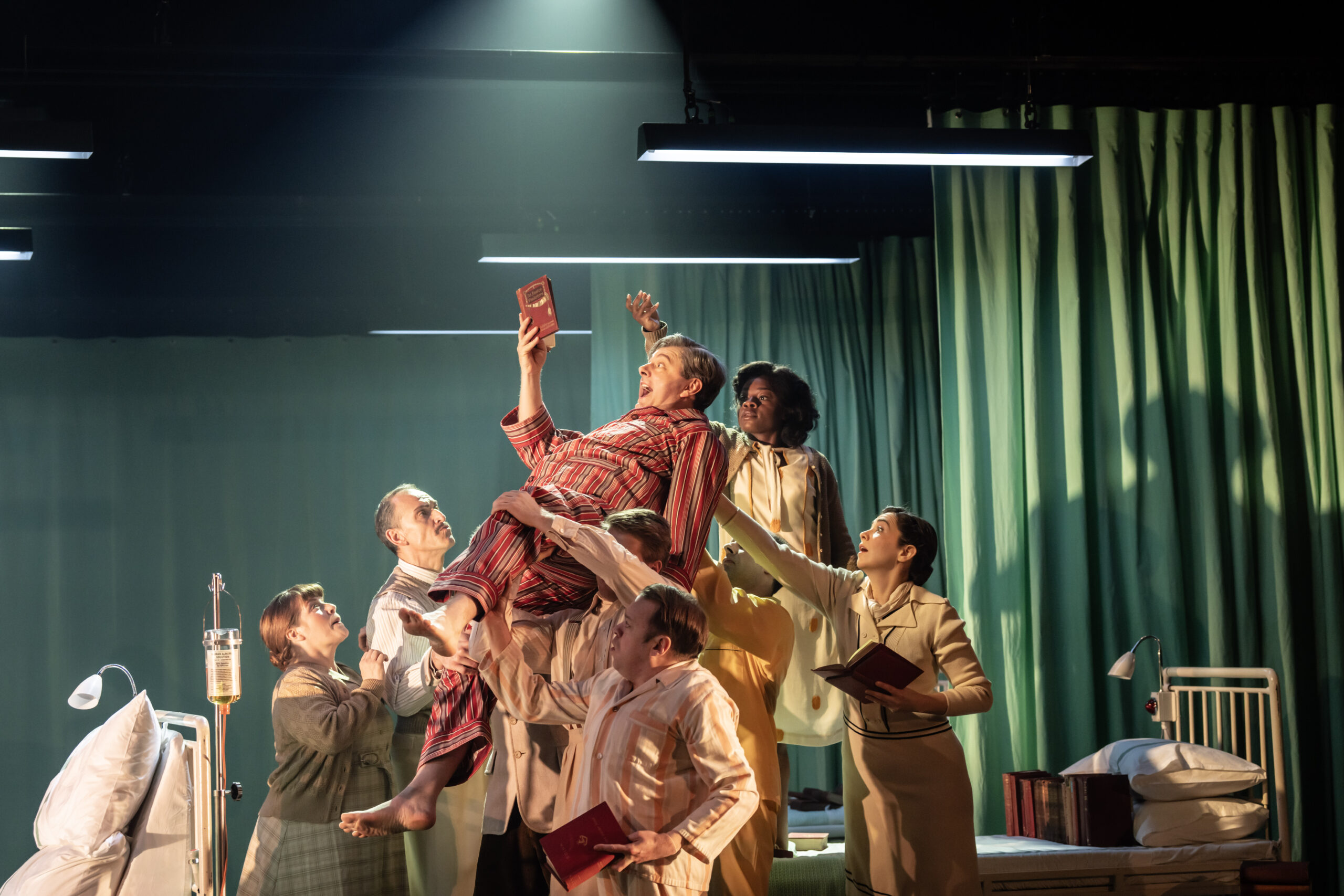
Playwright Tim Price’s concept is superb. For the entire play, Nye is on stage in his pyjamas and often in his hospital bed. This may remind you of Dennis Potter’s TV drama The Singing Detective, and there is even a sequence in which Nye sings Get Happy to the backing of a brass band. Whatever the inspiration, it’s a highly effective device.
It may be fair to say that, because of the constant presence of Nye, the production would not succeed without an actor of exceptional brilliance in the role. Fortunately, in Michael Sheen, it has one. He never overplays the part, tempting as it must be when portraying one of the twentieth century’s great orators. Nye himself may have had a huge ego, he may have been disloyal, and these characteristics are hinted at, but what we are given by Michael Sheen is a man scared by his present condition and wondering desperately whether his life has been worthwhile. It is a magnetic and moving performance.
Michael Sheen and the cast of Nye. Photo: Johan Persson
Vicki Mortimer’s clever set uses green hospital-style curtains to open to reveal a whole ward of beds, and close to provide the intimacy of a single room. The beds and curtains also move around to create a schoolroom, the House of Commons, a library, the local council chamber and a parliamentary tea room. A low ceiling from which hang the lights emphasises depth and human scale. The lighting designed by PauleConstable enhances each scene: flat fluorescent for the ward, green laser for the coal face, and so on.
So, we encounter Nye bullied by a teacher because his stammer, and receiving solidarity from his friends including his lifelong friend Archie Lush, given a solid portrayal by Roger Evans, and it’s he who helps him overcome his stammer by introducing him to the miners’ free library where he learns alternatives that avoid the traps of words beginning with ‘s’. And of course, it’s his wide vocabulary that helps him become one of the great orators of his time.
We see how he organises the mine workers in his home town Tredegar. How he was a lone and unpopular voice opposing that other great orator WinstonChurchill during World War Two. Tony Jayawardena giving a very amusing version of the wartime leader as a charming persuader, symbolically dancing light on his feet.
In the post-War Labour government, Nye becomes Health Minister and forces through the National Health Service against considerable opposition both from within his own party (a egocentric patronising Herbert Morrisson is played by Jon Furlong) and from the doctors. He sues tactics learned from his youth, his brief time in the mines and his time in local politics, as well his power of persuasion. Although in the end the doctors are brought round by throwing a lot of money at them. The use of a stark black-and-white video created by Jon Driscoll is hugely effective. First it shows the myriad challenges facing the new universal health service and overwhelming Nye, especially when people step out of the screen to tell their personal story. Then it shows the faces of the doctors harsh, greedy and recalcitrant.
On a personal front, we learn how his poetry-loving mineworker father who died from coal dust in the lungs influenced him. And how he met and wooed his wife and fellow MP Jenny Lee. Sharon Small is wonderful as the far left feminist, sharp of mind and tongue.
A worthy swansong for Rufus Norris
There are elements of a history lesson, but ultimately this is the story of a man and his mission. It is told with humour and compassion. Director Rufus Norris, in his last production as Artistic Director of the National Theatre, uses the stage to the full, creating a feel that is both epic and intimate. There are complex scenes choreographed by Steven Hogget and Jess Williams, there are small moments of passion and poignancy.
Now, you can say, as some critics have, that the other characters have little depth, and that may be true but this is a play about Nye Bevan. You may even say that it is not a full picture of him or the full story of the formation of the NHS. That may also be true, but why expect it to be something that it doesn’t claim to be? What we are given are the episodes that stand out in a life as remembered by a dying man.
When death finally arrives, he asks plaintively: ‘Did I look after everyone?’ It is a moment that brought tears to my eyes and a lump to my throat, and I was not alone. Tears for the loss of someone who we have come to care about, and maybe also for a health service that was started with such high ideals.
Coincidentally on the same day as I saw Nye, I also watched The Human Body at the Donmar Warehouse in which Keeley Hawes as a local GP and Labour politician is involved in ushering in the NHS at local level while having a Brief Encounter-ish affair with a film star played by Jack Davenport. If you’d like to know what I thought of it, click here.
Manage Consent
To provide the best experiences, we use technologies like cookies to store and/or access device information. Consenting to these technologies will allow us to process data such as browsing behaviour or unique IDs on this site. Not consenting or withdrawing consent, may adversely affect certain features and functions.
Functional
Always active
The technical storage or access is strictly necessary for the legitimate purpose of enabling the use of a specific service explicitly requested by the subscriber or user, or for the sole purpose of carrying out the transmission of a communication over an electronic communications network.
Preferences
The technical storage or access is necessary for the legitimate purpose of storing preferences that are not requested by the subscriber or user.
Statistics
The technical storage or access that is used exclusively for statistical purposes.The technical storage or access that is used exclusively for anonymous statistical purposes. Without a subpoena, voluntary compliance on the part of your Internet Service Provider, or additional records from a third party, information stored or retrieved for this purpose alone cannot usually be used to identify you.
Marketing
The technical storage or access is required to create user profiles to send advertising, or to track the user on a website or across several websites for similar marketing purposes.