Theatre review: The Truth

Stephen Mangan dominates light comedy

Apollo Theatre, Shaftesbury Avenue


⭑⭑⭑
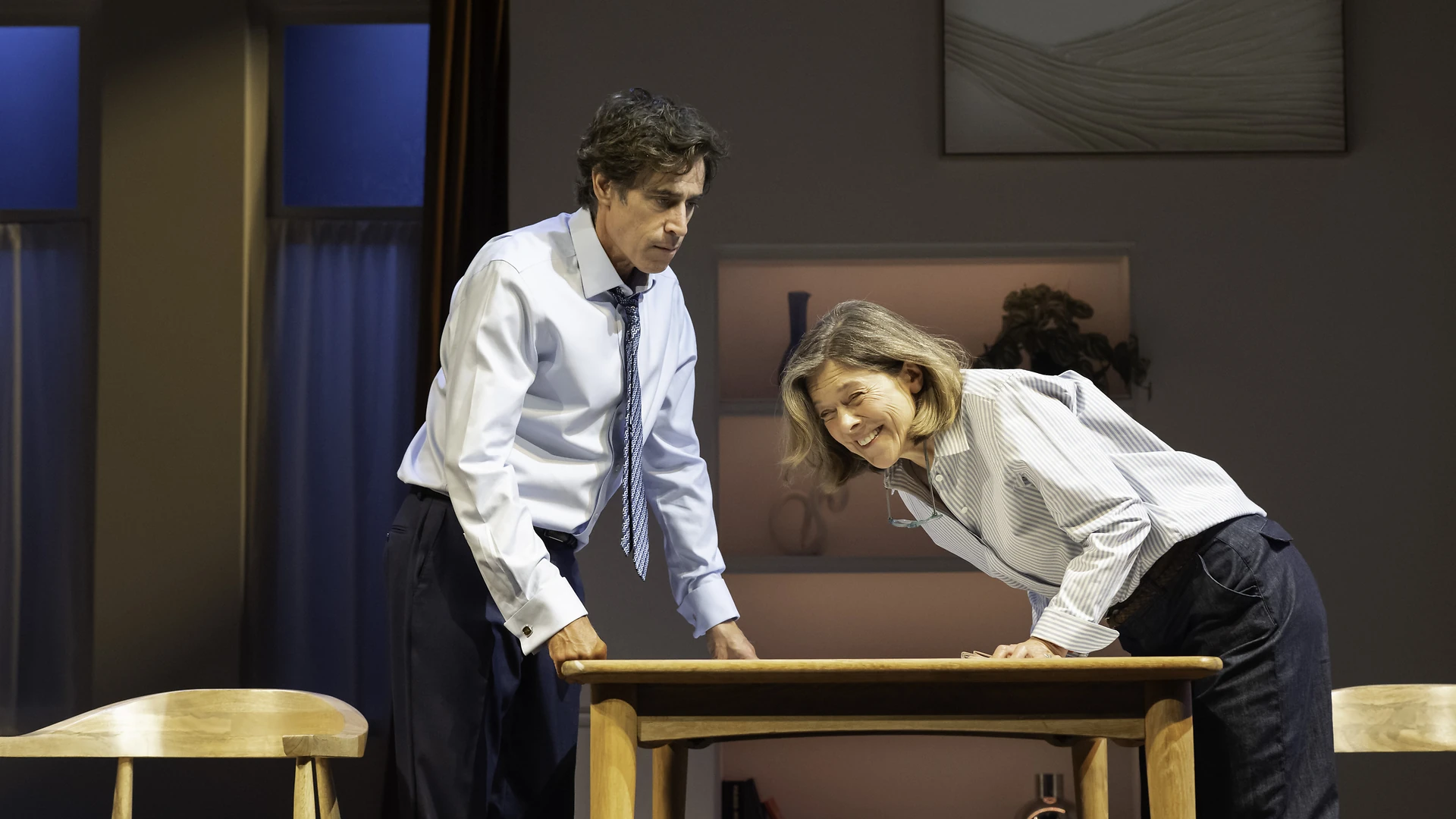
Stephen Mangan & Janie Dee in The Truth. Photo: Johan Persson

What can I say about The Truth? No, I mean, literally, what can I say about this comedy by Florian Zeller without it being a spoiler.  I can describe the first scene to you. After that, twist follows revelation follows surprise, so much so that to say anything may be to say too much. What I can tell you is that the four actors are fabulous and funny.

So, in the first scene, we find Michel played by Stephen Mangan in bed with Alice, played by Sarah Hadland. They are having an affair. It turns out Alice’s spouse Paul is Michel’s best friend, and her lover seems more guilty about betraying her husband than his wife. In fact, he seems to think it quite normal to be commit adultery.

Six more scenes follow in which Michel meets each of the other three one at a time. In these amusing confrontations, truth sometimes seems like a lie, sometimes is a lie, and sometimes what seems like a lie turns out to be true. The second scene sets the pattern. Michel is with his wife Laurence, played by Janie Dee, who seems suspicious about what he might be up to. He gets more and more tied up in his casual lies, and stutters his way into further deceits. Even after an hour and a half without interval, some questions of what is true and what is a deception are left hanging deliciously for us to chew on as we leave.

Zeller’s companion piece The Lie, that followed The Truth a few years later and featured what appear to be the same characters, explores the notion that deception makes the world go round and truth brings it to a halt. But that’s a more serious play. This is out-and-out comedy, written before Zeller got into ‘reverse theatre’ in a big way, causing us to question truth and reality by showing us scenes from various subjective perspectives, something that reached the height of confusion in his latest play on the subject of adultery The Forest.

Without the later plays’ theatrical trickery, the thin plot is exposed. While the many twists are funny, the play relies on its lead actor to do the heavy lifting as far as the laughs are concerned. Fortunately, in Stephen Mangan, the production has a player made for the part. Unfortunately, and not his fault, his blustering becomes repetitious, and there is no character development to offset the monotony. – no sense of a lesson learned or an issue resolved.

The fun is in what the characters say and don’t say, and how they react to what they’re told. And in an extension of that, how we as an audience react knowing what we think we know, and then finding out we didn’t know after all.

Perfect casting

Ardal O’Hanlan & Stephen Mangan in The Truth. Photo: Johan Persson

The casting is perfect. Stephen Mangan is like a naughty child, crashing into situations his own constructions like a toddler learning to walk, shouting as way of defending himself, and even at one point sitting sulkily in the corner with a big bottom lip. He not only doesn’t listen to others, he doesn’t listen to himself, being so self-centred that he cannot see the hypocrisy of being outraged by the betrayal of his friend deliberately losing at tennis, but oblivious to the upset caused by the revelation of his betrayal of wife and friend. Janie Dee’s facial expressions are quite brilliant: a slight widening of her eyes becomes as revelatory as a whole speech. Ardal O’Hanlan as Paul  quietly hides behind his neat beard, displaying a tight smile and a penetrating look that could be concealing either a secret or a feeling. Even Sarah Hadland‘s emotive Alice appears to have something up the sleeve she seems to wear her heart on.

In Lizzie Clachan‘s set design, hotels, a changing room, and sitting rooms all look similarly anodyne- there is even a joke about hotel rooms looking the same- suggesting an emptiness to these characters’ lives.

There is a familiarity about the creative team. This is an excellent translation by Christopher Hampton, who has brought seven of Zeller’s plays to English speaking audiences, including most famously The Father. Director Lindsay Posner has previously directed The Truth and The Lie at The Menier, and we should probably be thankful that he moves the production with such a pace that we have no time to dwell on the some of the more unlikely or more repetitive elements of the plot.

The Truth is a straightforward play compared with Zeller’s other hits, although you can argue that it m akes some profound points about the importance of deception to human society. It may also have become more relevant in an age of media and of leaders who give equal weight to lies and truth.

I think I’ve said enough.

The Truth can be seen as the Apollo Theatre in Shaftesbury Avenue, London, until 12 September 2026. Buy tickets directly from www.thetruthplay.com

Paul paid for his ticket.

Watch this review on the YouTube channel Theatre Reviews With Paul Seven
Read a roundup of other theatre critics’ reviews of The Truth (with ratings ranging from 2 to 5 stars) here

Theatre review: Unicorn with Nicola Walker, Stephen Mangan & Erin Doherty

Two plus one equals a challenging comedy


★★★★

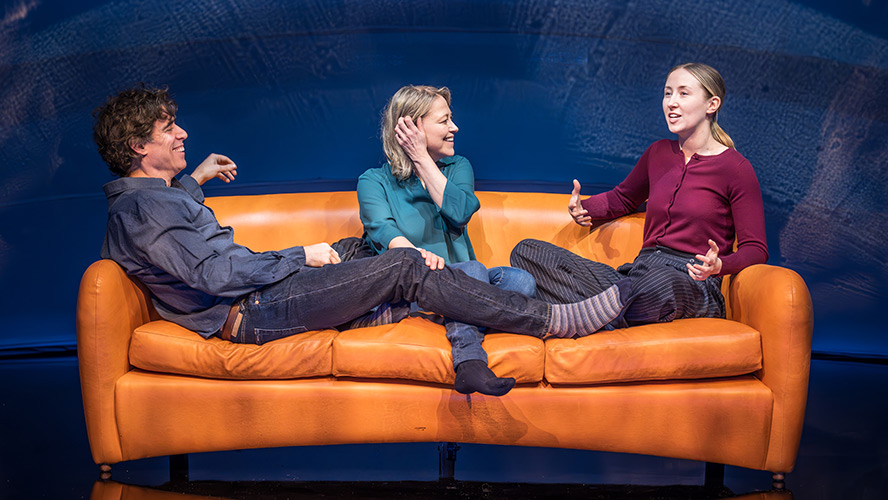
Stephen Mangan, Nicola Walker & Erin Doherty in Unicorn. Photo: Marc Brenner

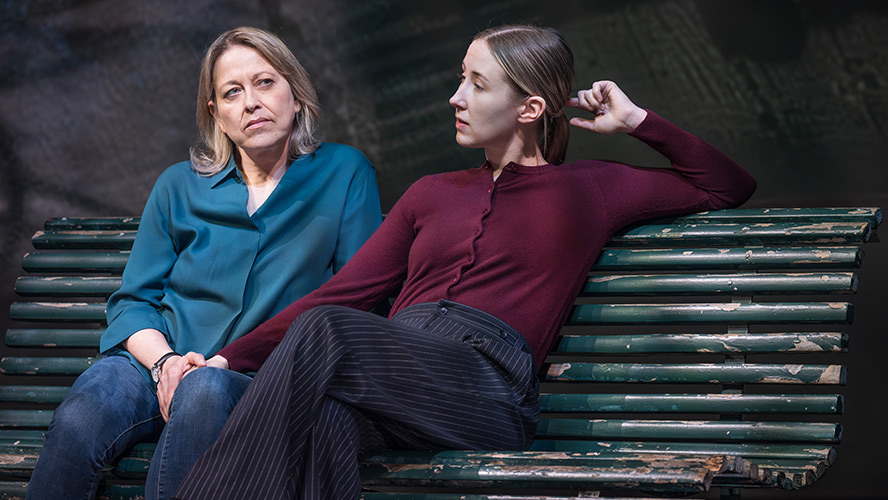
Unicorn is about a middle-aged couple played by Nicola Walker and Stephen Mangan who are attracted to the idea of introducing a third person into their relationship- in the form of a younger woman played by Erin Doherty.

This makes it a difficult play to review. Not because of some of the language- although that’s a problem too- but because so much of the play is about whether they will or won’t go ahead. I’ll do my best to talk about this adventurous comedy without giving away any spoilers.

Here are some things I can tell you about Unicorn. It’s funny, although the light-heartedness does give way to something deeper in the second half. I can also tell you it’s about emotional relationships rather than a simple threesome (if indeed a threesome is ever simple). And, even if it is about more than physical gratification, there is nevertheless much frank- and indeed filthy- talk about sex.

Having said that, if you were hoping to see these beloved stars in the buff, or were perhaps dreading the embarrassment of seeing bits of them that are normally covered up, there are no depictions of sex. They don’t even undress, well, Nicola Walker does take her shoes off. Frankly, it’s shocking enough to hear Nicola Walker and Stephen Mangan talking about sex in explicit four letter words- yes, even that word- without them actually doing it.

Our middle-aged couple still say they love one another but wonder if a third person might spice things up their sex life. Fortunately Polly, played by Nicola Walker at her most hesitant and nervously sensual, is a lecturer, and one of her mature but much younger than her students has the hots for her. And she feels the same.

Normally, if that’s the right word in this unusual situation, it’s difficult to find a young woman who wants a relationship with an older couple. (I’m not saying this from personal experience- it’s what we’re told in the play.) As rare as a unicorn, in fact. But fortunately, Kate, played by Erin Doherty, is interested, and so the story begins. The very word ‘unicorn’ may suggest a fantasy but we go with it because this is a scintillating script by Mike Bartlett, and these three actors, under James Macdonald’s direction, know exactly what to do with it.  Their comic timing is exquisite.

Erin Doherty nails the younger woman: frank, matter-of-fact and with a clear picture of what she wants. She talks loud and without hesitation. The generational gap is portrayed well. Stephen Mangan as Nick is especially good as an older man tying himself in knots as he tries to contain what he fears is stereotypical masculinity. He and Nicola Walker capture that respectful tone of the woke London middle class who are aware they shouldn’t offend or take risks, so beat about the bush and constantly retreat from what they really want.  ‘It’s entirely possible that on some level this is inappropriate,’ says Polly to Kate. Even when they kiss, all three contain any passion they might feel in favour of conversation.

So we journey through the first half continuing a will-they-won’t-they situation. At this point, I think I can add something to my plot summary. It might be a spoiler but I doubt you imagine this prevarication, funny as it is, could possibly continue for over two hours. In the second half, they do get together, but only after some significant turning points in all their lives.  We find that 30 year old Kate is increasingly the driving force in the potential three-way relationship, and we realise why. She comes to represent not only hope for the throuple but also a wider hope for humanity.

Nicola Walker & Erin Doherty in Unicorn. Photo: Marc Brenner

As we move into the dynamics of the menage-a-trois, and its ups and downs (no innuendo intended), the humour subsides a little in favour of more philosophical conversations. To summarise: we live in dangerous times, when the world and our bodies are threatened by pollution. We’re brought up on Disney happy-ever-after movies and bicycles made for two. So our primary choice of heteronormative coupling is tied up with this failed society. A willingness to try new, honest ways of living and loving could be the path to happiness and a better world.

It’s clear from the start that this particular arrangement is so rare that it is close to a fairy tale, a fairy tale that even features a unicorn. Then again,  children’s fairy tales are a way of tackling the challenges offered by a world that can seem dark and forbidding. I don’t want to say whether their happiness ultimately comes from their being all together or working out different kinds of relationships, but I certainly came out of the theatre feeling upbeat about the world.

Miriam Buether’s set is half of a dome, the other half being in effect the fourth wall. It occasionally concertinas up at the back to allow an entrance. The impression is that the three are contained within a cocoon, thus adding to the feeling that they are in a fantasy world. The backdrop is bathed in different colours, and sometimes Natasha Chivers‘ lighting design casts multiple shadows. I’m not sure if that’s to indicate the multiple possibilities of modern relationships or more mundanely to make the image of two or three people on stage more visually stimulating. There are few props- chairs or a sofa to sit on, a bed to lie on. Refreshingly, both designer and director take a discreet approach that lets the actors to do their job.

I certainly wouldn’t go see Unicorn if you’re hoping for an erotic evening, but if you take it as a fantasy delve into changing attitudes to relationships, then it’s both interesting and funny. If nothing else, it will get you talking, and who knows what that might lead to.

Unicorn can be seen at the Garrick Theatre until 26 April 2025.

Paul paid for his ticket.

Click here to watch this review on the YouTube channel Theatre Reviews With Paul Seven


Pick of 2018 Theatre Shows

Promotional image of Rory Kinnear and Anne-Marie Duff in Macbeth at National Theatre London
Anne-Marie Duff and Rory Kinnear in Macbeth at National Theatre. Photo: Jack Davison

I had a great year of theatre going in 2017. My best evening out was at the Soho Theatre where I saw Mr Swallow in Houdini. It was an hour of continuous laughter at its cleverness, clowning and sheer madness.

As for actual comedy drama, I really enjoyed The Lie by Florian Zeller at The Menier and James Graham’s Labour Of Love with Martin Freeman and Tamsin Greig but outstanding for me was the revival of Joe Orton’s Loot at Park Theatre and The Watermill Newbury (where I saw it), now uncensored and funnier than ever.

The best musical I saw, Follies and An American In Paris notwithstanding, was On The Town at the Regents Park Open Air Theatre.

The best drama was the revival of Who’s Afraid Of Virginia Woolf with Imelda Staunton. In fact there were many great acting performances this year- I’d also pick out Imelda Staunton again in Follies and Robert Lindsay in Prism but the crown must go to Ian McKellen as King Lear at Chichester Festival Theatre.

Looking forward to 2018

If 2017 was a good year, 2018 looks like being even better. There are so many wonderful prospects that it’s going to be very hard for we theatre lovers to choose what to see. Here’s my choice.

And straightway I’m having to choose between two productions of Macbeth. My money’s on Rory Kinnear and Anne-Marie Duff at the National Theatre (26 February – 12 May) but there’s no denying the  prospect of Christopher Eccleston and Niamh Cusack performing for the Royal Shakespeare Company (13 March – 18 September) in Stratford is hard to resist.

Promotional image of Sharon D Clarke in Caroline, Or Change at Hampstead Theatre
Sharon D Clarke in Caroline, Or Change at Hampstead Theatre

There are some fabulous musicals on their way. Tony (Angels In America) Kushner’s Caroline, or Change with Sharon D Clarke was rapturously received in Chichester. In 2018, it reappears in the lovely Hampstead Theatre (12 March – 21 April). Strictly Ballroom The Musical which I saw and loved a year ago at West Yorkshire Playhouse gets a well deserved London run at the Piccadilly Theatre (29 March – 21 July). The emotionally charged winner of five Tony Awards, Fun Home has its UK premiere at Young Vic (18 June – 1 September).

There’s a star studded production of Pinter’s The Birthday Party appropriately at the Harold Pinter Theatre (9 January – 14 April). When I say starstudded, the cast includes Toby Jones, Zoe Wannamaker and Stephen Mangan to name but three.

Promotional image of Carey Mulligan in Girls And Boys at Royal Court
Carey Mulligan in Girls And Boys at Royal Court

I thought Carey Mulligan was wonderful in Skylight so I’m looking forward to her return to the West End in a one woman play by Dennis Kelly called Girls And Boys which describes the unravelling of a relationship. That’s at the Royal Court (8 February – 17 March).

Alfred Molina reprises his 2009 success playing the painter Mark Rothko in Red at the Wyndham’s Theatre (4 May – 28 July). It will again be directed by Michael Grandage and will also star Alfred Enoch.

Near to where I live, Nuffield Southampton Theatres open their exciting city centre space with a new play by local lad Howard Brenton. The Shadow Factory looking at Southampton in the Second World War runs from 7 February to 3 March.

Happy theatregoing!

×