Theatre Review: The Cherry Orchard with Kristin Scott Thomas

Top Chekhov adaptation brings out the best in Kristin Scott Thomas & Stephen Mangan

Harold Pinter Theatre

⭑⭑⭑⭑
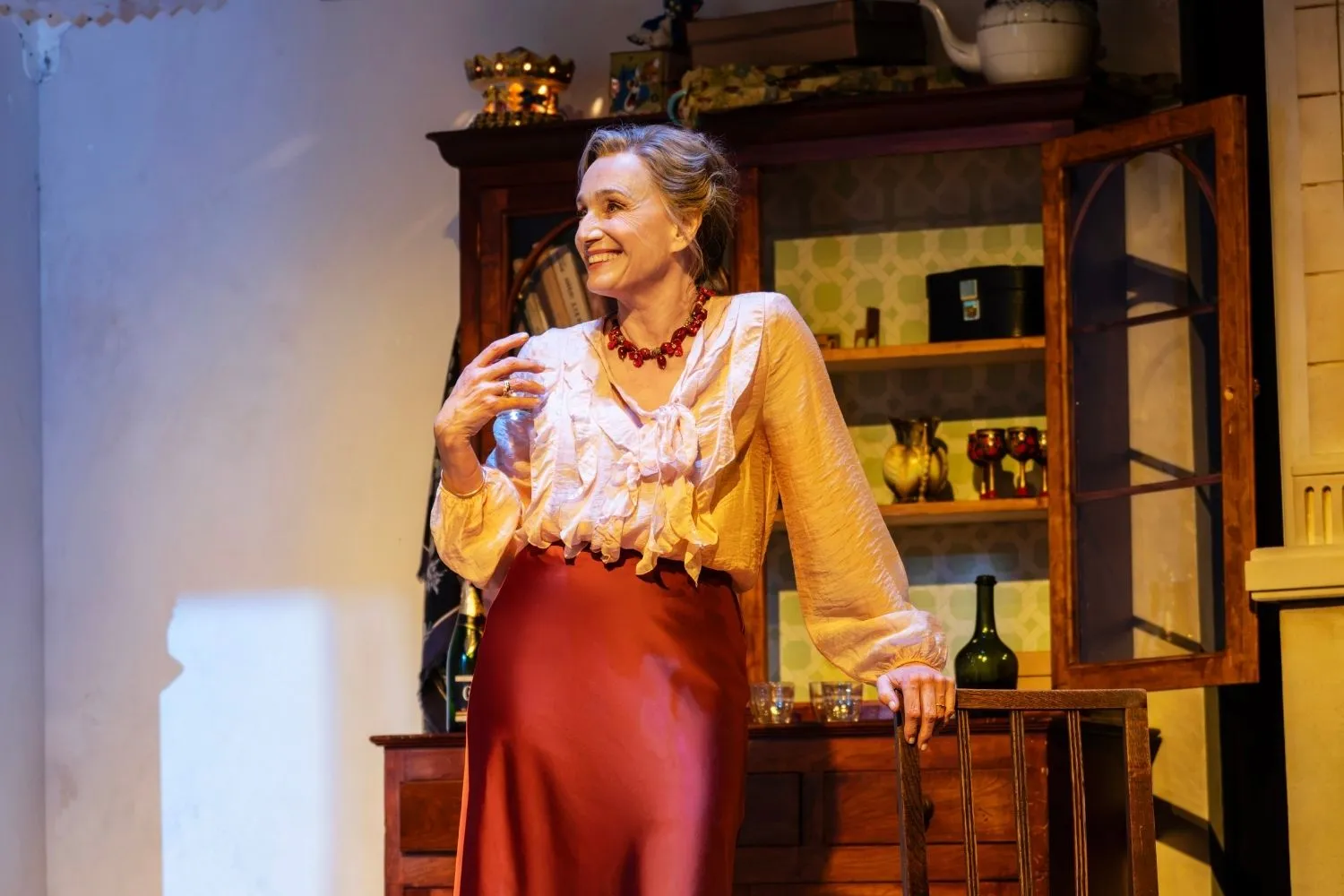
Kristin Scott Thomas in The Cherry Orchard. Photo: Johan Persson

Every production of Chekhov‘s The Cherry Orchard is different: like life, it’s so open to interpretation. Even so, there’s always a sense of doom, and there’s always a comical bubble of illusions shielding those who are looking doom in the face. So what makes this production at the Harold Pinter Theatre special? 

This is a particularly star studded production, not only Kristin Scott Thomas and Stephen Mangan starring, but top playwright Conor McPherson providing a re-imagining and Ian Rickson, a highly successful interpreter of Chekhov, directing. It’s also blessed with a cast of the highest quality.

The language provided by McPherson is blunt and speaks to a modern audience. Chloe Lamford’s decaying, damp looking set and Sussie Juhlin-Wallen’s costumes which mix period and modern elements give the production a sense of time passing. The mixed bunch of characters are either living in the past or seeking to preserve it.

The theme of resistance to change is timeless. The specific change in this case is the old Russian hierarchy crumbling in the face of the rising middle class.

Luba Ranevskaya, played magnificently by Kristin Scott Thomas, is the matriarch of a grand house and estate, the destitute successor to its previously rich and powerful owners.

The focus point of the land is a cherry orchard.  It’s a cute touch for the characters to look out on the audience when referring to the orchard. We are, it seems, both the past condemned to perish and the future they will never see.

So many of the characters are lost in their illusions, unable to articulate their thoughts or even finish sentences in the face of the reality before them. Kristin Scott Thomas’ character is like a rudderless ship, fiddling with her hair, offering rictus smiles, distractedly hugging people in a half hearted cure their sadness, looking vacantly as if seeing the past or a different reality, sentences trailing off. Luba continues to behave like the lady of the manor, giving away money she doesn’t have while the debts pile up. Always looking to take flight to Paris to join her unfaithful lover, preferring to keep the memory of its past rather than grapple with modern day challenges of an estate facing bankruptcy.

An impressive cast
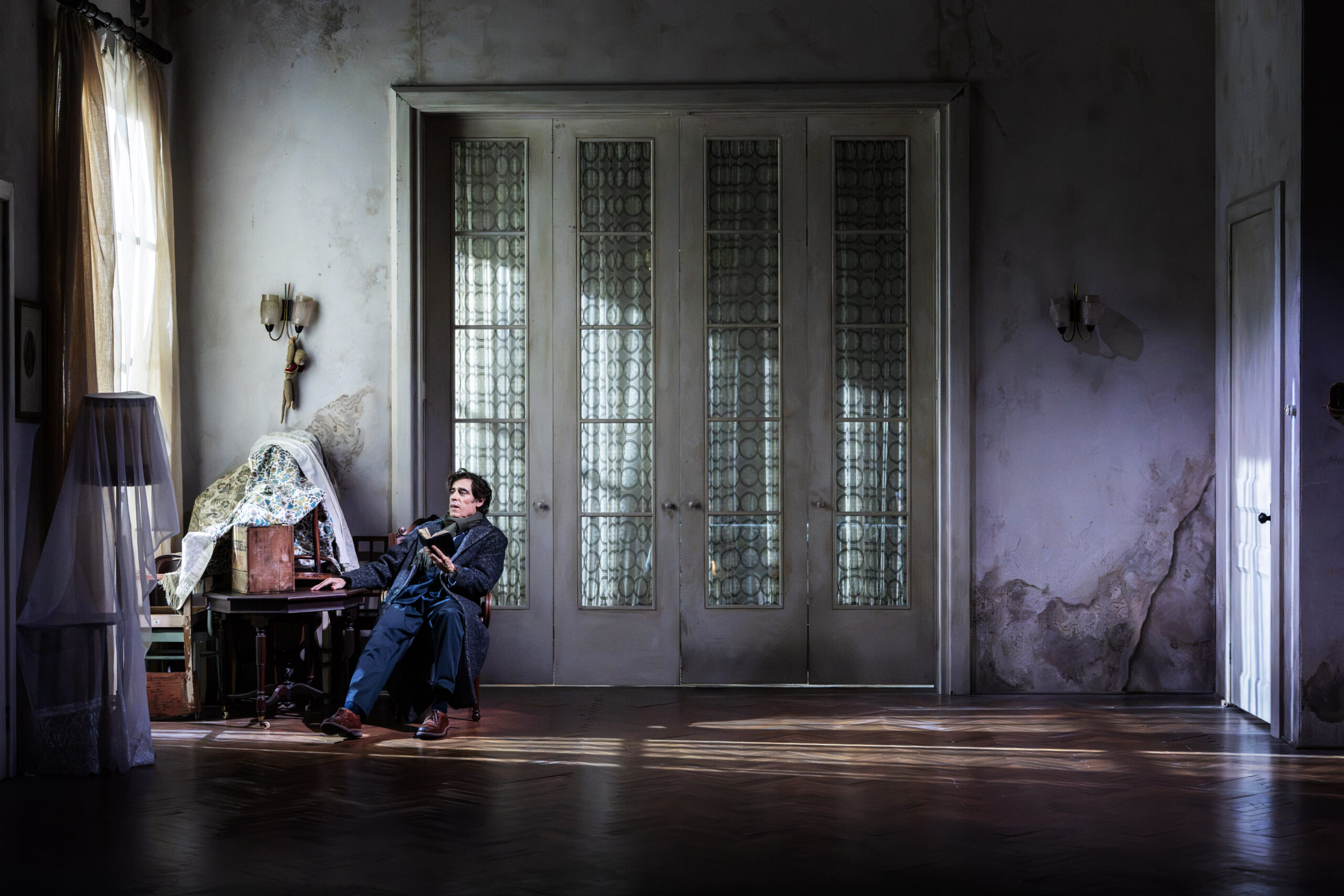
Stephen Mangan in The Cherry Orchard.Photo: Johan Persson

Through the next two and half hours, the people around her interact, sometimes in harmony, sometimes in conflict, fast, slow, sniping, soothing, revealing more and more of their characters, their illusions and their painful vulnerabilities.

Luba’s brother Leo is so inflated in his self importance, but actually a total scrounger, and so unpleasant. He could be a template for a certain ex-royal. Always reassuring himself and those around him that something will turn up. Peter Wight gives him just the right mix of nasty and pathetic.
Jeff Rawle brings more pathos to Boris, an impoverished landowner, smiling but always trying to borrow money.

Jack Riddiford is the perpetual student Petyo, even at 30 years old, still talking of graduation. He speaks of revolution but needs the aristocracy to revolt against.

Some female characters look to feckless men for salvation – their love repeatedly unreciprocated. Anastasia Martin is Luba’s unstable daughter. Vinette Robinson gives a powerful performance as the tightlaced adopted daughter Varya, trying to manage the estate finances while wishing she could be a nun. Megan Cusack is the servant Dunyasha taking advantage of the breakdown of the class system to dress up and flirt with attractive men.

Saddest and funniest of all, Karl Johnson is Firs, the old retainer, literally living in the past thanks to dementia but coming up with golden lines like ‘you’re wearing the wrong trousers’. Karl Johnson is an actor I’ve seen many times on stage and he never disappoints.

Only Yermi Lopakhin, played by Stephen Mangan , looks positively to the future. He’s part of a new generation of a self made rich men. Being from peasant stock and well aware of his inferiority, ‘sorry’ is his most used word, a wide-eyed nervous laugh is never far away. He has been in love with Luba since childhood but he can see that the estate must be commercialised to survive, which means the cherry orchard must go. His illusion is that saving the estate will win over Luba. His belief in money as the way to his ideal is as deluded as the head in the sand attitude of those around him. And he is blind to the possibility of happiness with Varya. Stephen Mangan is wonderful in this role, giving a light comic vulnerability to a character that can seem unpleasantly crowing.

This production of The Cherry Orchard is a masterful re-imagining from Conor McPherson that is brought to life by a perfect cast and Ian Rickson’s inspired direction.

The Cherry Orchard can be seen at the Harold Pinter Theatre until 9 January 2026. Buy tickets from the theatre haroldpintertheatre.co.uk

Paul was given a review ticket by the producer

Read a roundup of other critics’ reviews here

Watch this review on the YouTube channel Theatre Reviews With Paul Seven
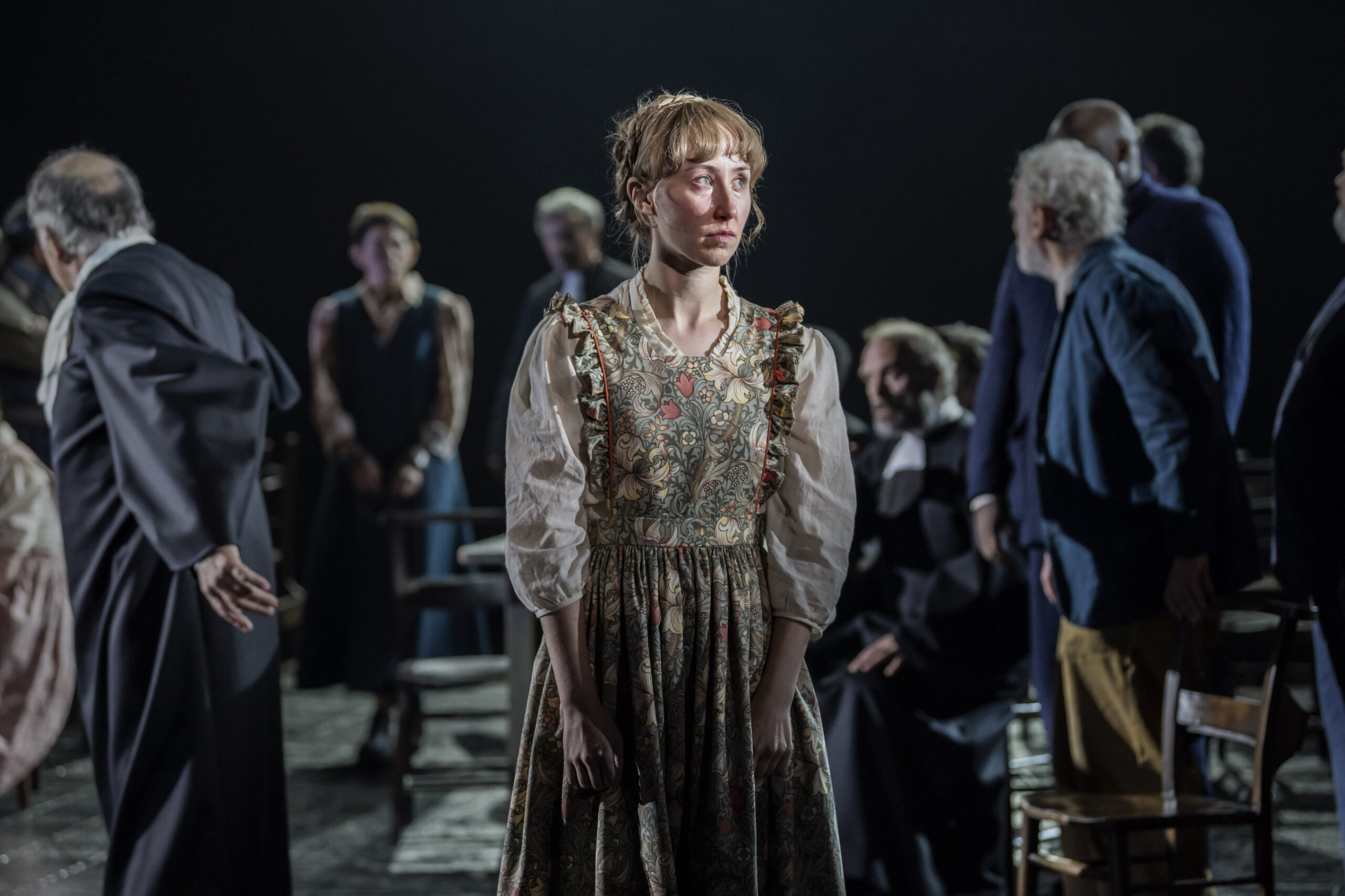


The Crucible with Erin Doherty – National Theatre – review

★★★★

Erin Doherty in The Crucible at National Theatre London 2022
 

Back in 1953, when Arthur Miller wrote The Crucible, a play about the late 17th century witch trials in Salem Massachusetts, he no doubt had in mind a modern day witch hunt in which a US senator persecuted perceived communists, especially in Hollywood. But it could be about any time when authorities demonise others to consolidate their power.

It’s a compelling study in how the process of a witch hunt develops a momentum of its own and triggers vengeance, fear and even mass hysteria. Lyndsey Turner’s intense production is powerfully acted by Erin Doherty, Brendan Cowell and the rest of the cast.

In a small town run by the church, some misbehaving girls try to get off the hook by claiming to be possessed by the Devil. This gets out of hand as they take the opportunity to get their own back on some respectable and respected citizens by accusing them of being disciples of the devil who lead them on. A trial ensues. Adults confess to outlandish encounters with demons, more accusations fly, more adults confess in a form of mass hysteria, and the children too start to believe their own tales.

The girls are led by Abigail. It’s a bravura performance by Erin Doherty. You might know her best as an excellent Princess Anne in The Crown but she shows her full range as an actor here. Her character is clearly a rebel but also scheming. So, we see her wheedling, pleading, and, in a terrifying scene, inspiring the other girls into wild-eyed, uncontrolled shaking, as if possessed.

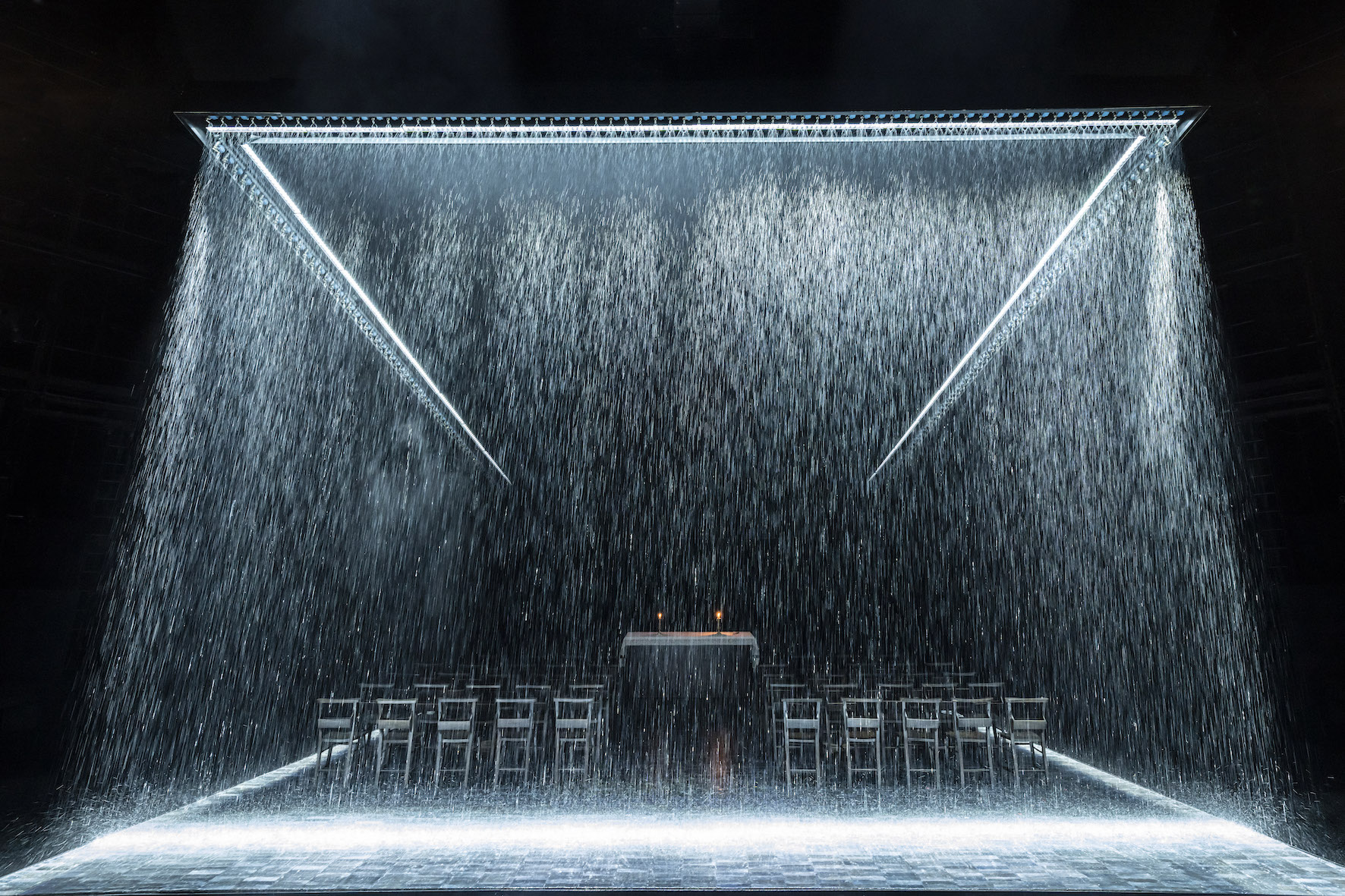
Authoritarian power is just one of the subjects explored in Arthur Miller’s complex play, but it’s the one from which all elsefrom which all else arises. As we enter the Olivier auditorium, we are confronted by pouring rain. Every scene begins with pouring rain. Torrents of water team onto the front of the stage. It seems this community is already suffering the punishment of a pitiless Old Testament God. We’re told the community is a theocracy. No separation in those days between church and state: the Church is in charge and there can be no challenge to its authority.

Photo: Johan Persson

The church leader Reverend Parris is confronted by children secretly rebelling against the church’s rules by secretly dancing, among other things. Some of the citizens believe this behaviour has been caused by the Devil in the form of witchcraft. The priest is skeptical but he knows support for him in the community is shaky, so he calls in a preacher with higher authority and a knowledge of witchcraft: the Reverend Hale. A major trial follows, headed by Deputy Governor Danforth, played with a steely eye and a stern jaw by Matthew Marsh. He has his own reasons for wanting to stamp his authority on the community.

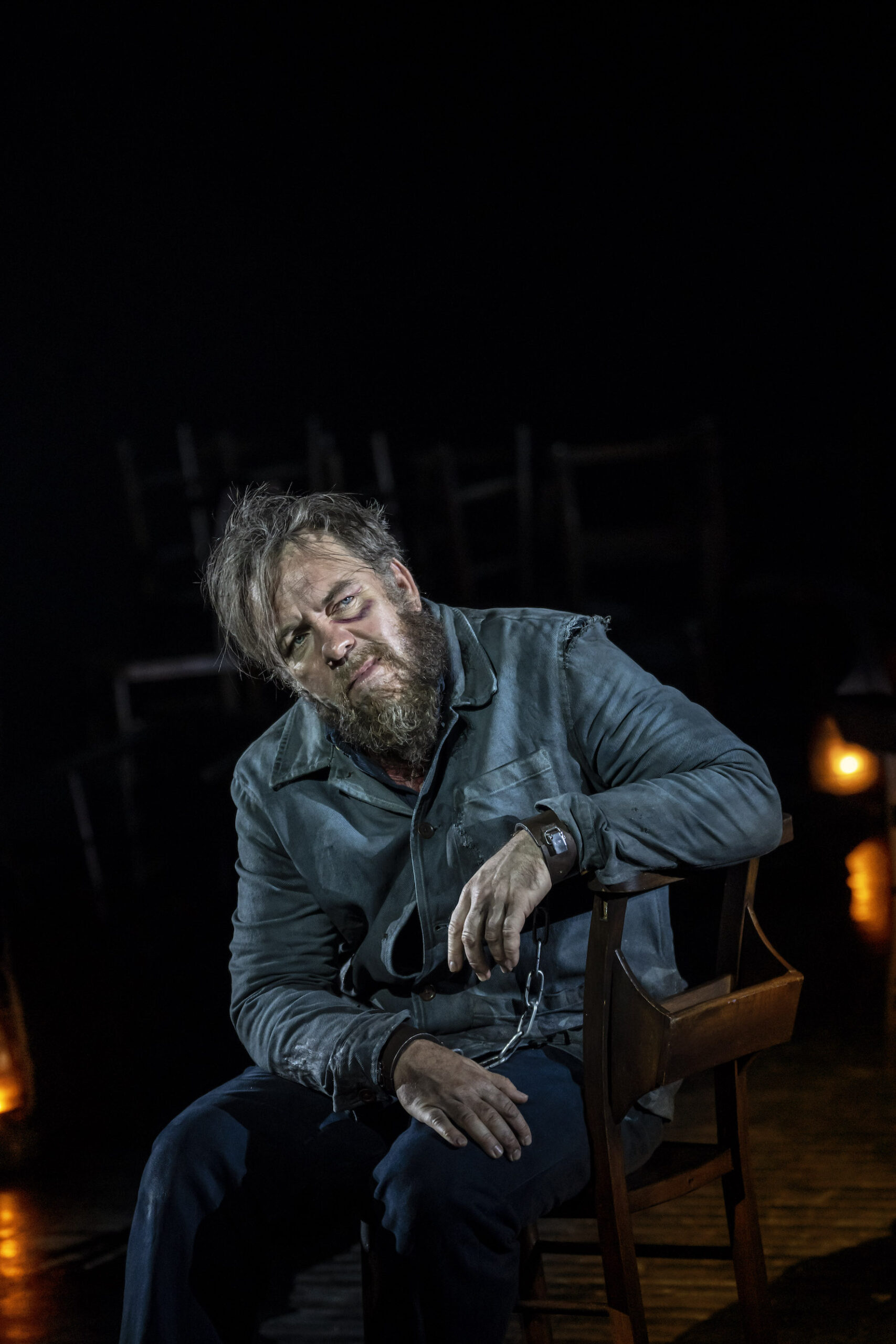
At this point, it’s a case of ‘to a hammer everything is a nail’. It seems obvious that the children are dissembling but, as the excellent National Theatre programme points out, the authorities see what they believe rather than believing what they see. As the witch hunt goes to extremes in the heat of the ‘crucible’, both Parris and Hale, given passionate and nuanced performances by Nick Fletcher and Fisayo Akinade respectively, begin to see how one-sided the trial is. They realise good people are being dragged down and note that ‘every defence is seen as an attack on the court’.

Production photo from The Crucible at the National theatre London in 2022 showing Brendan Cowell
Brendan Cowell in The Crucible. Photo: Johan Persson

One man who speaks out against the trial is John Proctor whose wife is accused of witchcraft. It’s a thundering piece of acting from Brendan Cowell as a good but flawed man. In a heart-breaking sequence, he nobly tries to reason with the Court and is brought down by his own honesty and the challenge he poses to the Church’s teachings.

What else is going on? Oppression of women by the church. They are expected to be silent and obedient. As the girls are indoctrinated by tales of hellfire and damnation, they are primed for believing they have been taken over by unseen forces. And they have a readymade means of excusing themselves.

Fear, revenge and greed all play a part. People turn on each other to save themselves. The girls are only too quick to denounce the many adults they resent. Ruthless people take the opportunity to gain land from those found guilty of witchcraft. There’s a lot to think about and be shocked by in this intelligent, frightening play.

It’s easy to discern many parallels more modern than the McCarthyite witch hunt. We can see what goes in all totalitarian countries where a weak authority cannot be questioned: the actions of the morality police in Iran for example, or would-be authoritarians closer to home for whom an alternative point of view or a minor misdemeanour can ignite outrage on social media leading to death threats and cancellation.

Director Lyndsey Turner has created an fervid production, only marred by a tendency at times towards melodrama. One nice touch is that nearly all the characters point fingers as they argue, a metaphor made physical. The masterful set by Es Devlin is appropriately black-and-white except when we visit the Proctors’ warmer-coloured home. An opaque ceiling hangs over hhe entire stage. Through it filters a diffused flouredcrnt white light suggesting no one can hide from a pitiless regime.

Crucial to the production are Tim Lutkin’s lighting and the sound by Caroline Shaw, Tingying Dong and Paul Arditti. The cast are usually lit from the side creating a lchiaroscuro effect, again suggesting no middle ground. A stretched low note drones in the background, ratcheting up the tension.

The impressive cast also includes Sophia Brown, Karl Johnson, Eileen Walsh and Tilly Tremayne.

The Crucible was performed at the National Theatre 21 September – 5 November 2022, and will transfer with cast changes to the Gielgud theatre from 2 June to 7 September 2023

Paul was given a press ticket by the producer.

Click here to see the review on the One Minute Theatre Reviews YouTube channel

×