She Did It! Rachel Kavanaugh’s production and newcomer Keziah Ibe’s Eliza hit the right notes
Chichester festival Theatre
⭑⭑⭑⭑
Keziah Ibe & Hadley Fraser in My Fair Lady. Photo: Johan Persson
Let’s start at the beginning. Except, where is the beginning? The overture is missing! I love an overture. It sets the mood and fills you with anticipation.
But it seems churlish to complain when Rachel Kavanaugh‘s production plunges you straight into the uplifting story of an impoverished cockney flower seller called Eliza Doolittle. She soon encounters and confronts Professor Henry Higgins, an expert in phonetics. The musical establishes their characters from the get-go, so we the audience glimpse from the start the quality of the two stars on which the musical stands or falls.
Higgins is entitled, lacking social skills, self centred, insensitive and misogynistic but in Hadley Fraser’s hands, this is leavened by his child-like enthusiasm. He’s often shown in production as stiff and distant but here his sheer bullheaded enthusiasm- and Groucho Marx-like postures- make him more loveable than expected.
Eliza is feisty and ultra aware of her inferior position in society. Keziah Ibe, making her theatrical debut, gets the mix right. And she nails the first big song of the night Wouldn’t It Be Loverly? That’s a relief because a lot of big songs are coming her way, which she goes on to sing beautifully and with expression.
So it’s game on as Higgins and his friend Colonel Pickering set about transforming this ‘squashed cabbage leaf’ as he calls Eliza into a Lady. It’s worth noting that Eliza initiates the process by offering to pay for lessons- an entrepreneurial move that flies in the face of Higgins’ sexist views, as expressed in Why Can’t A Woman Be More Like A Man?
This is the first time 60 year old Chichester Festival Theatre has presented My Fair Lady. So how do the open spaces of the huge thrust stage with no capacity to fly in scenery convey the spectacle? Not with big sets. The lavish Embassy Ball at which the transformed Eliza triumphs is represented by, in effect, a few standard lamps, the ‘street where she lives’ is two lengths of iron fencing, Ascot Races an empty stage. The Chichester ‘wow’ factor, picking up from the musical’s use of the ensemble to provide a kind of Greek chorus, is to fill the stage with people.
So we have Gary Milner as Eliza’s dustman father Alfred P Doolittle leading an exuberant chorus of around twenty through Stephen Mear’s complex choreography in With A Little Bit Of Luck and I’m Getting Married In The Morning, as well as a more restrained but still impressive circle of racegoers. It’s not completely sparse of scenery. There is one magnificent set, namely Henry Higgins’ study. Designer Peter McIntosh has created a massive truck that sweeps on and off stage, full of cluttered corners and different levels for the actors to weave and jump through.
It’s easy to understand why some consider My Fair Lady the perfect musical. Lerner and Loewe‘s songs consistently reveal character or advance the narrative, possibly even more so than those of the great Rodgers And Hammerstein who invented the modern musical. And they’re nicely played by a small orchestra under Cat Beveridge.
Keziah Ibe performs the songs with great eloquence. Her high point is also the apex of the musical itself, the moment when she is so excited at getting the pronunciation right in The Rain In Spain. It’s a moment of euphoria for Higgins, Pickering and Eliza that leads her into the incomparable I Could Have Dance All Night.
There is also a lot of dialogue, perhaps this was because Lerner, who wrote the book as well as the lyrics, wanted to give due respect to George Bernard Shaw‘s socialist message in Pygmalion, on which the musical is based. There’s a lot of conversation about class divisions and the importance of language as a marker of class: Shaw’s point being we’re all people with the same qualities and faults under our disguises. So you need good actors, which this production has assembled in spades.
A loverly production
Gary Milner & company in My Fair Lady. Photo: Johan Persson
In the end, Eliza undergoes more than a superficial transformation. She realises there is more to happiness than a romantic husband and a ‘loverly’ room. And she has learned from those around her that there is more to class than how you speak. From Colonel Pickering, well played by Tony Jayawardena, she learns politeness and respect, although he is shown to be a bit of a dunderhead. From her father, she acquires cynicism. From Higgins, she not only acquires received English but the value of being honest to oneself and others. She also learns what she doesn’t want when she is courted by the full hearted but empty headed Freddie, nicely played by Ben Culleton. He performs On The Street Where You Live. It’s my favourite song from the musical even if it is, as the programme points out, evidence that ‘his head is too much in the clouds’. I guess I’m an old romantic.
Eliza also observes the women in Higgins’ life as a model for dealing with him. His housekeeper Mrs Pearce and his mother, given strong, humorous portrayals by Finty Williams and Belinda Lang respectively, maintain a balance between loving him and being honest with him.
Eliza initially leaves because she feels unrecognised for her achievement. (Higgins and Pickering take all the credit in the song You Did It, behaving as so often like two little boys). Ultimately Eliza recognises he can’t help being what he is, but, more than that, he has a depth of character that the featherweight Freddie or the pliant Pickering haven’t. Most importantly, in this production, it is clear she realises she wants to be with him as an equal.
For his part, Higgins seems more stuck in his ways and shows less development, but he learns to feel love for another person, or as he puts it, I’ve Grown Accustomed To Her Face. Hadley Fraser delivers the song with great poignancy from the front of the stage, despite the difficulty of bringing emotion to songs that are virtually spoken, this in deference to the non-singing Rex Harrison who first played Higgins. Rex? Forget him. Hadley takes the crown.
As a love story, it’s highly unlikely and potentially offensive to feminists. The problem is exacerbated because the coming together of Higgins and Eliza was not the climax intended by Shaw. Quite the opposite: the professor was to be left a sad and sorry man by the newly independent woman. However, Rachel Kavanaugh, supported by her fabulous cast, makes it work by avoiding extreme portrayals and emphasising friendship and respect as the basis for their relationship. Well done, Ms Kavanaugh, You Did It!
Neil Gaiman’s fantasy story is adapted into a theatrical spectacle with a heart
★★★★★
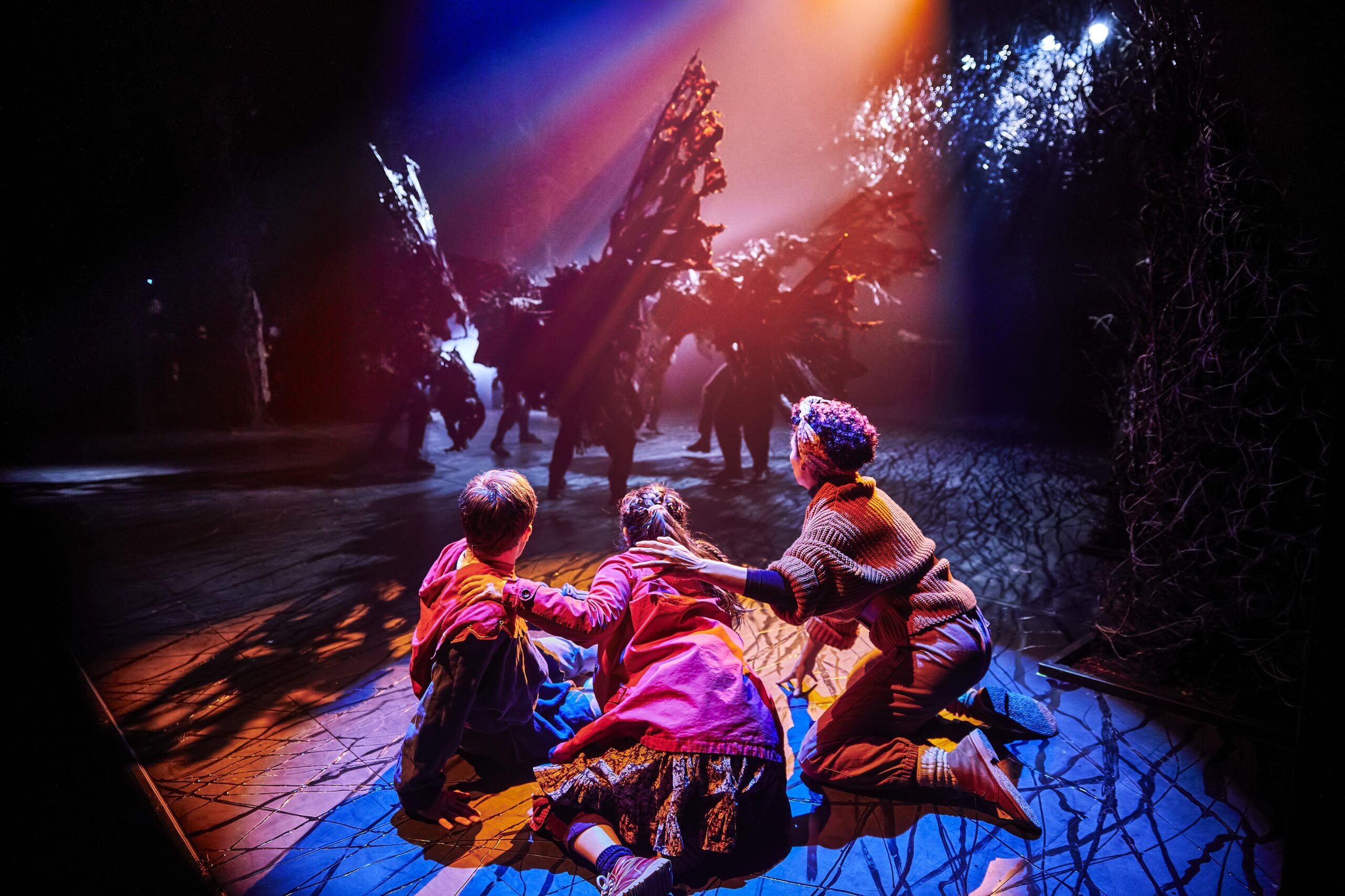
Keir Ogilvy, Millie Hikasa & Kemi-Bo Jacobs in The Ocean At THe End Of The Lane. Photo: Brinkhoff-Moegenburg
Maybe, like me, you’ve never got around to seeing The Ocean At The End Of The Lane. Yes, it has been around a while. It opened at the National Theatre in 2019, then Covid intervened. Then it was revived and a tour throughout this year has finally seen it wash up at the Noel Coward Theatre in the West End. There have been plenty of opportunities, so what’s your excuse?
Let me give you mine. It’s a children’s show, or even if it’s not, it’s a fantasy, or even if it is rooted in real life, it’s all spectacle and no heart. Well, I’ve finally seen it, and I can tell you, none of these excuses hold up.
The Ocean At The End Of The Lane is a stage adaptation of a novel by Neil Gaiman. The idea of bringing this story to the stage came from a true theatre person: Katy Rudd. She knows theatre, she loves theatre and she knows how to make a magical show.
I’ve got to be careful here because the word ‘magical’ is loaded. There is a whole literary genre known as magical realism, wherein an ostensibly real world has unnatural things going on. Then there’s the magic that is more properly called ‘tricks’, which theatre is full of. Then again, there is the magic of theatre that involves no tricks but somehow transports you into another world.
All these forms of magic combine in this production.
The story concerns a child. So is it a children’s show? Well, older children will probably enjoy it, but the answer is emphatically ‘no’. It’s very much about how we as adults lose our ability to see beyond the world in front of us and enter into the world of imagination.
We meet a particular adult who is reminded of something that happened to him as a child- or may have happened. Cut to an unhappy 12 year old, already regarded as weird because he seems to prefer books to people, who has gone through the trauma of losing his mother. Keir Ogilvy is magnificent in this part, a stuttering, gangling, wide-eyed performance.
He meets a strange girl called Lettie, a Peter Pan like character played with energy and passion by Millie Hikasa. He also gets acquainted with her mother and grandmother, who seem to know things well beyond the time and space they occupy.
Thus begins a fantastic adventure that takes place on their farm and in his house.
So, yes, it is fantasy but not Star Wars or Marvel Universe fantasy. This is the everyday world you and I might occupy, suddenly host to strange goings on.
Like a monster from another parallel world being let in ours and wreaking havoc. And what a monster. Guaranteed to send chills down your spine. Until it is personified in the form of a sinister lodger- Ursula, played by Charlie Brooks, with mad eyes and a steely smile). Then the battle begins.
The stage is filled with the kind of spectacle, that is far more impressive than cinema CGI because it is being created before your eyes with smoke and coloured lights and swirling cloths and people in costumes.
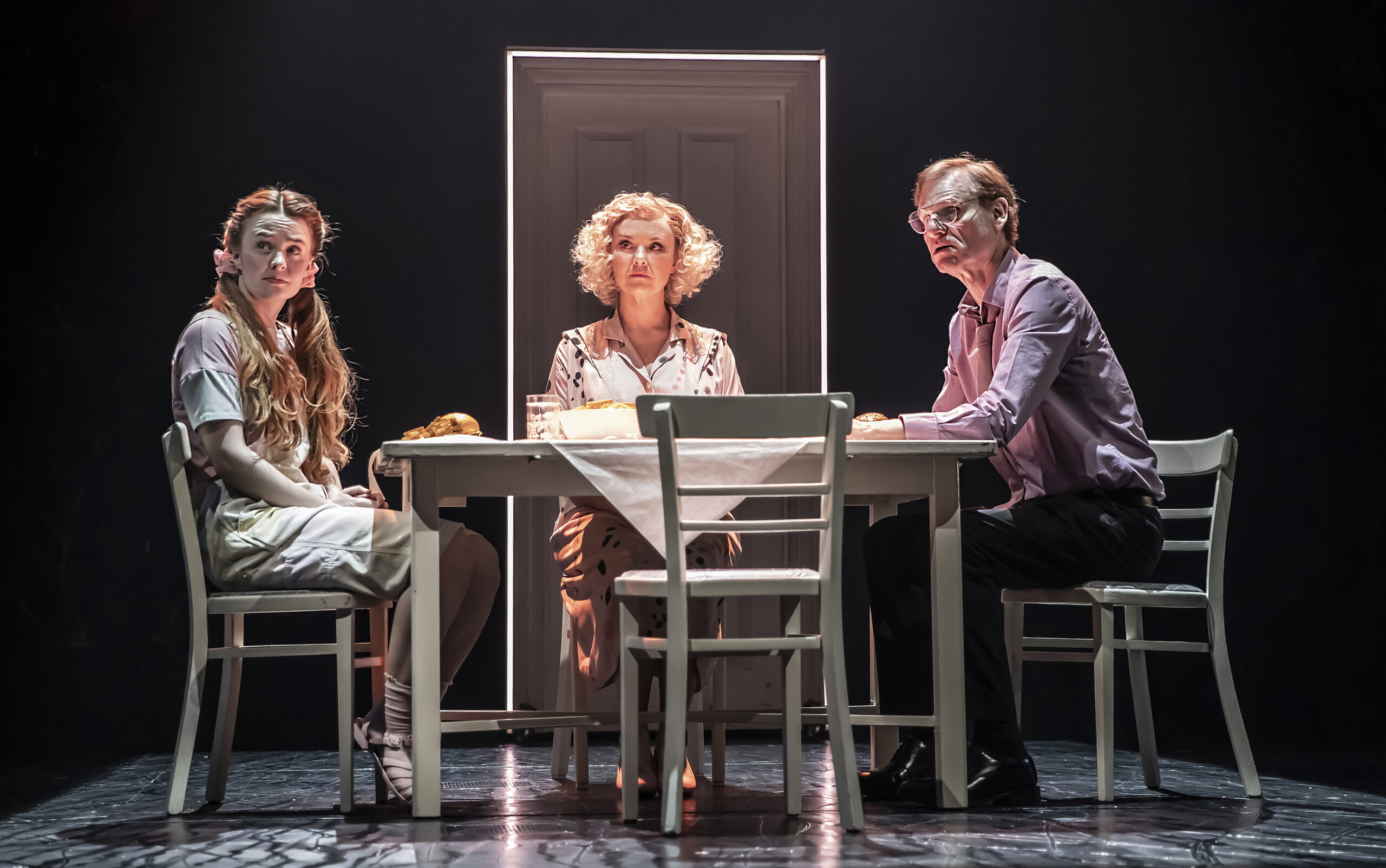
There is no better moment of stageLaurie Ogden, Charlie Brooks and Trevor Fox in The Ocean at the End of the Lane. Photo: Pamela Raith
magic than when Ursula disappears through a door stage right and instantly reappears through another door stage left. Then more and more doors appear with Ursula appearing here there and everywhere until your brain is overwhelmed. Members of the audience were gasping with astonishment.
And in this eulogy to theatre, we are shown how some of the magic works- we see the ensemble of ‘stage hands’ who carry characters through the air when they are flying, falling or swimming; or moments when a scene ends and the stage hands move in to remove scenery only to find the characters decide to carry on talking, so they pause and replace the props. We see the mechanics, but still imagine it to be ‘real’. I use the word advisedly since, as this play reminds us, your perception of reality, present and past, will be different to mine.
The point is, like all art forms, theatre stimulates our imagination, then requires our imagination in order for it to work. And, as this story underlines, imagination is what enables us to see the truth about the world and how to change it,
If it were purely to enjoy the magic of theatre, I would recommend seeing this show. But there is more, much more, and that’s in the power of the storytelling. The boy regularly quotes from The Chronicles Of Narnia but also Alice In Wonderland and Peter Pan.
Like many great stories, The Ocean At The End Of The Lane engages the heart as it takes us into the world of this lonely young misfit. It leaves us simultaneously uplifted and sad.
It is irrelevant whether the events really happened or were invented as a way of coping with an unfriendly world. The story of threatening monsters, benevolent witches, and a faithful friend is grippingly real for him, as it is for us.
Neil Gaiman is one of the great storytellers, and all praise to Joel Horwood too for adapting the story into two and bit hours of character-driven adventure.
The other actors deserve recognition. Trevor Fox, who plays the boy’s father and the boy as an adult, is as funny, melancholy and eccentric as adults so often are in children’s eyes. Laurie Ogden is suitably annoying and obnoxious as the boy’s sister. Kemi-Bo Jacobs is Lettie’s gentle, loving mother. Finty Williams makes her grandmother seem as old as the hills but has a glint in her eyes that show she is as sharp as a brand new knife.
While I’m giving credits, I must praise- or more properly bow down to- set designer Fly Davis, Costume and Puppet Designer Samuel Wyer, Lighting designer Paule Constable, and Magic and illusions director Jamie Harrison.
So, even if you normally shun shows about children, or flee from fantasy fiction, or sidestep spectacle, I urge you to make an exception and go to the Noel Coward Theatre to see this 5 star show about the power of storytelling.
Manage Consent
To provide the best experiences, we use technologies like cookies to store and/or access device information. Consenting to these technologies will allow us to process data such as browsing behaviour or unique IDs on this site. Not consenting or withdrawing consent, may adversely affect certain features and functions.
Functional
Always active
The technical storage or access is strictly necessary for the legitimate purpose of enabling the use of a specific service explicitly requested by the subscriber or user, or for the sole purpose of carrying out the transmission of a communication over an electronic communications network.
Preferences
The technical storage or access is necessary for the legitimate purpose of storing preferences that are not requested by the subscriber or user.
Statistics
The technical storage or access that is used exclusively for statistical purposes.The technical storage or access that is used exclusively for anonymous statistical purposes. Without a subpoena, voluntary compliance on the part of your Internet Service Provider, or additional records from a third party, information stored or retrieved for this purpose alone cannot usually be used to identify you.
Marketing
The technical storage or access is required to create user profiles to send advertising, or to track the user on a website or across several websites for similar marketing purposes.