Theatre review: The Truth

Stephen Mangan dominates light comedy

Apollo Theatre, Shaftesbury Avenue


⭑⭑⭑
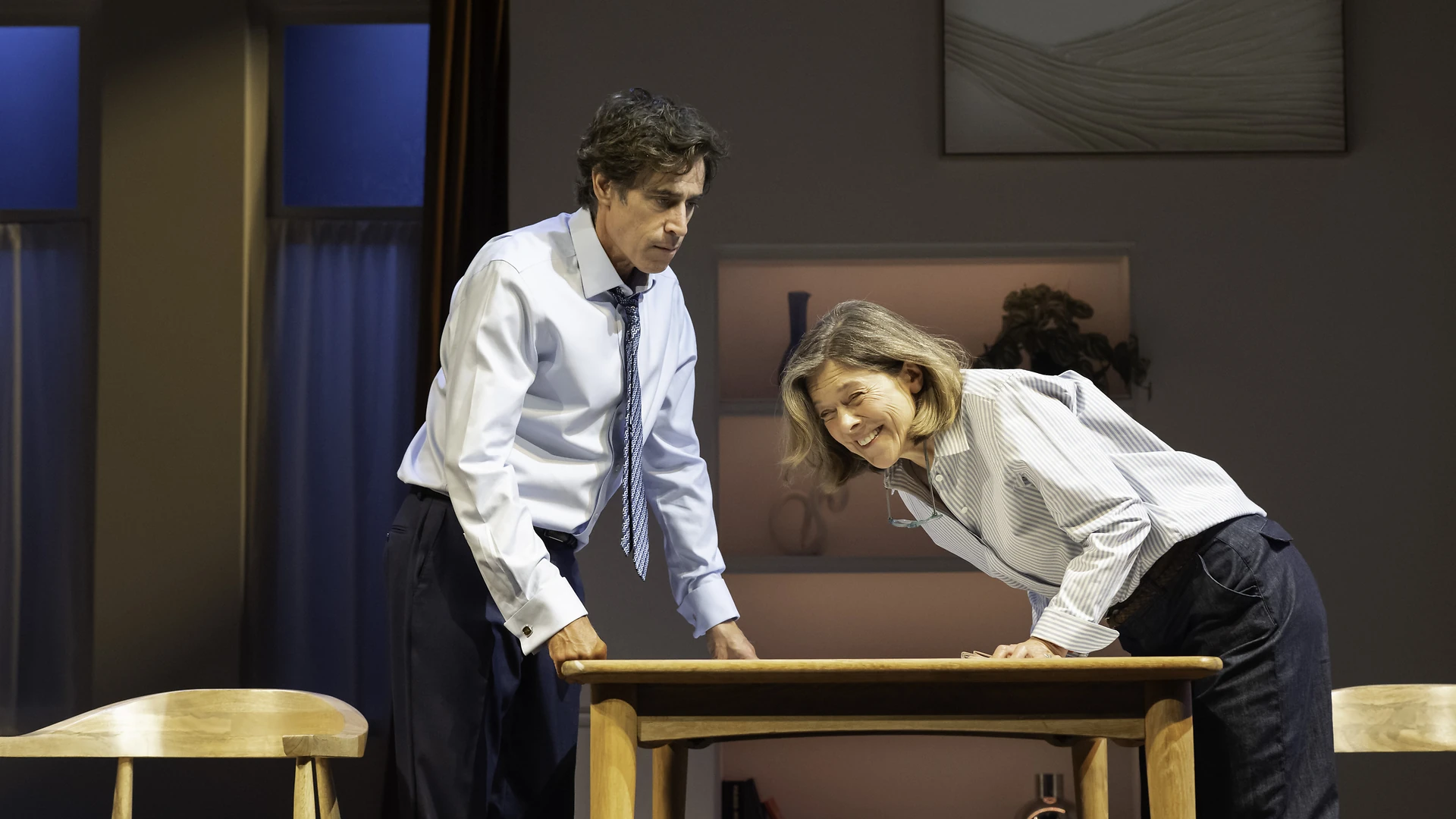
Stephen Mangan & Janie Dee in The Truth. Photo: Johan Persson

What can I say about The Truth? No, I mean, literally, what can I say about this comedy by Florian Zeller without it being a spoiler.  I can describe the first scene to you. After that, twist follows revelation follows surprise, so much so that to say anything may be to say too much. What I can tell you is that the four actors are fabulous and funny.

So, in the first scene, we find Michel played by Stephen Mangan in bed with Alice, played by Sarah Hadland. They are having an affair. It turns out Alice’s spouse Paul is Michel’s best friend, and her lover seems more guilty about betraying her husband than his wife. In fact, he seems to think it quite normal to be commit adultery.

Six more scenes follow in which Michel meets each of the other three one at a time. In these amusing confrontations, truth sometimes seems like a lie, sometimes is a lie, and sometimes what seems like a lie turns out to be true. The second scene sets the pattern. Michel is with his wife Laurence, played by Janie Dee, who seems suspicious about what he might be up to. He gets more and more tied up in his casual lies, and stutters his way into further deceits. Even after an hour and a half without interval, some questions of what is true and what is a deception are left hanging deliciously for us to chew on as we leave.

Zeller’s companion piece The Lie, that followed The Truth a few years later and featured what appear to be the same characters, explores the notion that deception makes the world go round and truth brings it to a halt. But that’s a more serious play. This is out-and-out comedy, written before Zeller got into ‘reverse theatre’ in a big way, causing us to question truth and reality by showing us scenes from various subjective perspectives, something that reached the height of confusion in his latest play on the subject of adultery The Forest.

Without the later plays’ theatrical trickery, the thin plot is exposed. While the many twists are funny, the play relies on its lead actor to do the heavy lifting as far as the laughs are concerned. Fortunately, in Stephen Mangan, the production has a player made for the part. Unfortunately, and not his fault, his blustering becomes repetitious, and there is no character development to offset the monotony. – no sense of a lesson learned or an issue resolved.

The fun is in what the characters say and don’t say, and how they react to what they’re told. And in an extension of that, how we as an audience react knowing what we think we know, and then finding out we didn’t know after all.

Perfect casting

Ardal O’Hanlan & Stephen Mangan in The Truth. Photo: Johan Persson

The casting is perfect. Stephen Mangan is like a naughty child, crashing into situations his own constructions like a toddler learning to walk, shouting as way of defending himself, and even at one point sitting sulkily in the corner with a big bottom lip. He not only doesn’t listen to others, he doesn’t listen to himself, being so self-centred that he cannot see the hypocrisy of being outraged by the betrayal of his friend deliberately losing at tennis, but oblivious to the upset caused by the revelation of his betrayal of wife and friend. Janie Dee’s facial expressions are quite brilliant: a slight widening of her eyes becomes as revelatory as a whole speech. Ardal O’Hanlan as Paul  quietly hides behind his neat beard, displaying a tight smile and a penetrating look that could be concealing either a secret or a feeling. Even Sarah Hadland‘s emotive Alice appears to have something up the sleeve she seems to wear her heart on.

In Lizzie Clachan‘s set design, hotels, a changing room, and sitting rooms all look similarly anodyne- there is even a joke about hotel rooms looking the same- suggesting an emptiness to these characters’ lives.

There is a familiarity about the creative team. This is an excellent translation by Christopher Hampton, who has brought seven of Zeller’s plays to English speaking audiences, including most famously The Father. Director Lindsay Posner has previously directed The Truth and The Lie at The Menier, and we should probably be thankful that he moves the production with such a pace that we have no time to dwell on the some of the more unlikely or more repetitive elements of the plot.

The Truth is a straightforward play compared with Zeller’s other hits, although you can argue that it m akes some profound points about the importance of deception to human society. It may also have become more relevant in an age of media and of leaders who give equal weight to lies and truth.

I think I’ve said enough.

The Truth can be seen as the Apollo Theatre in Shaftesbury Avenue, London, until 12 September 2026. Buy tickets directly from www.thetruthplay.com

Paul paid for his ticket.

Watch this review on the YouTube channel Theatre Reviews With Paul Seven
Read a roundup of other theatre critics’ reviews of The Truth (with ratings ranging from 2 to 5 stars) here

The Third Man at The Menier – review

A musical thriller from a stellar team

★★★★

Scene from The Third Man at The Menier in June 2023
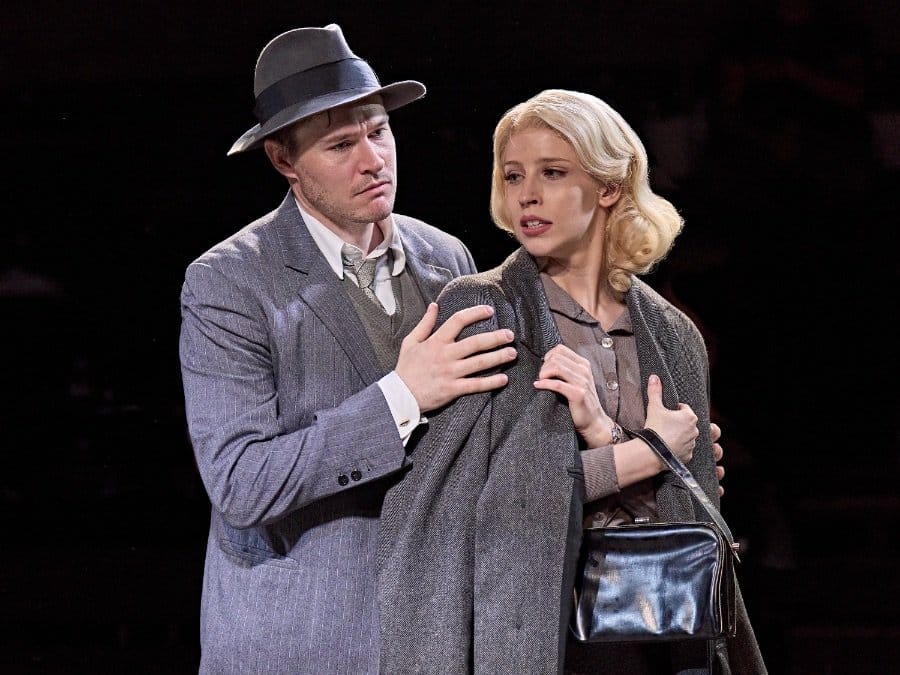
Sam Underwood and Natalie Dunne in The Third Man. Photo: Manuel Harlan

Theatre has become something of a vampire in recent years, roaming the dark auditoria of cinemas searching for films to turn into musicals. Sunset Boulevard is being revived; Groundhog Day is at the Old Vic; a version of Brokeback Mountain with music can be seen at Sohoplace; 42nd Street, The Wizard Of Oz, Sunset Boulevard and Grease are all back this year; Mrs Doubtfire is on the way and of course Back To The Future, Moulin Rouge and The Lion King are already racking up long runs. Even so, one film I never expected to be adapted as a stage musical is The Third Man. Yet here it is at London’s Menier Chocolate Factory – and it’s a triumph.

I have a slight reservation about one aspect of the adaptation of The Third Man, which I’ll come to, but it’s far outweighed by the thrilling pace and the rollercoaster emotions it evokes. Wisely it sticks closely to Graham Greene’s original mystery story of love and betrayal with its reluctant hero, its twists and turns, and its shocks. I’ll try not to give too much away because you may not have seen Carol Reed‘s classic black-and-white film from 1949.

The creative team of Christopher Hampton, Don Black, George Fenton and Trevor Nunn are all as old or older than the film. Their new musical version is a distillation of all their talent and experience.

Let’s start with the music written by George Fenton. Among the hundred plus films and TV series for which he has written the score are Gandhi, You’ve Got Mail, The Jewel In The Crown and David Attenborough’s Planet series. Appropriate to a serious story, it leans towards the drama of Claude-Michel Schoenberg‘s music for Les Miserables or the starkness of Kurt Weill’s The Threepenny Opera.

Mr Fenton is a brave man to tackle The Third Man because the film’s theme is one of the most famous ever written. In this musical version, he pays brief homage to the jangling zither-based hit but goes for a score that suggests danger, passion and anger. Played by a live nine piece orchestra, directed by Tamara Saringer, the songs enhance the story and reveal character, as they should in a good musical.

The legendary Don Black and Christopher Hampton, provide the tight book and sharp lyrics. There are even a couple of duets that Rodgers and Hammerstein would have been proud of.

The story is about a pulp fiction writer called Holly Martins, who arrives in Vienna at the end of World War 2, when it is occupied by the American, British and Russian soldiers. He’s there to do some work for an old school friend Harry Lime, only to find he has died in an accident. As the first act progresses, he becomes increasingly suspicious about the circumstances surrounding his death. The British military police meanwhile indicate to him that Lime was a bad lot.

The first act ends with an astonishing discovery and the show continues with even more shocking revelations and heightened drama.

Where the musical really stands out is in the feelings expressed by Holly and also by Lime’s lover Anna. Both loved Harry and can’t believe he would have been involved in anything truly bad. As the pair investigate Harry’s death, Holly falls in love with Anna and pursues her with reckless, puppy-like devotion, a sentiment she does not return.

Sam Underwood is a fine singer and actor who communicates sadness, frustration and infatuation as he searches for the truth and wrestles with his conscience. With his naïve, boyish determination, Holly could be a hero from one of his adventure novels

Natalie Dunne is strong as Anna. By dwelling on her character more than is the case in the film, the musical is able to show her in a nightclub singing songs that could have come out of The Threepenny Opera or indeed Cabaret, songs both sad and amusing- and indicative of her free-thinking character. And because we get to know her, the subplot of the triangle between Holly, Anna and Harry carries more weight.

Simon Bailey also impresses as a callous villain who commands devotion. And that’s my reservation about the adaptation: he is portrayed as more obviously nasty and not as full of fake charm as this key character was in the film.

The Third Man at The Menier. Photo: Manuel Harlan

Edward Baker-Duly and Jonathan Andrew Hume strike just the right note as righteous but ruthless military policemen Major Calloway and Sergeant Paine. Other characters are more in the way of caricatures but they are well acted- it’s a pleasure to see Derek Griffiths as The Porter. Rachel Izen is his wife, and Gary Milner, Alan Vicary, and Harry Morrison are Lime’s shady associates.

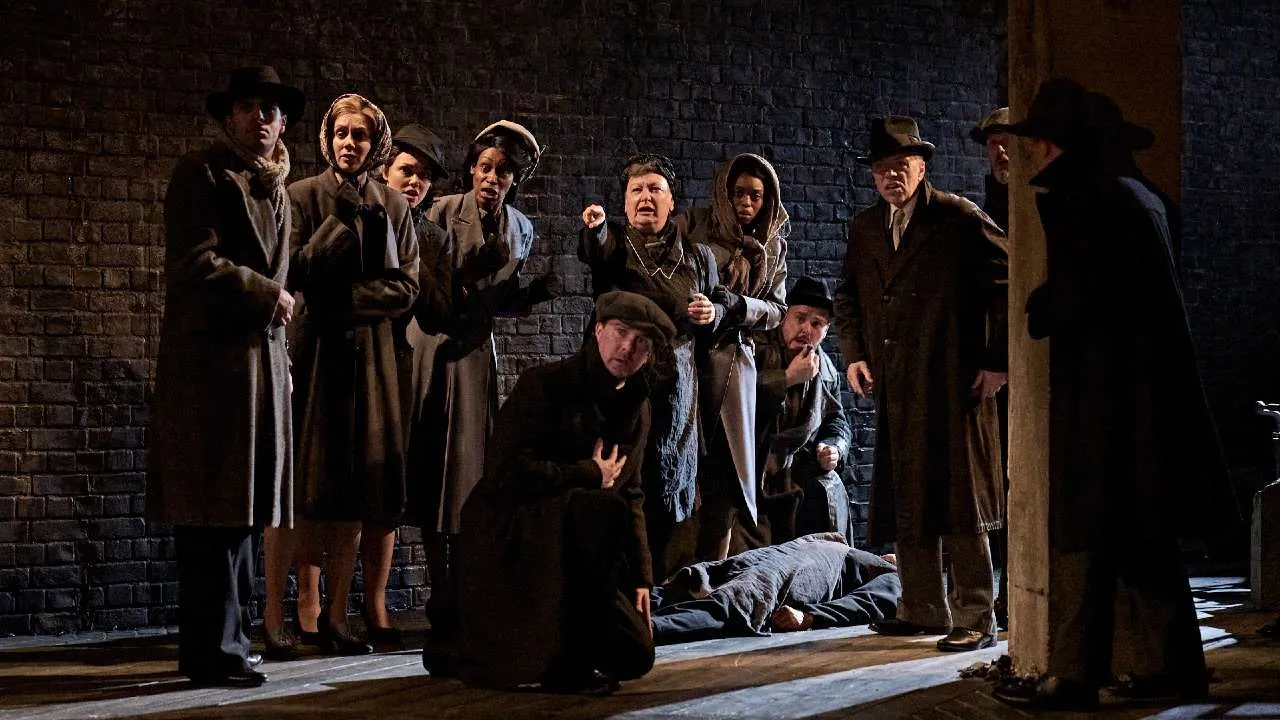
The design by Paul Farnsworth is full of atmosphere. The costumes in grey or other subdued colours add to the film noir effect. Rubble litters the edges of the stage floor, a dark alley or tunnel goes off to the side: You feel you are in a sinister city ravaged by war.

The Menier has been reconfigured so the audience is on three sides. Actors run up and down aisles, ramping up the excitement, and, thank goodness, the sight lines are kept free from obstruction. The simplest of furniture is enough to suggest effectively a hotel lounge, backstage at the nightclub, a flat, and even a ferris wheel gondola.

Getting us off to the best of starts is the opening scene where Holly wanders the dimly lit streets of Vienna at night, helped by dark expressionist lighting from Emma Chapman, and is surrounded by people begging. Straightaway we know we are in desperate times.

It’s a masterpiece of direction by Trevor Nunn, who brings so much that he has learned and practised in a long career that encompasses Les Miserables, Cats and the National Theatre production of Oklahoma! He constantly holds our attention, with a changing pace that switches from frenetic activity to tense conversation.

I must credit to Christopher Hampton whose previous plays and translations  include Les Liaisons Dangereuses, Art, Sunset Boulevard and Florian Zeller’s The Father. I thought a musical adaptation of The Third Man couldn’t be done, but he and his team have done it.

The Third Man is performing at The Menier Chocolate Factory until 9 September 2023.

Paul paid for his ticket to see the final preview performance.

Watch this review of The Third Man at The Menier on YouTube


Maggie Smith in A German Life – review

Downton Abbey star in clever one woman play by Christopher Hampton


[usr=4]

Production shot of Maggie Smith in A German Life at The Bridge Theatre
Maggie Smith in A German Life at The Bridge Theatre. Photo: Helen Maybanks

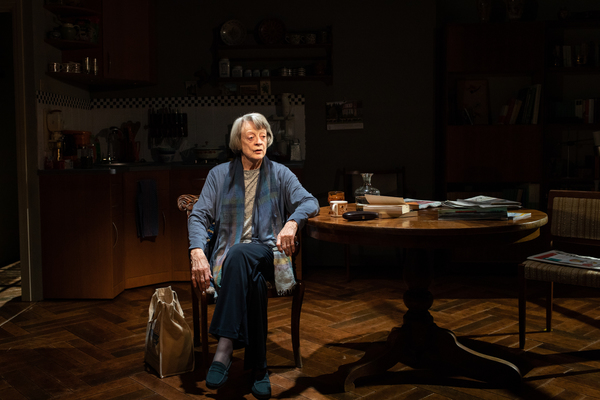
The set comprises a small living room with an old lady sitting on a chair alone on a thrust stage talking to the audience. She never stands up. For 100 minutes we listen, I mean really listen.

The lady is Maggie Smith playing a real person called Brunhilde Pomsel who among other things was secretary to the monstrous Josef Goebbels, a top Nazi during World War Two. Apart from the light around her getting darker and focusing increasingly on this slight figure, Jonathan Kent’s production and Anna Fleischle‘s design are restrained, by which I mean, as gimmick-free as they can be.

The play is based on interviews Frau Pomsel gave in her old age. They may have been intended to show how ordinary Germans behaved during Nazi rule and pose the question, would you have behaved any differently: ‘I had no idea what was going on. Or very little. No more than most people.’ However Christopher Hampton’s play is much more nuanced.

A German Life is partly about the false memory of old age but also the deliberate rewriting of one’s history. And Hampton is brilliant at giving clues as to what the truth might be but leaving you to make your own mind up.

This woman says she was brought up to obey but she got her first job by going off to Berlin on her own initiative. She says she was quite distanced from the womanising Goebbels yet she describes with excitement how she sat next to him at a dinner in his house when his wife was away.

Production shot of Maggie smith in A German Life art the Bridge Theatre in London
Maggie Smith. Photo: Helen Maybanks

She clearly didn’t subscribe to the Nazi ideology- for example, she had nothing against jews, she had jewish friends and employers. In that sense she is only guilty of acquiescence, of not doing anything, like many ‘ordinary’ people. But she was not in an ordinary situation- and we are bound to question her claims that she was unaware of what was going on, when she was one of the people in Goebbels’ office.

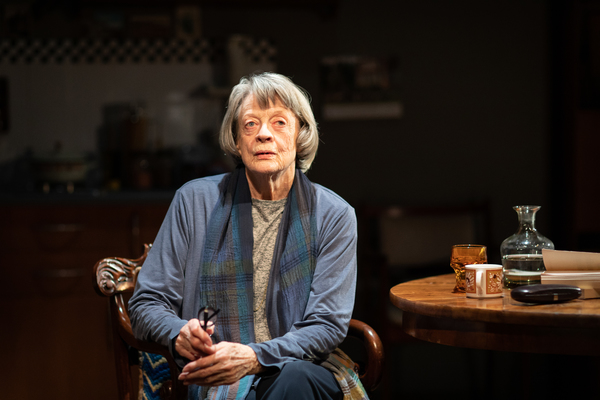
So how does Maggie Smith do at conveying this? The answer is, in the main,  she plays Pomsel as a doddery old lady. Personally, I found the hesitations and repetitions grated a little but perhaps they were meant to. It’s as if Pomsel is acting, deliberately portraying herself in this way to emphasise how harmless and how naive she was. She fiddles with her glasses, puts her hands to her face. Then every so often, emotion, usually in the form of pride, causes her mask to slip: her face lights up with a vivid memory, her voice gains a steely confidence and her glasses stab the air. 

I accept that a portrayal of a normal person isn’t going to lead to a barnstorming performance but I have to say I wasn’t as overwhelmed as I expected to be. I think the problem was that this was an intimate play and, although I could hear her familiar nasal voice perfectly well at the back of the stalls, I could not see her piercing eyes and facial expressions.

This may have been a performance for people sitting in the first ten rows but it takes a great actor and a great play to hold an audience for an hour and 40 minutes.

A German Life continues at the Bridge Theatre until 11 May 2019

Watch the review of A German Life on YouTube

The Height Of The Storm by Florian Zeller – review

Jonathan Pryce & Eileen Atkins shine in confusing drama

[usr=3]

Production shot from The Height Of The Storm by Florian Zeller with Eileen Atkins and Jonathan Pryce
Eileen Atkins & Jonathan Pryce in The Height Of The Storm

Florian Zeller’sThe Height Of The Storm is confusing. If you’re going to see it, it’s good that you know this because otherwise, like me, you’ll spend the whole evening trying to work out what’s going on instead of simply enjoying a moving love story.

The play is meant to be confusing but, unlike Florian Zeller’s The Father where it’s soon apparent that we are seeing the world from the point of view of a brain befuddled by dementia, on this occasion it is never clear why.

We start by meeting an elderly man called Andre. It appears that his wife is dead. Sometimes he seems vague, hardly there, sometimes people are hardly aware of him. Is he living in memory but not physically? Does he have dementia? Then it seems he is dead and it’s his wife Madeleine who has survived. At other times, it seems both could be dead or both alive.

Click here to watch Paul’s review of The Height Of The Storm on the YouTube channel One Minute Theatre Reviews

These appear to be various possibilities of how the end days will pan out for an elderly couple.  My take is that they are visions of the future imagined by a couple prior to a suicide pact (there is much mention of poisonous mushrooms) but there are as many possibilities as there are potential outcomes of the Brexit negotiations.

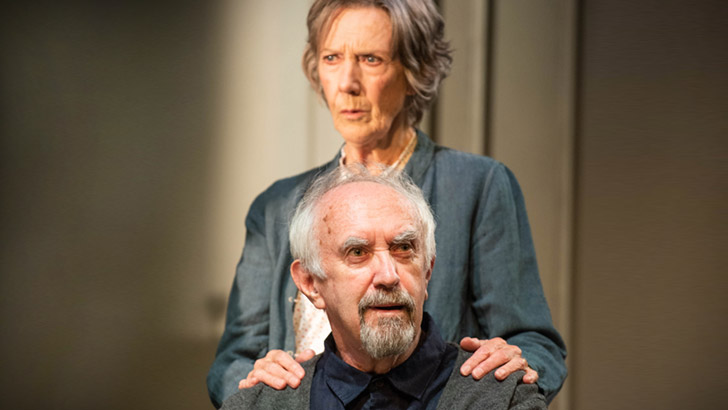
What we do know for sure is that we are witnessing a couple at the end of their days who have been so in love for a lifetime that their bond lasts beyond death or perhaps dementia. There’s no sign of age withering Jonathan Pryce and Eileen Atkins. They give an acting masterclass as the couple. They fill their performances with subtle emotions- not only love but compassion, confusion, frustration, anger. Andre’s quiet warmth radiates into the auditorium. Madeleine’s acid comments cut through the air with stiletto sharpness.

Jonathan Kent’s naturalistic production is perfect for Florian Zeller’s play about enduring love 

Their relationship is the heart of the drama and leads to an immensely sad but uplifting climax, like, to use a key image from the play, a bird singing at the height of the storm of old age.

Jonathan Kent‘s naturalistic production, the detailed set by Anthony Ward that suggests a lifetime’s accumulation of possessions and Christopher Hampton‘s translation provide Zeller with perfect support.

Production shot showing cast of The Height Of The Storm at Wyndham's Theatre London
The Height Of The Storm

Depending on your age, you may also recognise the amusing attempts of the adult children to organise their parents’ lives and indeed shut those lives down by making arrangements for moving to a home.

I’ve read that you need to see this play two or three times to understand it. Since this is being presented at a mainstream London theatre, I imagine few will arrive expecting such confusion and even fewer will be able to afford to pay West End prices to see it again. If you go to see it, you might wish M. Zeller had given you a few more clues as to how to get inside The Height Of The Storm but you will come away touched by this portrait of transcending love.

The Height Of The Storm by Florian Zeller starring Jonathan Pryce and Eileen Atkins can be seen at Wyndham’s Theatre until 1 December 2018

Watch Paul’s YouTube review of The Height Of The Storm below

×