Gillian Anderson & Billy Crudup in the best production of Edward Albee’s play you could wish for
@sohoplace
⭑⭑⭑⭑⭑

This could well be the best version of Edward Albee‘s Who’s Afraid Of Virginia Woolf ever performed. I can’t imagine anyone better than Gillian Anderson and Billy Crudup in the lead roles, but what makes Marianne Elliott‘s production exceptional is that it is performed in the petri dish of the small in-the-round stage of @sohoplace. This is a rare coming together of the best writing, production and acting. This multi-layered play about a toxic marriage shreds your nerves. And, if you think Who’s Afraid Of Virginia Woolf is just a play about people shouting at each other, this will change your mind.
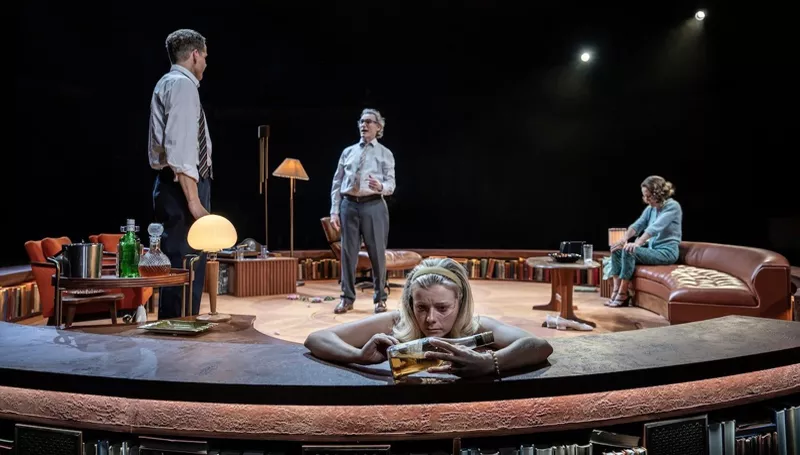
@sohoplace is a small theatre. There are about 600 seats on three levels and all round the circular stage. In the stalls, where most of the seats are, you are never more than 5 rows away from the front. So you really feel you are in the same room, or, as someone put it, breathing the same air as the two couples on stage.
Martha and George enter and straight away they are sniping at each other. They’ve just arrived back from a party and have already had a bit to drink. It soon becomes clear that alcohol is their escape route from facing reality. He is an associate professor of history, she the daughter of the president of the college where he teaches. We realise from early on that they are disappointed that each has failed to meet the other’s expectations of their marriage, although why takes time to become clear. We do know from early on that George has failed to become the candidate to take over from her father.
It’s 2 a.m. by the way, so, as someone once joked, the following, continuous three hours are a long night’s journey into day. (Don’t worry, there is one interval.) Martha has invited a young couple over. It soon turns out that this is for the older couple’s sport. The first act is entitled Fun And Games. We may divine that, along with the alcohol, this is how Martha and George amuse and distract themselves. The guests comprise Nick, an up and coming member of the faculty, and his somewhat naïve wife Honey. In between scoring points off Martha, George goads his young rival, like a boxer jabbing and withdrawing. When Nick threatens to retaliate physically, because he is no match for George verbally, he notes he has never hit an ‘older man’, which provokes George into a tirade about what younger people he has hit- children? babies?
Billy Crudup is extraordinary in the role. He is humiliated by his wife for his failure to progress in his job, and we find out she regularly cuckolds him. He laughs, peers through myopically through his glasses, and seems to let it roll off him. But he snarls back with sarcastic comments about her and delivers biting digs at the guests. He has a broad smile like a tiger’s, unkempt hair like a lion ‘s main, but the animal he most resembles is a hyena, laughing and attacking weakened prey.
Gillian Anderson as Martha is his equal in acting, making her character appear dominant while masking vulnerability. She is loud, aggressive and self centred, and very physical, feline almost, in movements that at times seem desperate or like an appeal for help. Every so often a worried look on her brow suggests she fears her love-hate relationship with George is on the brink of collapse.
So much of the ensuing play is about reality and fantasy, or illusion if you like. Martha and George both present versions of their lives which turn out to be stories or wishful thinking. George, a would-be writer, is a particularly good storyteller, weaving many fantasies for his guests to lap up before the rug is pulled from under them.
Nick, presents a facade of pleasant wholesomeness, but is tricked into revealing his amoral ambition to rise to the top, and his plan to bed all the professors’ wives. He starts his seduction, in front of George, with an enthusiastic Martha. As Nick, Josh Dylan offers an impressive combination of over-confidence and gullibility.
Honey, we are led to believe, trapped Nick into marriage by pretending to be pregnant and has so far not delivered the children that institution of marriage required at that time. Phoebe Horn is perfectly cast, with an open face that produces wide smiles as she steps credulously into humiliation, and crumpled upset, as she suspects she has been made a fool. She also gets drunk very convincingly.
You could argue the end is dragged out a little but I didn’t get bored. In case, you’re unfamiliar with the play, I won’t tell you the revelation of the third act which, as the light of dawn shines, may reset their relationship and force them to face the truth. And that’s what being afraid of Virginia Woolf means. Virginia Woolf, or, if you take away the joke, the Big Bad Wolf, represents reality.
Now, you may not be interested in the wider implications of the play. You may simply see this as a play about a toxic relationship, and want to wallow in the theatricality and rich dialogue, which bring out the best in these fine actors. And of course that alone is enough to slap you in the face, without anything added.
A multi-layered play
But if you are interested in some of the underlying themes, let’s start with the time at which the play was written- the early 1960s. The western world was still obsessed with the nuclear family- the man as the career-orientated breadwinner, the woman as his support and the provider of children. In Who’s Afraid Of Virginia Woolf, we see the consequences of that. So, in some ways, it depicts the approaching end of that particular American Dream.
It was also a time when culture was demonised, and science was at the fore. It’s no coincidence that George is in the history department, representing the past, while Nick is biology, representing the scientific future. And as we contemplate today’s world, we find the arts are undervalued and tech dominates our lives more than ever.
So as not to block your view, the scenery is minimal on Miriam Buether‘s set but what there is places the play in the early 1960s at a US university: the chairs, the bookshelves, the drinks trolley which is almost the centre of attention as each character becomes increasingly drunk. It’s not only round, it revolves, but so imperceptibly, you may not even notice, because the play is so riveting.
The revolving stage, enclosed space and a ring high above say something about the way the play can seem like a neverending argument. This is why there seems a strong connection with Samuel Beckett’s Waiting For Godot, where the two tramps go through the same day twice, or Albee’s contemporary Harold Pinter. In the so-called Theatre of the Absurd, the plays seem to have no story arc, no purpose except to show what it is to be a human trapped in a meaningless life. So, it’s a waste of time wondering why Martha and George haven’t divorced, or why Honey and Nick don’t walk out. We are in a world specially created for a night at the theatre, a world in which nothing changes except our understanding of ourselves.
Who’s Afraid Of Virginia Woolf can be seen at @sohoplace until 19 December 2026. Buy tickets from the theatre sohoplace.org
Paul paid for his ticket.
Watch this review on the YouTube channel Theatre Reviews With Paul Seven
Read a roundup of other critics’ reviews here