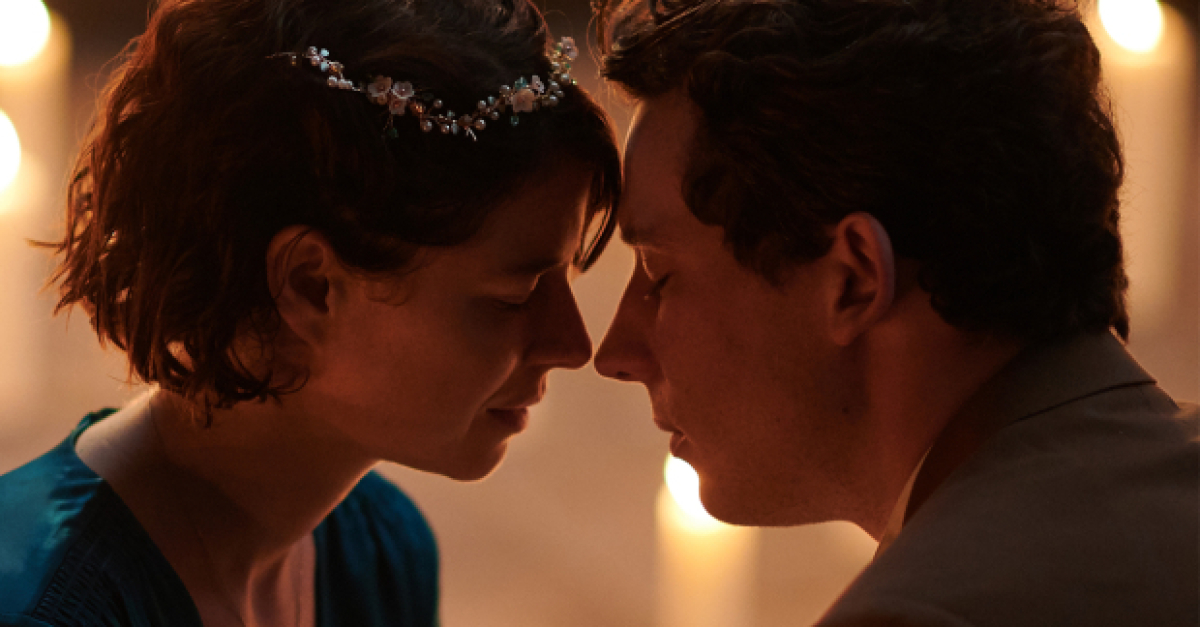
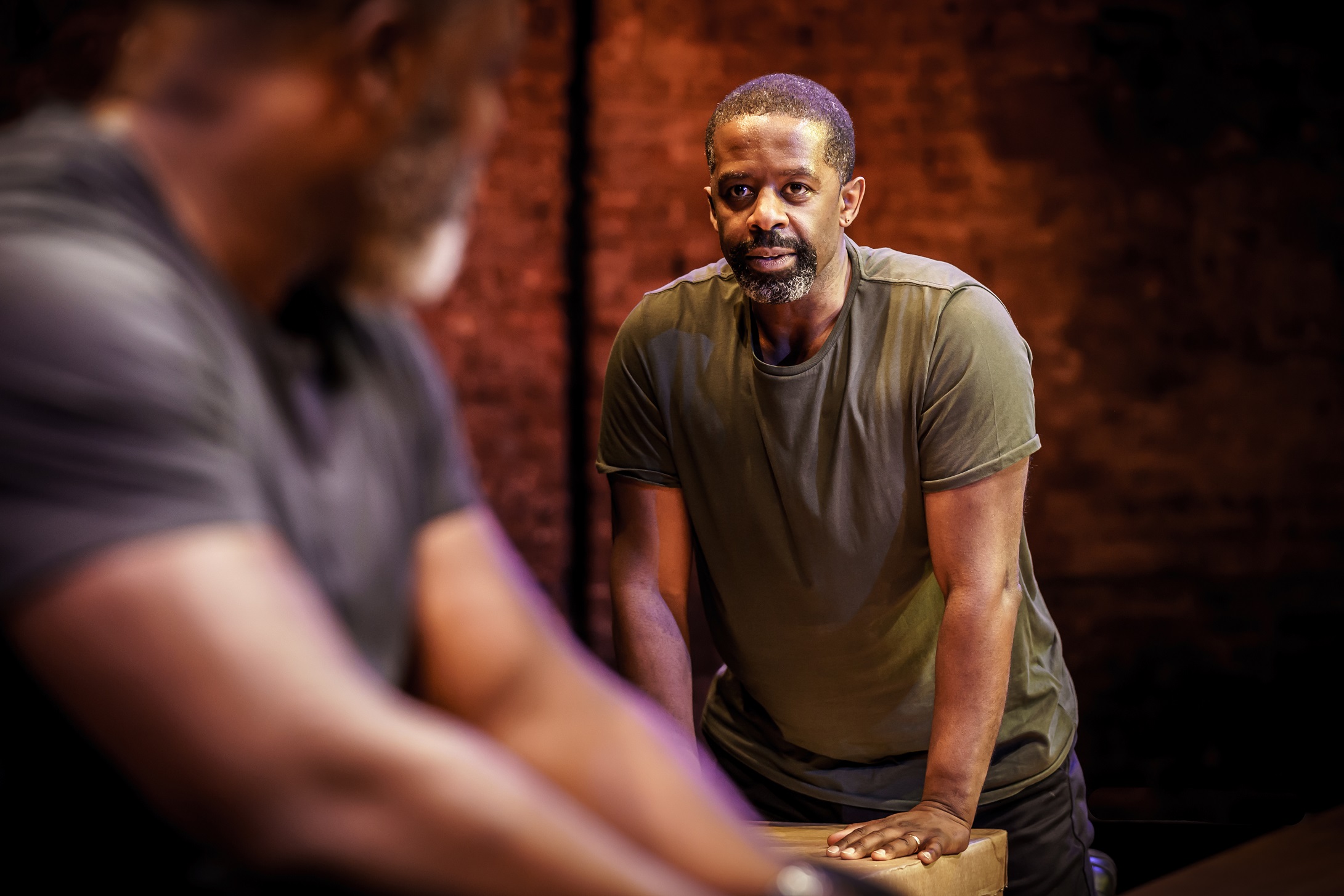
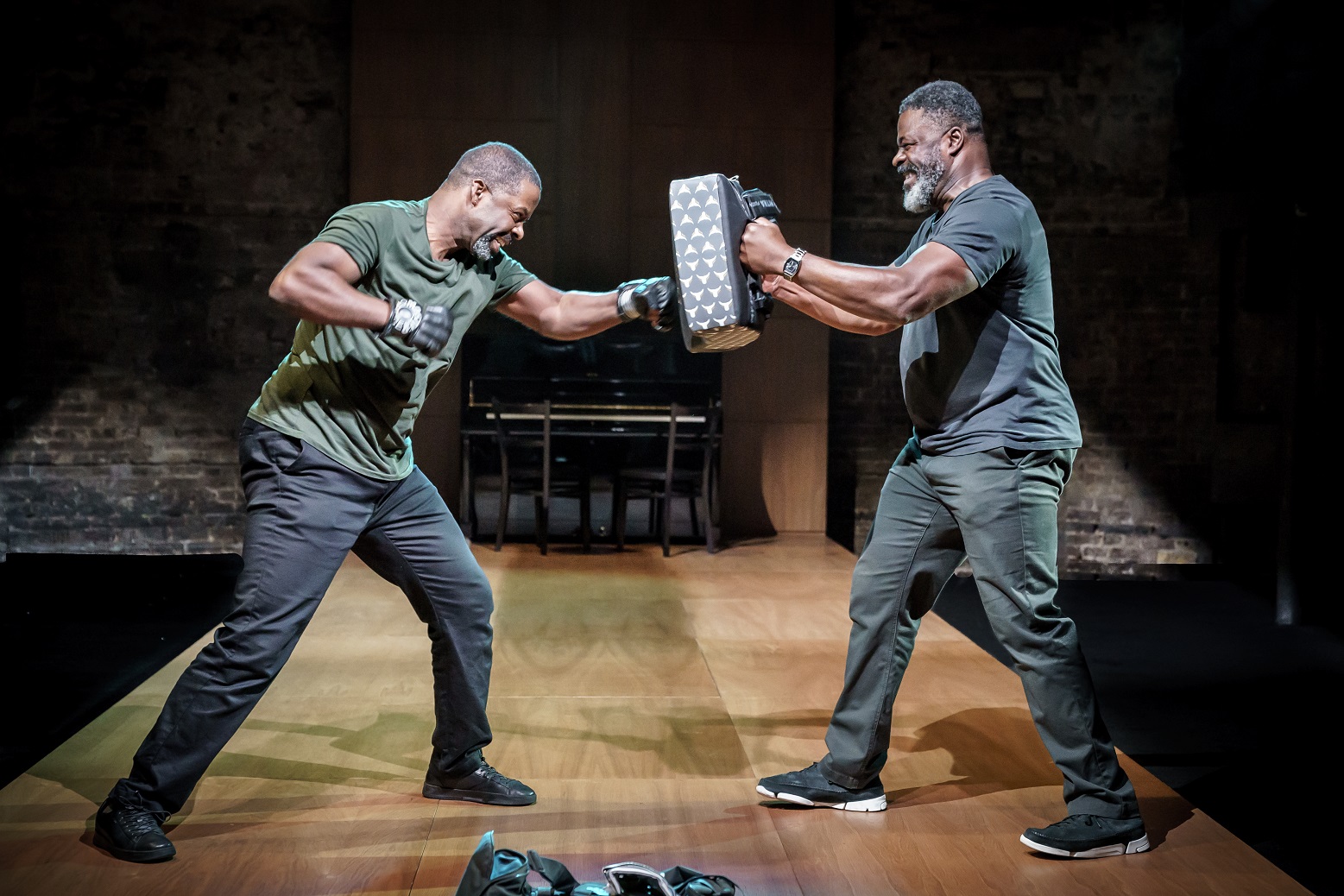
Adrian Lester as Cyrano is funny, lyrical and tragic, often all at once
Noel Coward Theatre
⭑⭑⭑⭑⭑
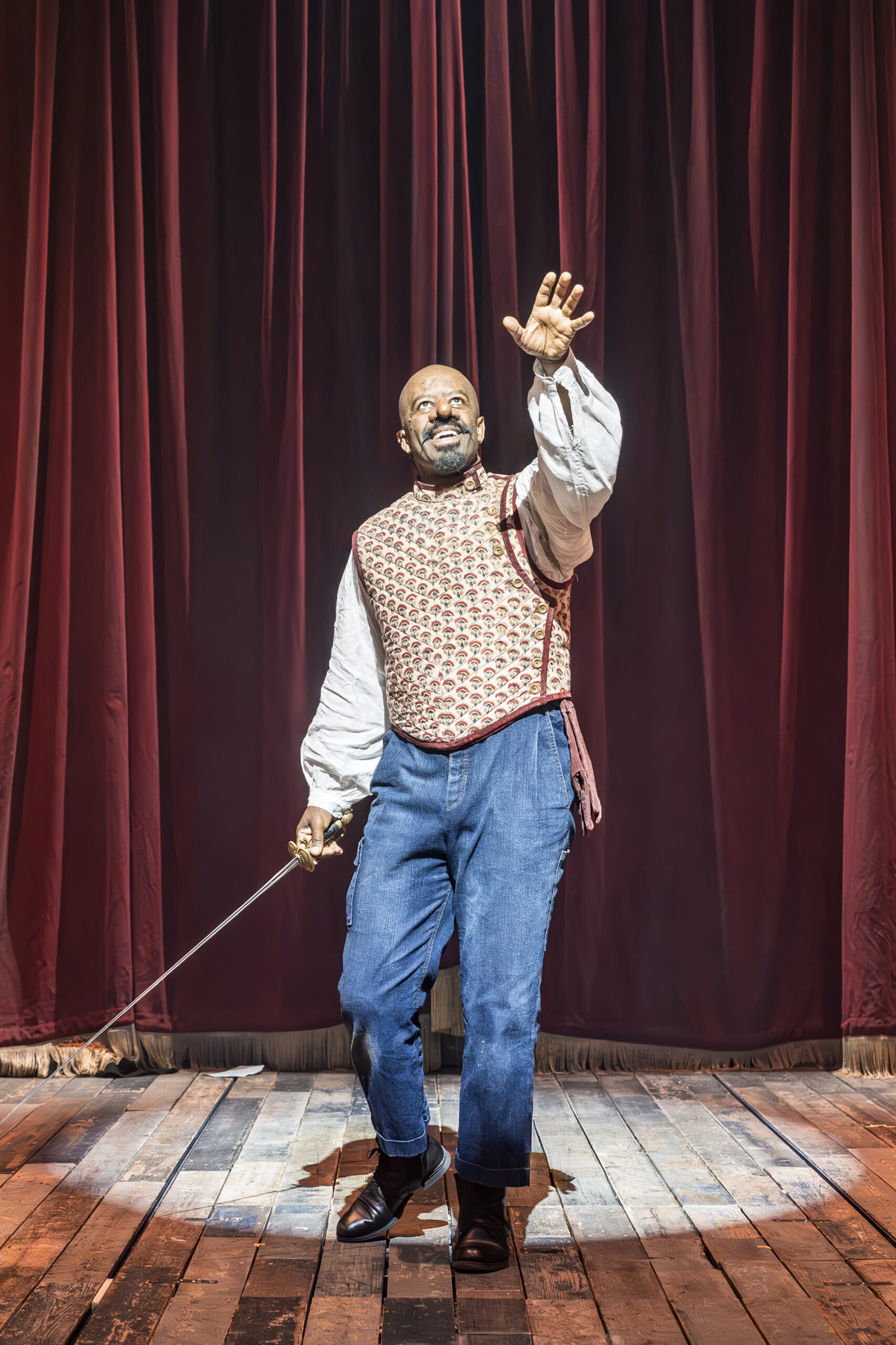
I have rarely enjoyed a night as good as this in a theatre. This new adaptation of Cyrano de Bergerac first seen in Stratford and now in London pays homage to the language of poetry, and provides a uniquely theatrical experience. Best of all, it features a performance by Adrian Lester to rank among the greats. He is funny, lyrical and tragic, often all at the same time.
I last saw him as Othello in 2013 at the National Theatre, when he won an Olivier Award for Best Actor, and I don’t believe he’s been in a fully staged play in the UK since. Which is a loss to those of us who love great acting.
It was his idea, apparently, to play Cyrano de Bergerac. And you can see the attraction: an awesome anti-hero possessed of supreme swordmanship, a quick wit and a poet’s passion for language, but cursed with a tragic flaw- he is convinced his large nose makes him an unattractive laughing stock.
Of course, the story of a man who is so self loathing that he cannot declare himself to the woman he loves and instead woos her through a proxy has become one of the most familiar in the world since it was written by Edmond Rostand at the end of the 19th century. Thankfully, this adaptation doesn’t attempt to modernise the narrative. In fact it sticks pretty closely to the original, even to the setting in 17th century France. What makes it special is the translation into modern poetry by Simon Evans, who also directs, and Debris Stevenson, poet and author of one of my favourite recent musicals Poet In Da Corner. She was brought in to provide the actual poems within the play but she has clearly contributed to the whole script with a dazzling display of wordplay.
Just as the original play was written in verse, so much of the dialogue is here is based on classical poetic metres, but each character has his or her own rhythm and use of language. I can’t convey to you how well this is done. but here is a sample of the verse. Cyrano talking as he faces battle: ‘This is what words mean here: / Not beauty. Not art. But armour. / Words that hold the line when hands can’t. /That give the dying something to chant. / That beat across time like a giant’s drum, / and say: I was here and I was Loved and I was someone.’ I didn’t scribble them down while watching the show- I was so impressed by the script that I bought a copy!
The adaptation squeezes every drop of comedy out of the play as well. We first meet Cyrano in a theatre, the theatre we’re in. Someone introduces a show we’re apparently about to see. There’s clearly some nervousness that Cyrano might turn up. Actors looking for him appear all over the place- in the boxes, at the back of the stalls, leaning over the circle, sitting among the audience. (Try doing that in the cinema.) And instantly we’re involved.
When Cyrano does appear he’s accompanied by a six piece band. He won them in a bet about grammar, what else? Sometimes they play at his command, sometimes they play when he doesn’t want them to, but mainly they play sublime music by Alex Baranowski that enhances the emotions being expressed by the characters.
He gets into an argument with Valvert, a stooge of his arch enemy the Comte De Guiche. Cyrano is disappointed that the best insult about his nose that antagonist can come up with is ‘It’s fucking huge’. Apart from the fact that we go on to witness one of the best stage sword fights I’ve seen, Cyrano decides to accompany it with an acrostic. He explains that he’s going to take each letter of that insulting phrase and make it the beginning of a whole line about his nose. So- ‘F: Look Papa Geppetto, I’m a Real boy. U: Utilitarian- what’s it for? Hanging coats, putting out candles, herding wild goats? C: Capricious – should we worship it, for fear it might destroy us? K: Kinky – Do women moan if you pull it out mid-coitus?’ And so on. But before that, he gets us, the audience, panto-style, to join in and remind him of the insult.
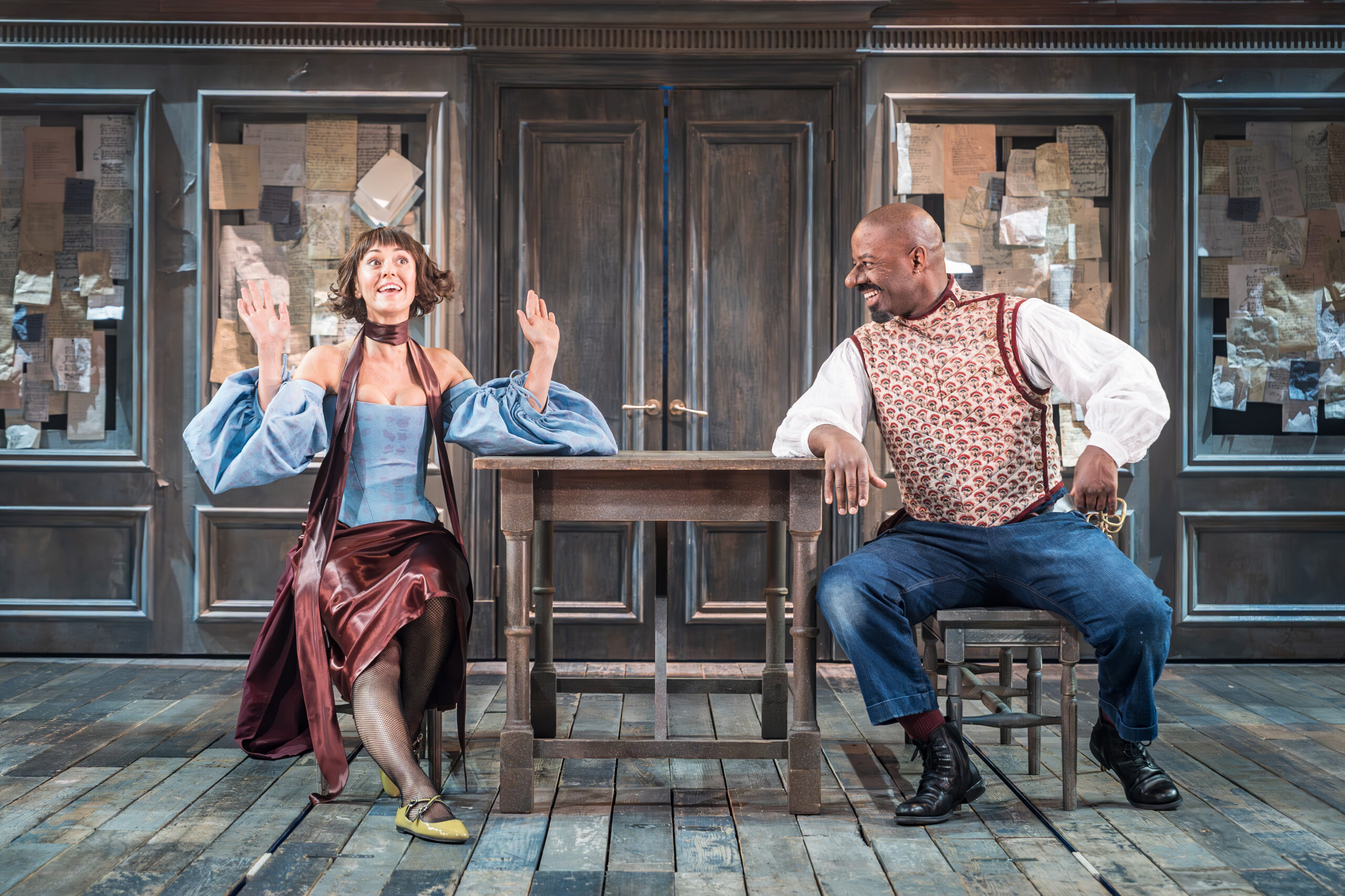
Now, I don’t know how funny I’ve made this sound but I can assure you that when it’s done by Adrian Lester, it’s hilarious. The deftness of the dialogue is present throughout. When he meets Roxane, the woman he loves and whom he has known since childhood, they play a word game, constructing a conversation where all the words begin with the same letter. She apparently has something to tell him, so here’s some of the repartee: ‘Some secret?’ ‘Soon.’ ‘Straightaway.’ ‘Stop searching.’ ‘Silence?’ ‘Suspense.’ ‘Stubborn!’ and so it goes on.
Words, which are both Cyrano’s power and his protection, carry us through the play like a trip down the rapids. It all goes wrong when Cyrano, convinced he cannot possibly be attractive to Roxane, decides to assist a new recruit to his rag tag cohort, a farmer called Christian, in wooing her. She has told her old friend that she finds Christian attractive but it is the words supplied to him by Cyrano with which she falls in love. Now, I know this sounds unlikely, but, then, think of the verses in greetings cards that people use to express the feelings they cannot.
Christian himself is only be able to speak ‘plain, rough, simple, small’ words of love which are totally inadequate to her ears. He does actually appreciate some words- he has learnt the collective nouns for animals. So, when Roxane exhorts him to come up with a word other than the cliché ‘love’, in desperation he tells her ‘The collective noun for wildebeests is a confusion’. The door slams in his face. Roxane falls for Christian through the words of Cyrano, foolishly believing that good looks and a poet’s art go hand-in-hand. Ironically, she even realises that there is ‘a strange darkness lingering’ behind the flattery of the poems, she detects that the writer ‘hates the world in which he loves me’.
This quality of script means each actor is given the tools to be exceptional and the cast rise to the occasion. Susannah Fielding as Roxane is suitably bolshy and arrogant, so relaxed in Cyrano’s company and so blinded by the idea of romantic poetry that she loses touch with what is in front of her. My only caveat is that she doesn’t convey sufficiently the sadness of her situation.
Levi Brown as Christian could easily be eclipsed by the remarkable repartee of the two stars but he is perfect as the cheeky, naive farm boy with a big bursting heart. Scott Handy is superb as Comte de Guiche, sly and slimy but never overplaying the villain, always suggesting a sensitivity beneath the sneer. Greer Dale-Foulkes is a joy as Roxane’s randy servant Abigail. And Philip Cumbus and Christian Patterson are heartwarming as Cyrano’s faithful friends.
And what a production. Grace Smart‘s set is just right. At the back, various flats suggesting a theatre, a tavern, a courtyard, and, as we move to the finale, a battlefield and a garden. No gimmicks, just sensitive support for the story. The lighting too, designed by Joshie Harriette, bathes the various scenes in beautiful colours.
We move to war and tragedy. Then, far too late, Roxane and Cyrano realise how they have deceived themselves. We are told right at the beginning that our time in the theatre offers us ‘precious moments. The world out there. Us, quiet in here.’ To take time out from the cares of the world and immerse ourselves in the life of Adrian Lester’s Cyrano is a privilege.
Cyrano de Bergerac can be seen at the Noel Coward theatre until 5 September 2026. Buy tickets directly from the theatre
Paul was given a review ticket by the producers.
Watch this review on the YouTube channel Theatre Reviews With Paul Seven